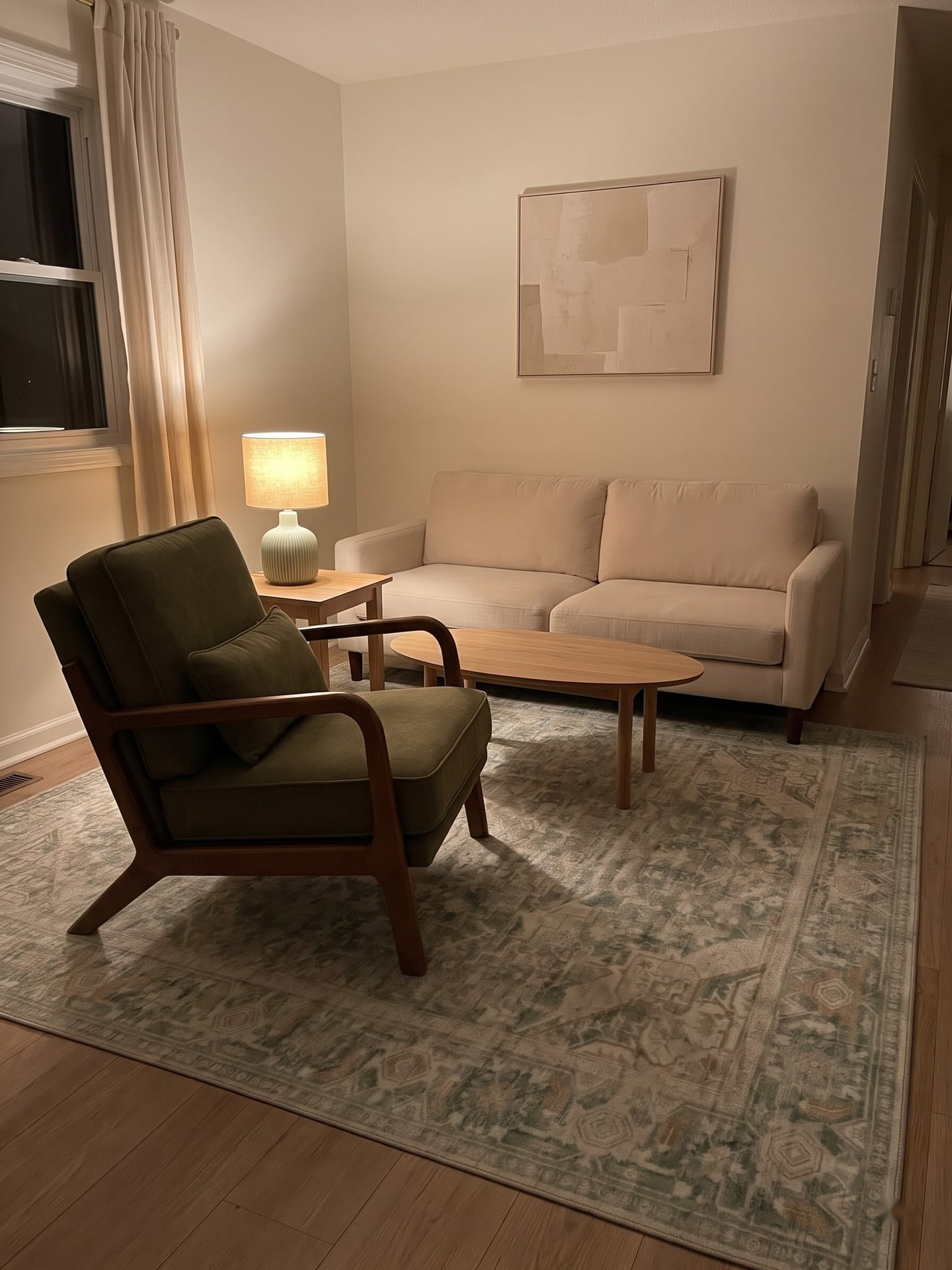
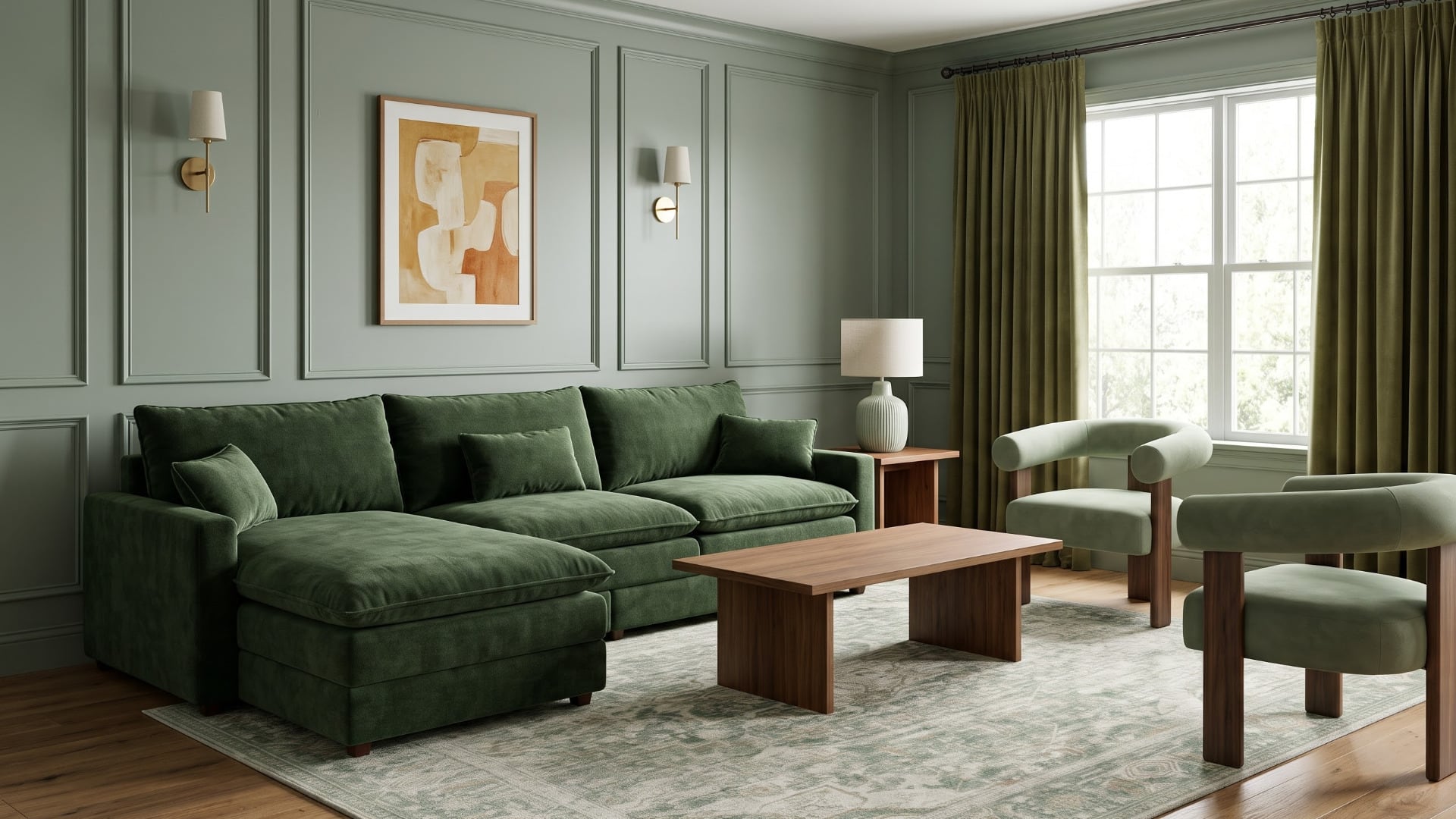
Interactive living room view. Select a product area to view source details.
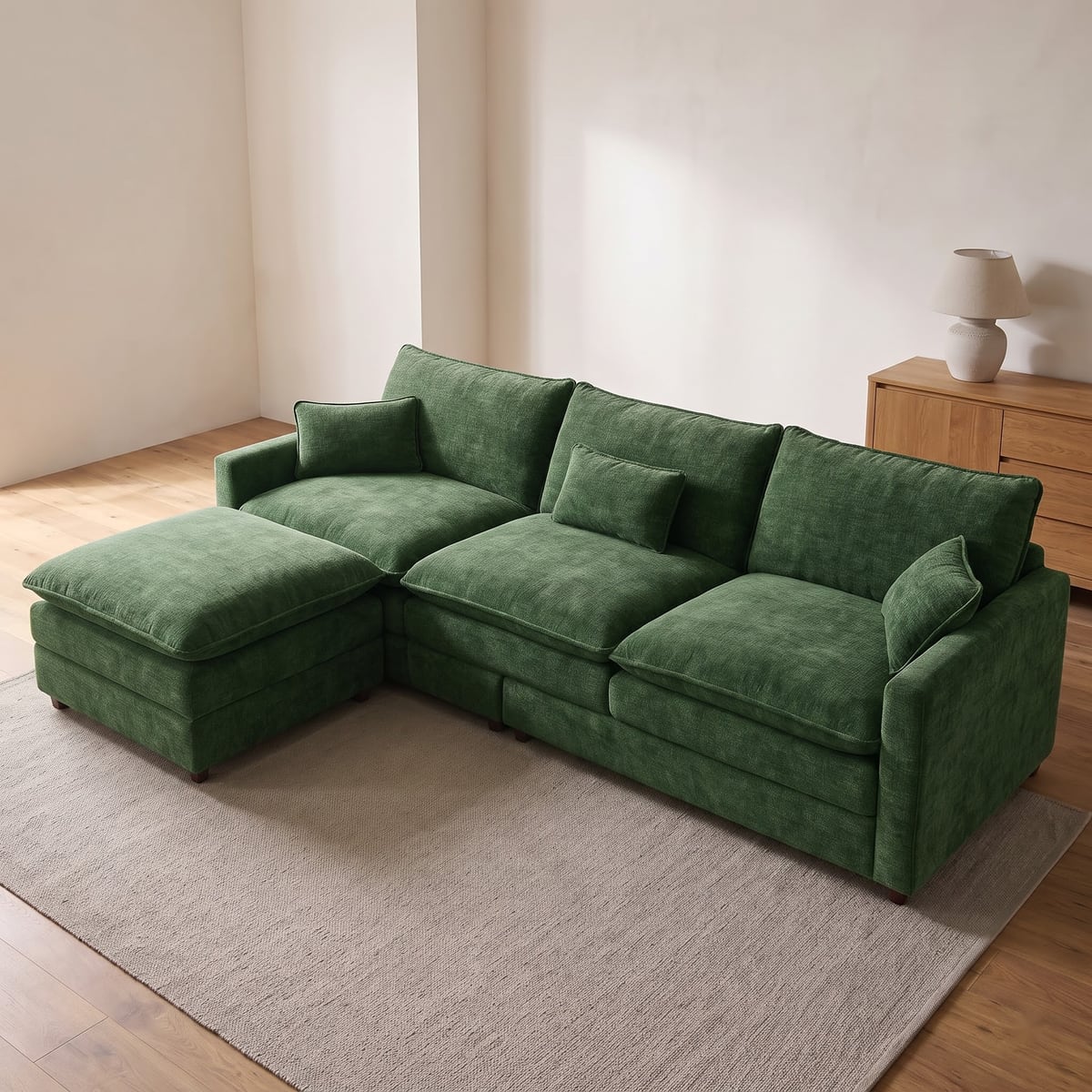
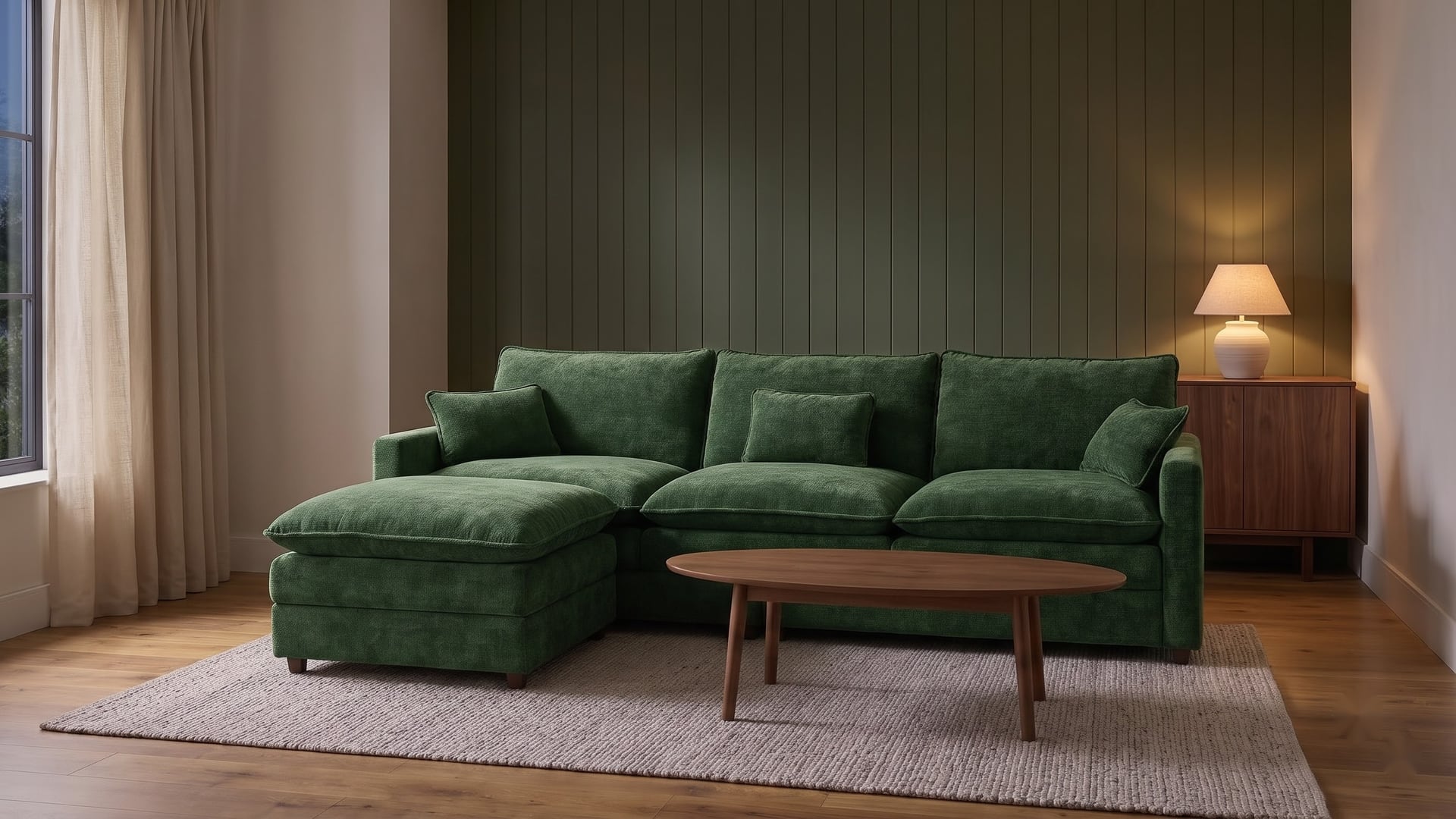
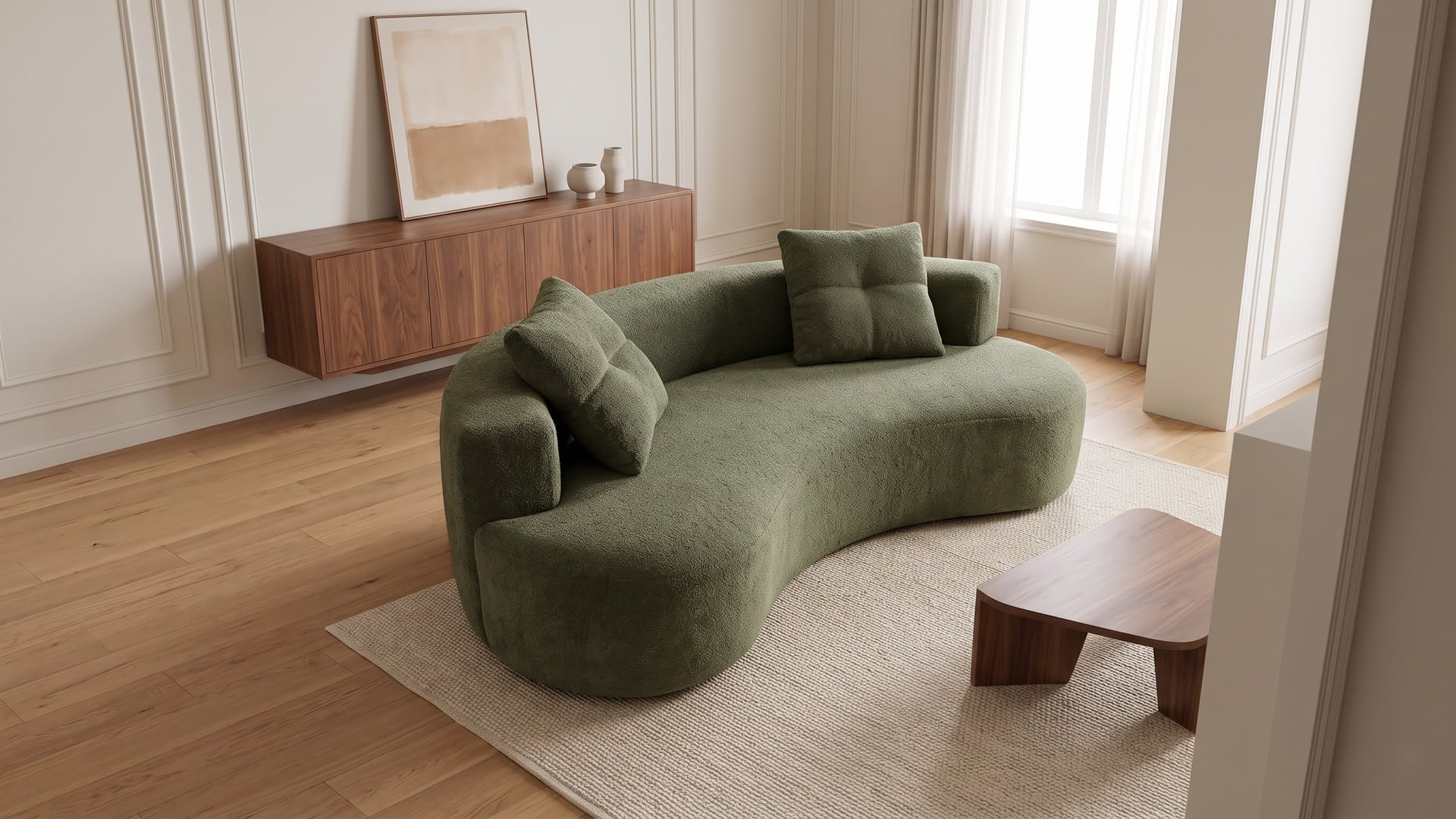
Deep Forest Green Modular Sectional
Modular deep-seat sectional sofa in deep forest green upholstery with clean low-profile proportions.
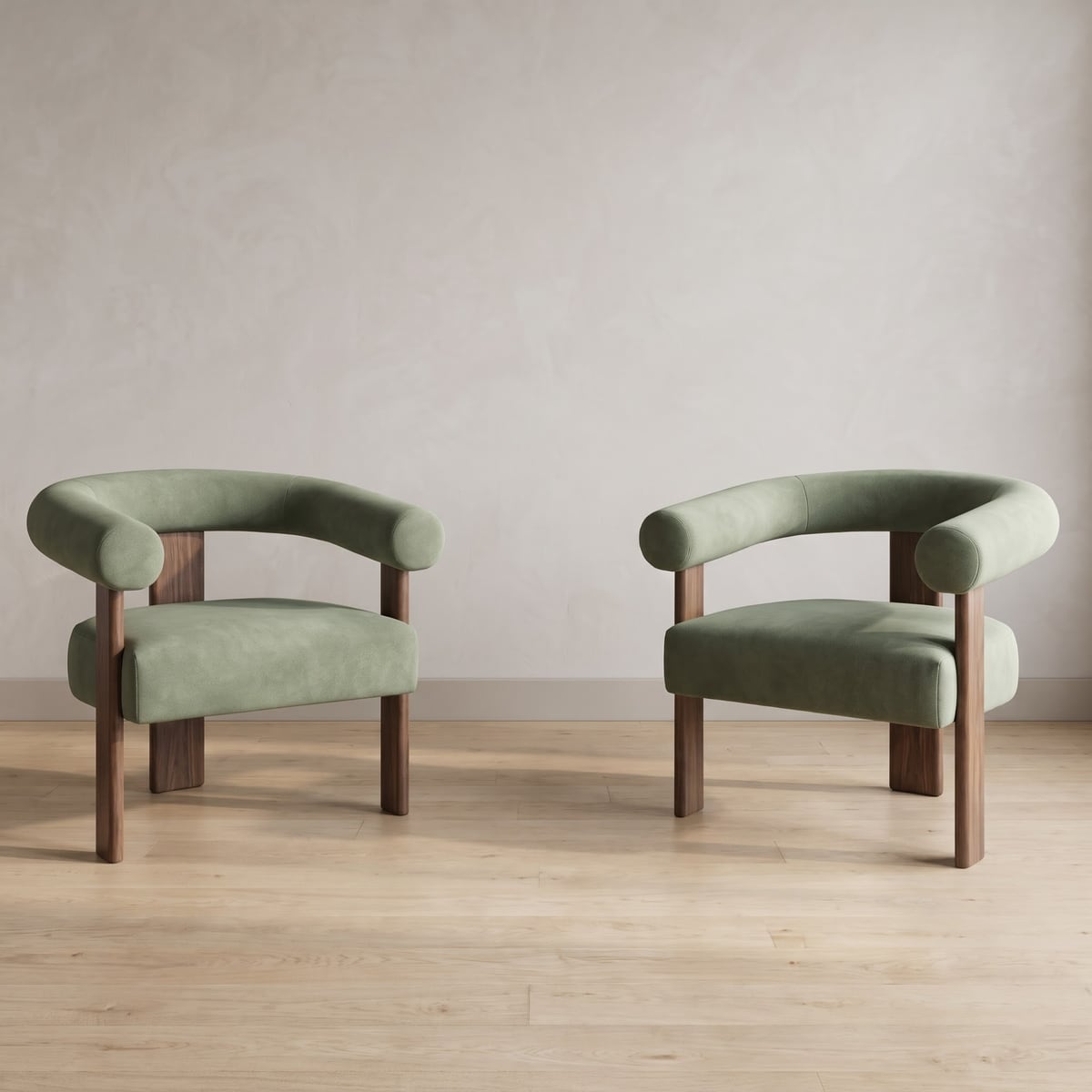
Green Barrel Accent Chairs (Pair)
Curved barrel accent chairs in soft sage upholstery with warm walnut-toned wood supports.
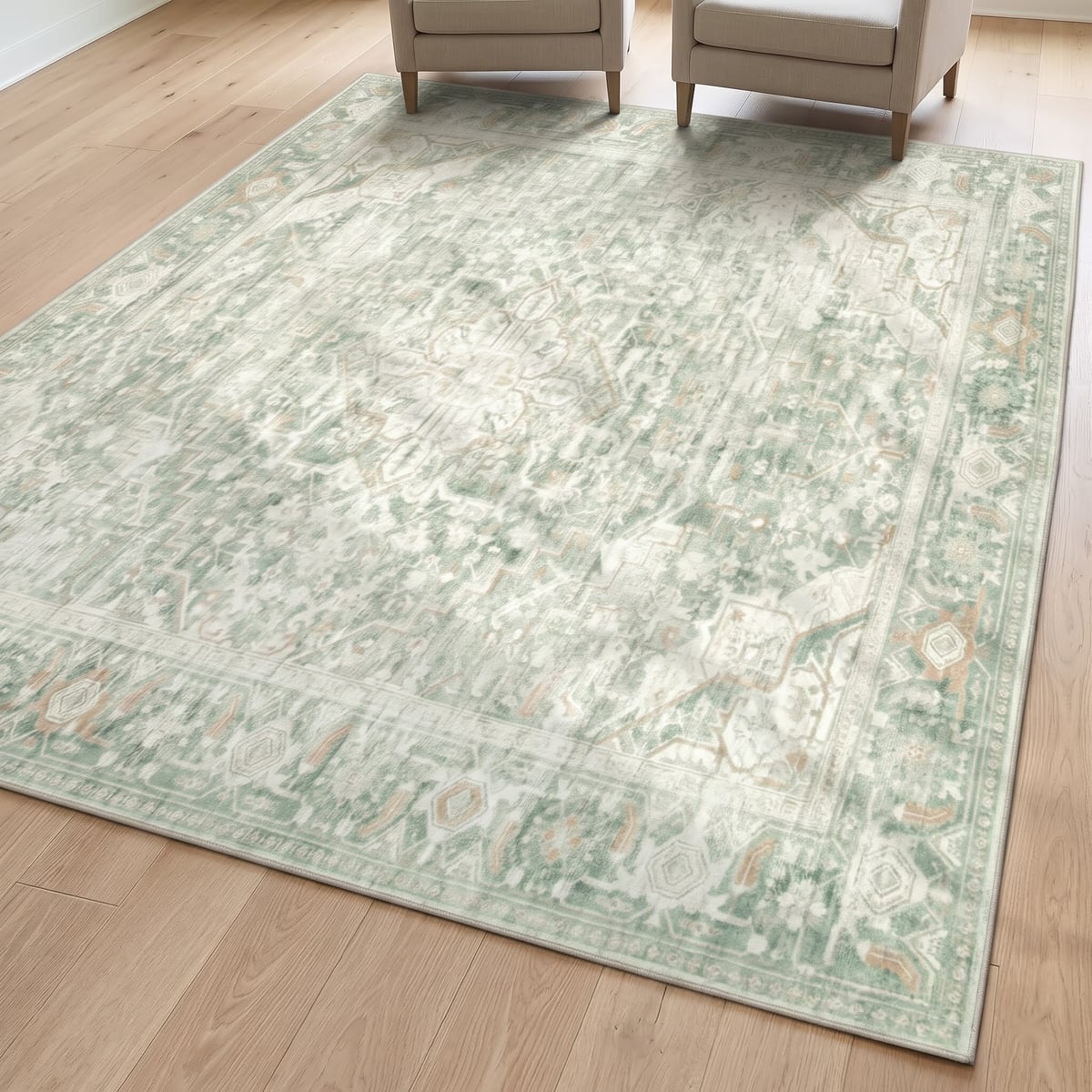
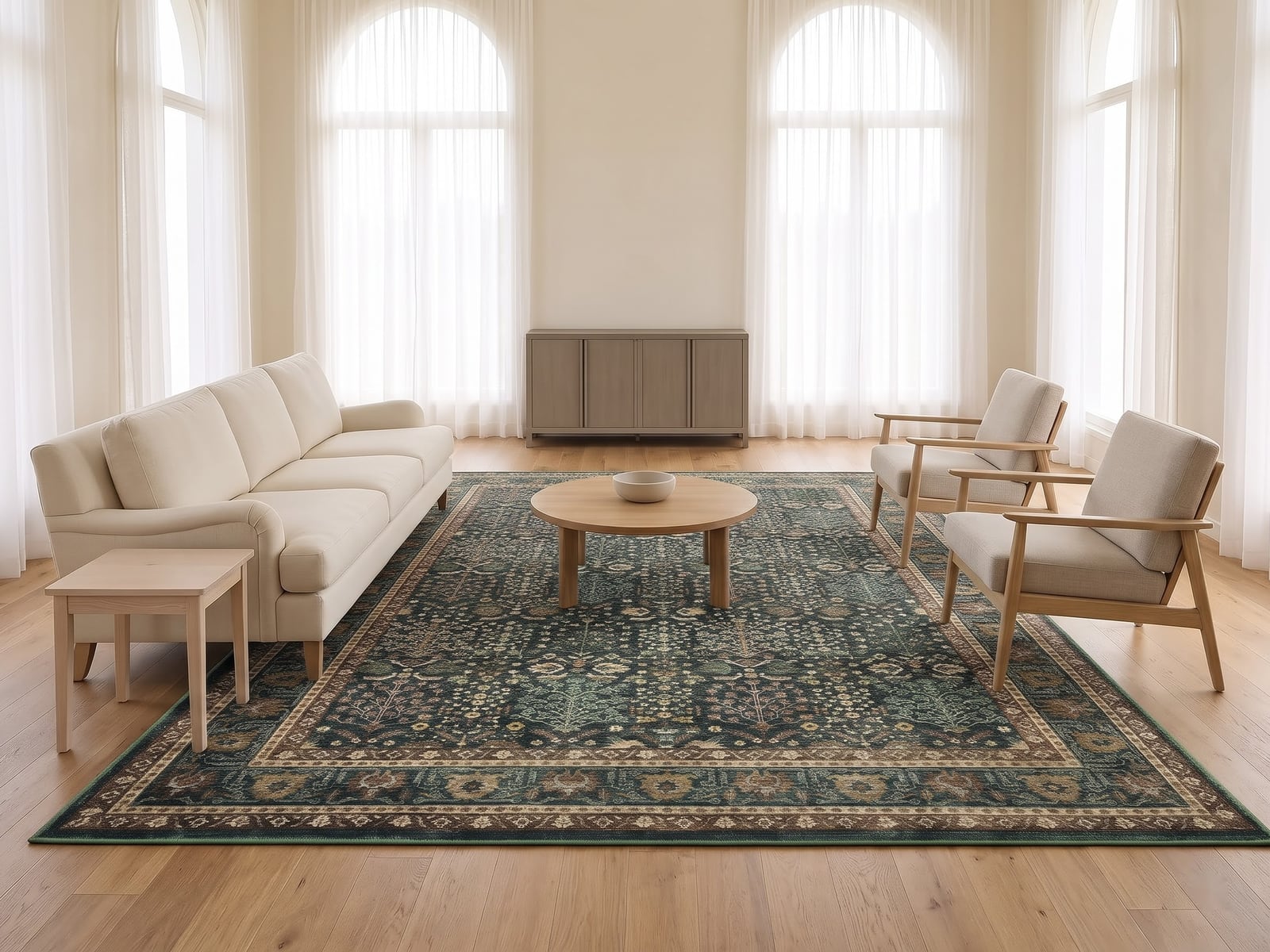
Faded Sage Patterned Area Rug
Low-pile vintage-inspired printed area rug in muted sage and warm cream tones.
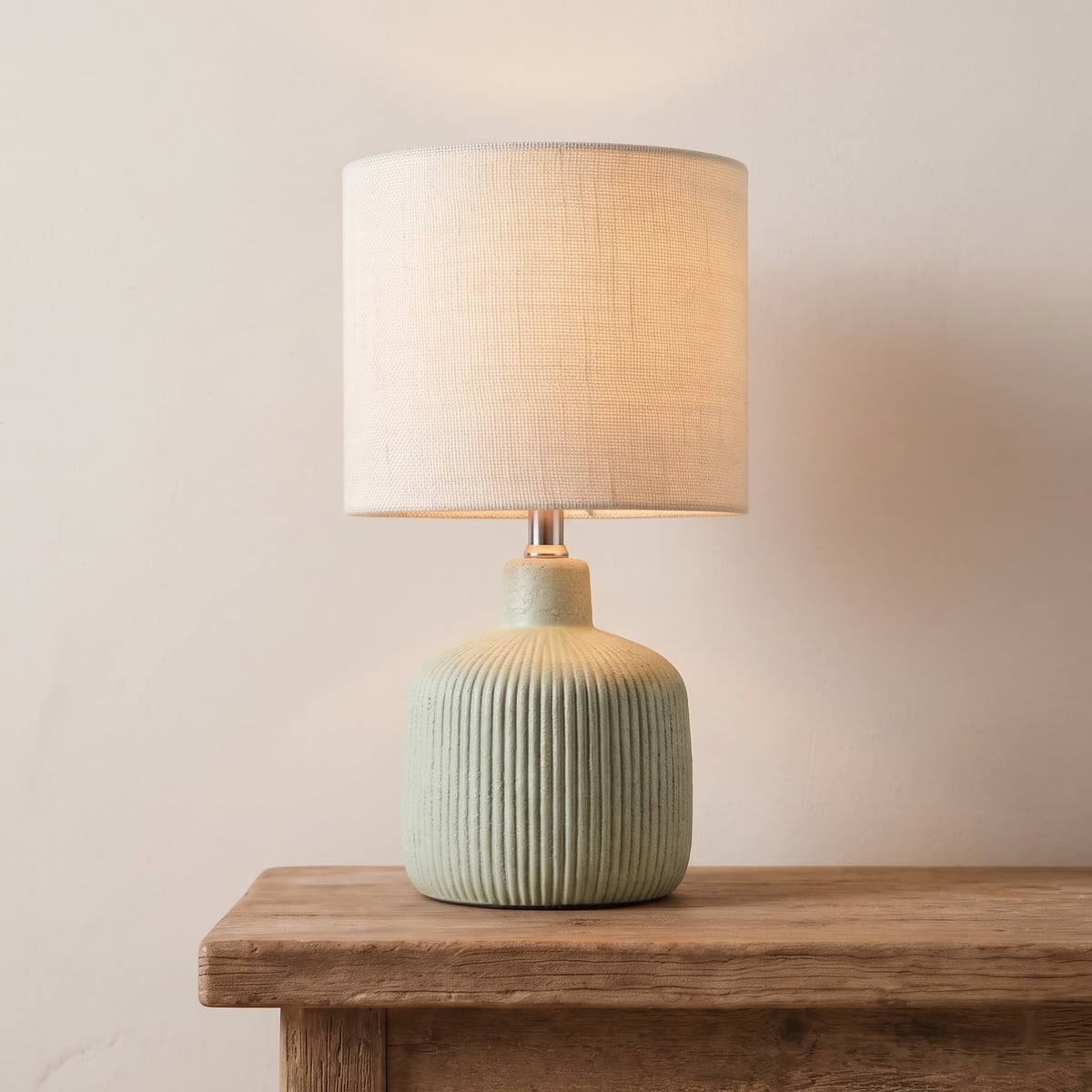
Ribbed Celadon Ceramic Table Lamp
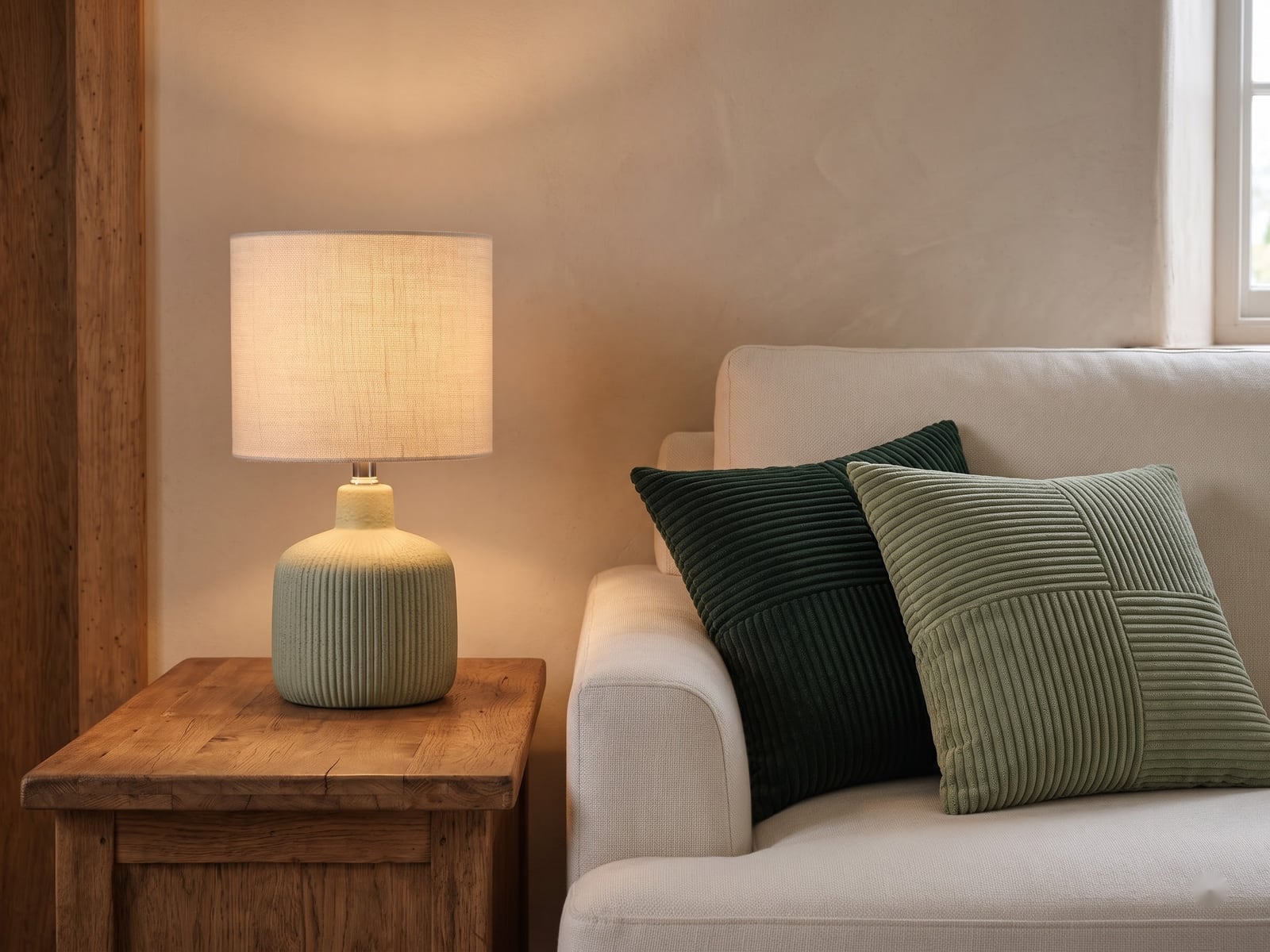
Ribbed celadon ceramic table lamp with aged brass accents and textured linen drum shade.
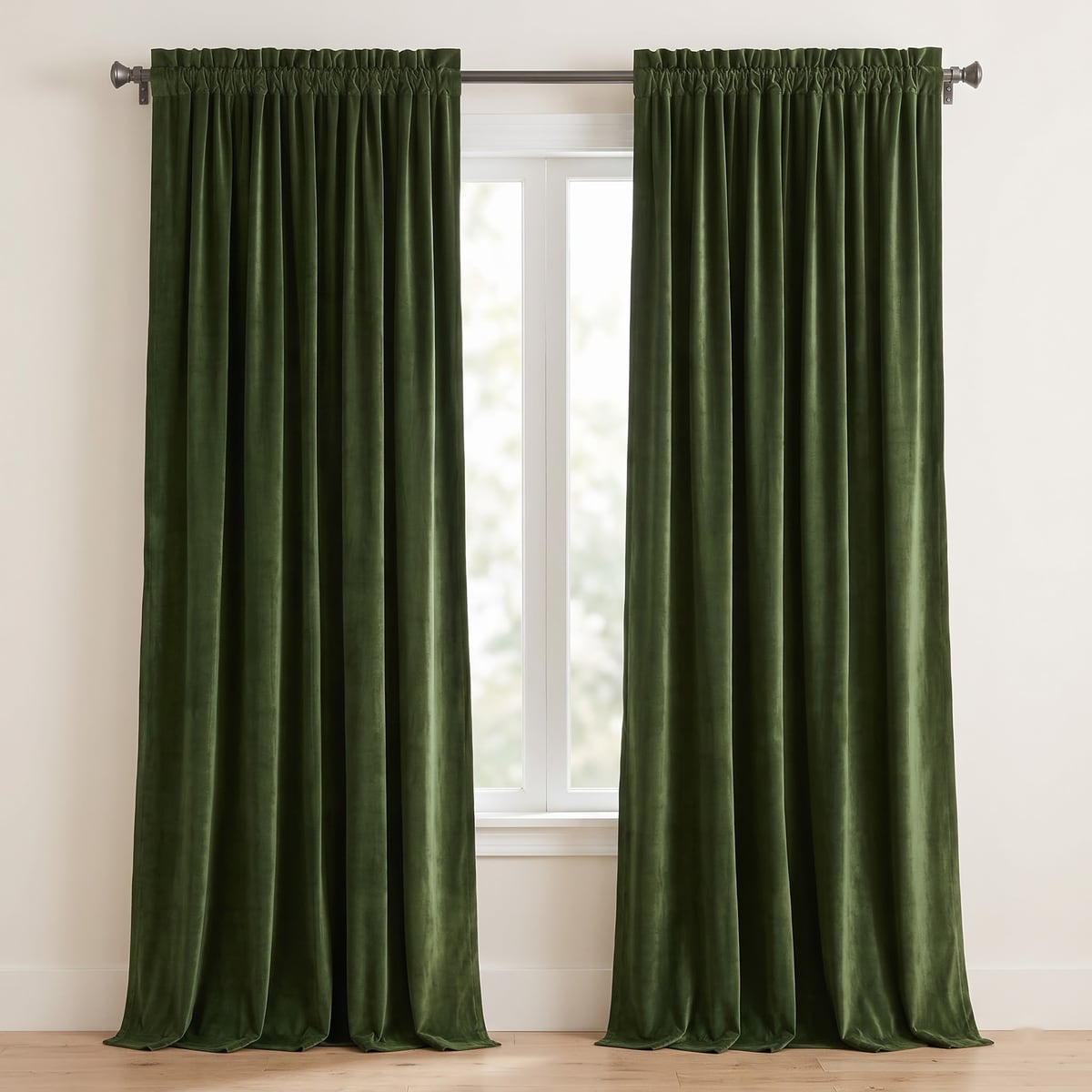
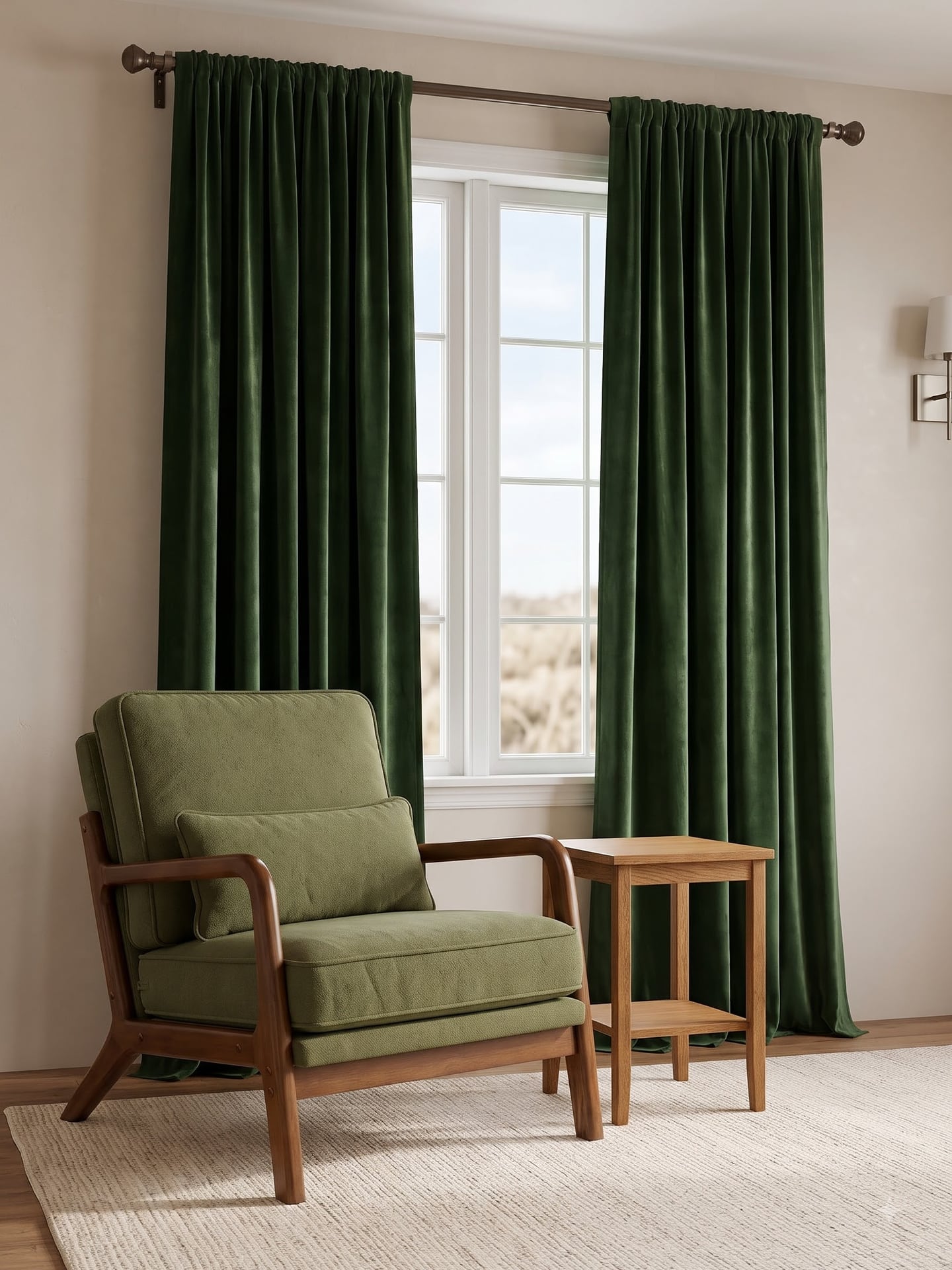
Deep Olive Velvet Curtains (Pair)
Heavyweight velvet curtain panels in rich olive green, providing privacy and deep textural drape.
A layered green seating area, from the sectional and chair pair to the rug, lamp and olive curtains. Select a piece to see its source.
A green sofa can look perfect online and strangely heavy in your room. A sage wall can feel restful at breakfast and distinctly gray under the lamp at night. And a beautiful green rug may do very little if it is too small for the furniture sitting around it.
The trick is not finding one universally perfect green. It is figuring out what your room already has, deciding where the colour should do most of its work, and giving it the right materials and proportions beside it. You can do that with a painted wall, a sectional, a rug, or one well-placed chair. You do not have to replace everything to make the result feel deliberate.
This guide starts with the pieces you own, then works through colour, paint, seating, rugs, curtains, art and lighting—with practical checks that help a lovely photo translate into a room you can actually live in.
Reading path / choose what you need
Start with the room you have already got
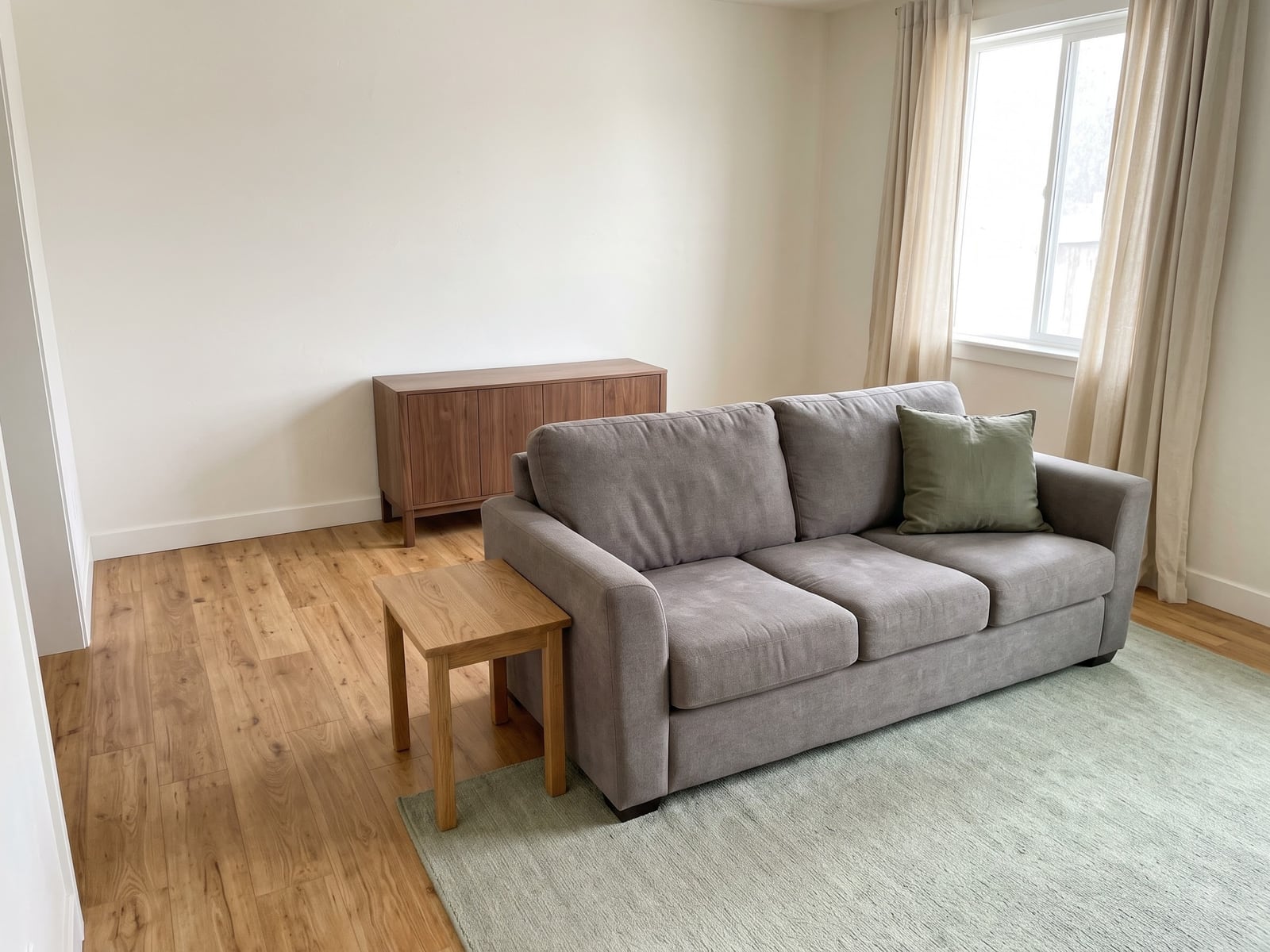
Before you look at shades of green, stand in the doorway and name the three largest things you are keeping. Often they are the sofa, the floor and the window treatment. Sometimes it is a walnut media console or an armchair you do not want to give up. Those choices matter more than the colour name on a paint card.
If your sofa is cool gray, put any proposed green beside that upholstery rather than comparing it against a white screen. If your floor is honey-coloured oak, notice whether the green makes that wood look pleasantly warm or unexpectedly orange. With cream seating, check whether the fabric leans pink, yellow or gray in the actual room.
Then decide what you are willing to change. A renter who wants to keep the walls has a different starting point from someone ready to paint and replace the main sofa. Both can have a good green room. They just need different starting moves.
A useful first decision: Keep the expensive or difficult pieces in place and change one large visible surface first. A rug, curtain pair or substantial chair can tell you whether you enjoy living with green before you commit to the whole room.
Choose where green should have the biggest role
Green does not need to appear on every surface. But it does need an understandable role. Pick the largest area that can carry it comfortably, then decide how much contrast the rest of the room should offer.
| Where green leads | A good starting situation | What keeps the room balanced |
|---|---|---|
| Walls or panelling | You love your existing cream or gray sofa | Light upholstery, wood furniture and a rug that separates the floor from the wall |
| Sofa or sectional | You are replacing the main seating | Quiet walls, a sufficiently large neutral rug and one contrasting material |
| Rug or curtains | You want green without painting | A sofa you already own and one small supporting echo elsewhere |
| Accent chair | The room is mostly finished, or space is tight | A chair that fits the walking route, with a lamp or side table placed for actual use |
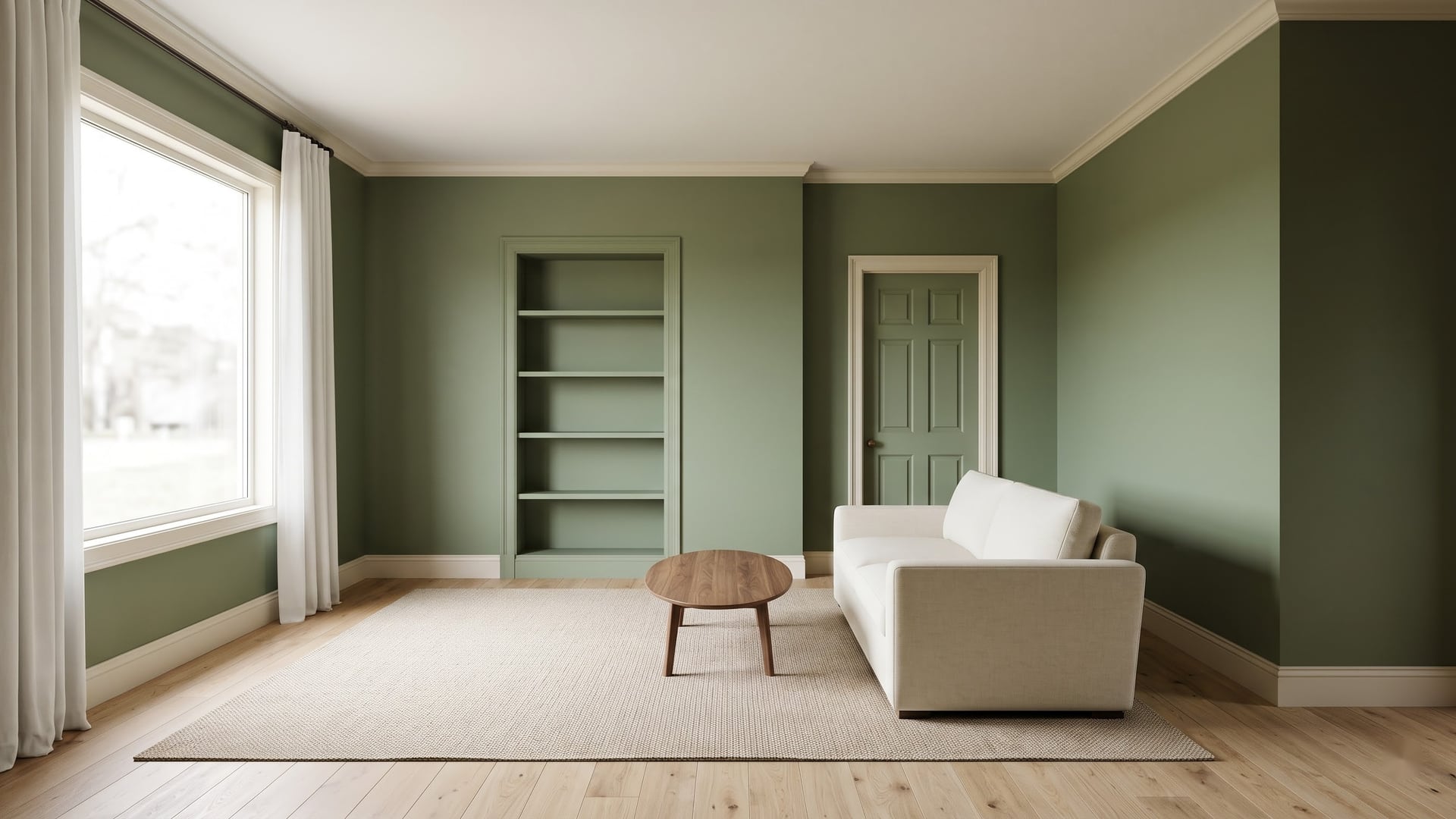
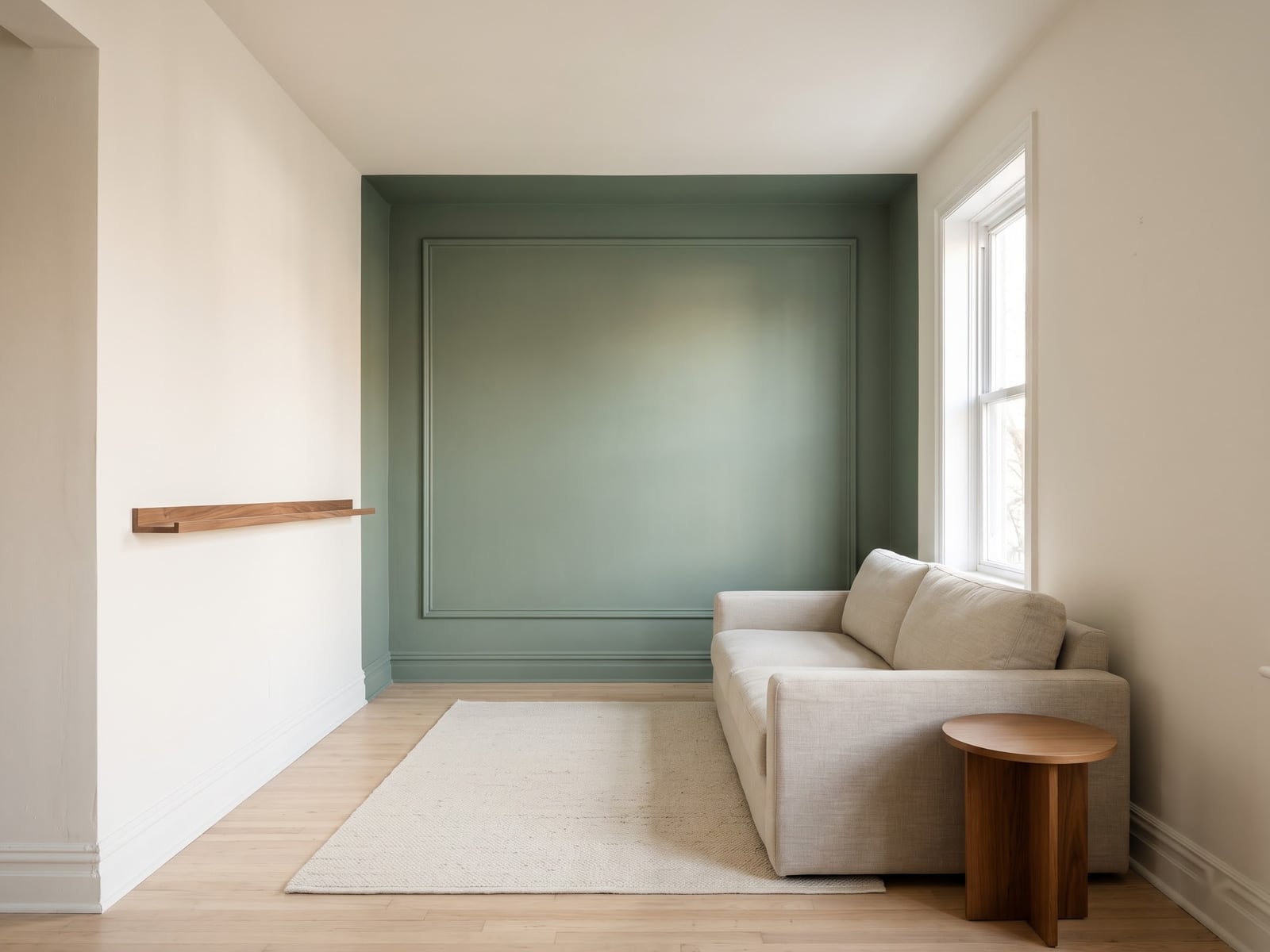
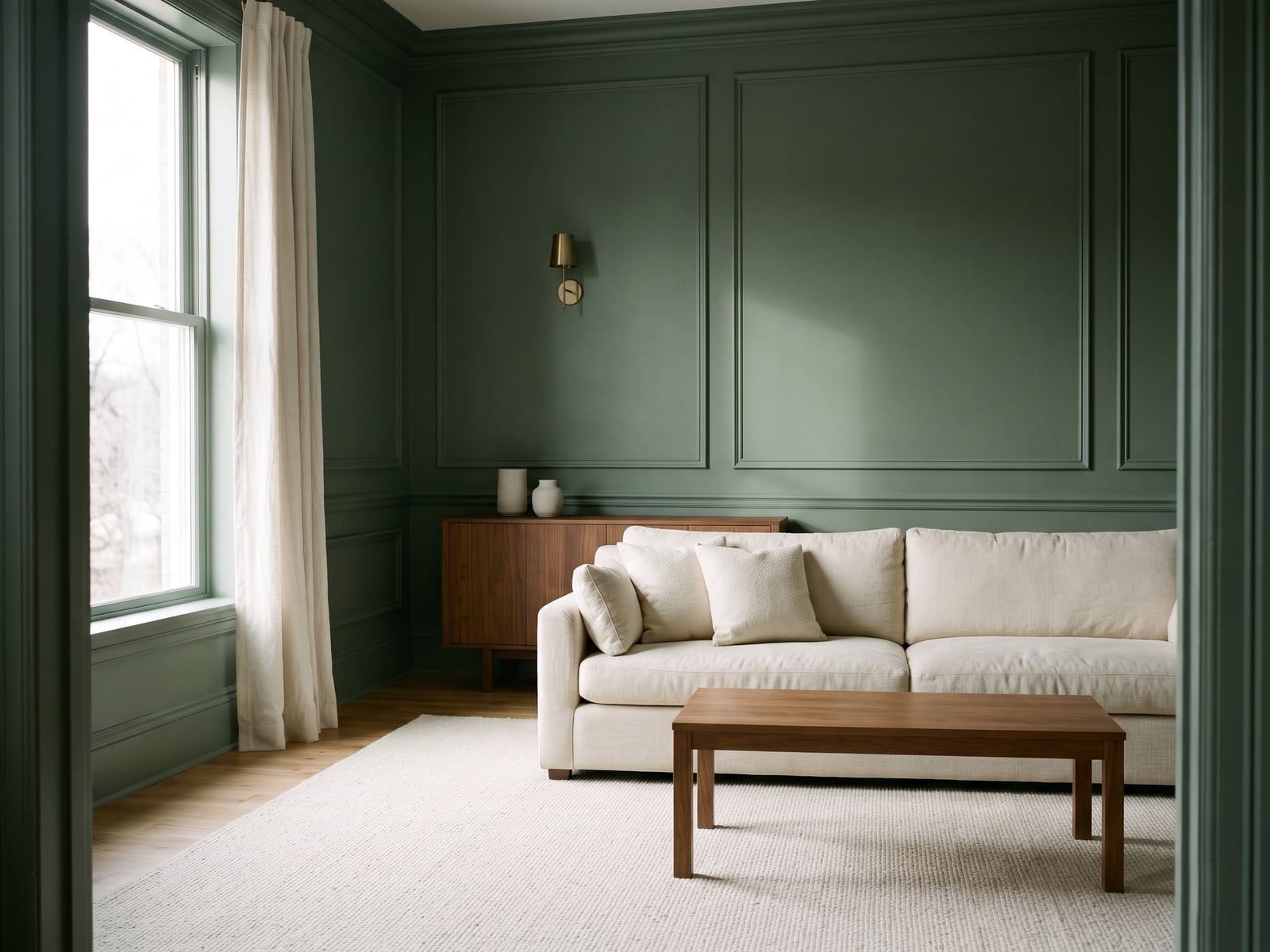
One green anchor is the simplest place to begin, not an absolute rule. A green sofa against a green panelled wall can look rich and intentional. The difference is usually separation: a deeper wall behind a slightly lighter sofa, a warm wood table between them, or an oatmeal rug that gives the furniture a distinct outline. If the wall and sofa are too similar in brightness and texture, the whole arrangement can flatten into one shape.
Find the right green in your own light
Sage, olive, moss and forest are helpful shorthand, but the words do not guarantee what a sample will look like. One sage can lean gray-blue; another can be noticeably yellow. Olive may feel earthy next to walnut and too yellow next to a cool gray floor. Dark forest green can look almost black in a shaded corner.
Start with two or three candidates rather than twenty. Compare them next to the actual sofa and flooring, ideally in large enough samples to see more than a tiny patch of colour. Look in morning light, afternoon light and under the lamps you normally use. The same sample should be tested in more than one location. A window wall and a recess often tell different stories.
Benjamin Moore recommends movable colour samples or painted sample boards for comparing colours around a room in changing light. That is more dependable than choosing from a phone photograph alone. 1
In the paint-test photograph here, three greens sit above a gray sofa and a wood floor. The point is not to crown one shade the winner. It is to make the background materials visible while you judge each green. Take the same test into evening light before making your decision.
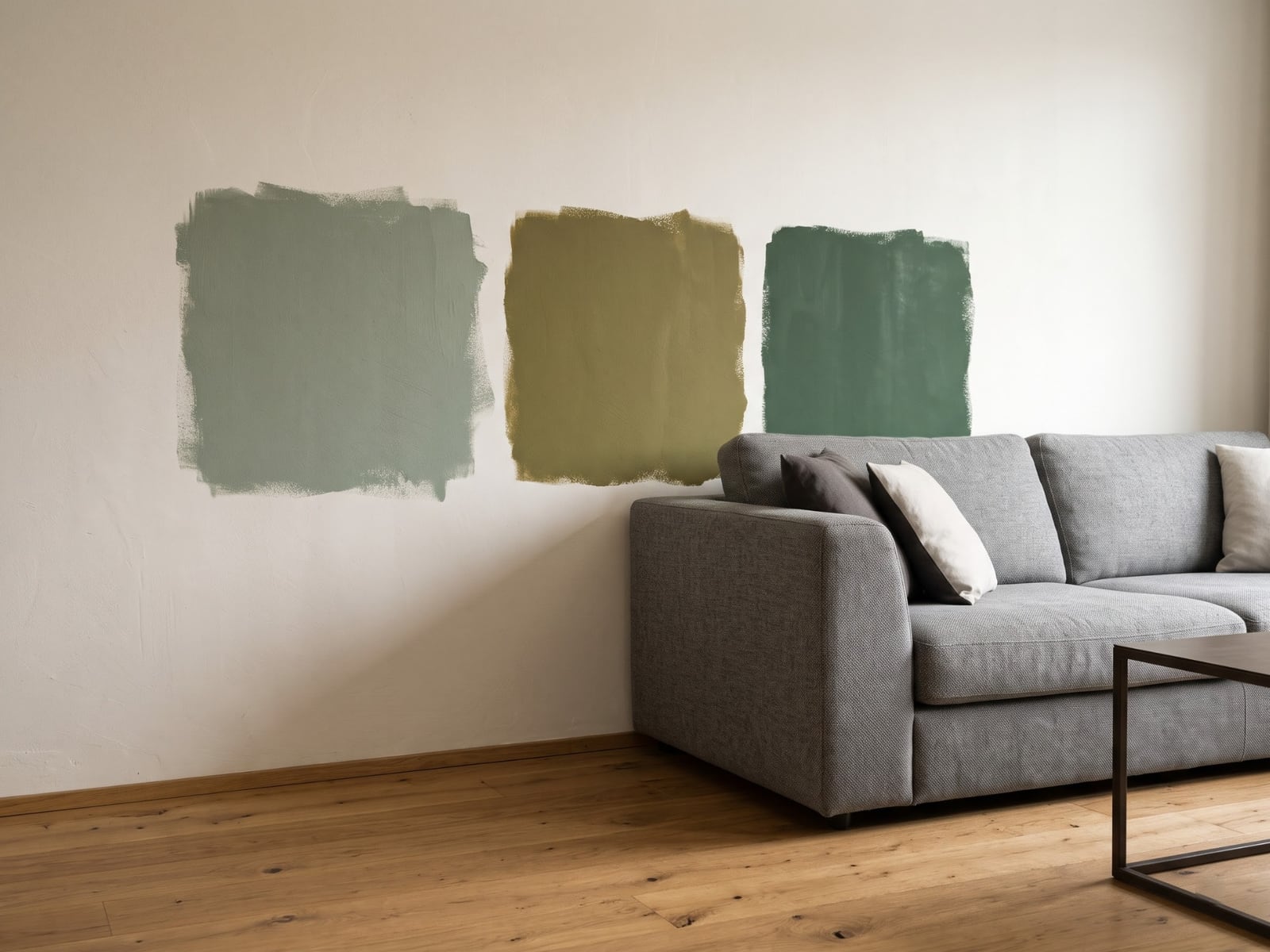
Olive, sage and the softest things around them.
Look for relationships between surfaces, not an exact match to a digital swatch.
Green walls: one plane, the whole room, or the details?
A single green architectural plane works when you want a clear focal point but still need the other walls to reflect light. Paint a meaningful wall—behind the sofa, for example—rather than selecting a random short section that has no relationship to the room’s layout. If you have existing wall mouldings, the colour can make their relief more visible without adding any new decoration.
All-green walls can be calmer than a patchwork of accent colours, particularly with cream seating and natural wood. The catch is that daylight and artificial light become more important. Watch what happens where the wall turns a corner: if the finish turns overly glossy there, you will notice every irregularity. Choose a paint finish based on the product’s cleaning and durability requirements as well as its sheen, rather than assuming that the flattest finish is always best.
Green on trim, a door or built-ins is a smaller architectural decision. It can create continuity with a green chair or rug without making the entire room dark. Keep the transitions intentional. A single painted door in an otherwise neutral room looks strongest when another element gives its colour a reason to be there.
Don’t pick a paint colour from a generated room photograph. These scenes illustrate relationships and proportions; they are not verified paint swatches, and screen colour varies from device to device.
Make the sofa and rug work together
If you are starting with a green sofa, let the floor do some of the calming. An oatmeal, cream or warm beige rug can make the upholstery look greener, while a faded green patterned rug can create a softer, more layered room. Neither is automatically better. The choice depends on what is already happening on the walls and in the cushions.
A curved green sofa is a strong sculptural element, but its shape should not excuse awkward circulation. Check the real width, depth and access route. Can it turn through the hall or stair landing on delivery day? Does the curved back waste a useful strip of space? Is there enough room for a table that people can actually reach?
A deep modular sectional solves a different problem: generous shared seating. It can also dominate the room. Measure the chaise projection, the remaining walking route and the table distance before choosing one. Try the footprint on the floor with painter’s tape. That five-minute test catches problems an impressive wide-angle product photo can hide.
The rug is not just a colour patch beneath all this furniture. It establishes the seating zone. Aim to have at least the front legs of the main pieces on it when the proportions allow, and check that the rug extends far enough beyond the coffee table to look deliberate. Ruggable’s sizing guidance uses the furniture arrangement as the starting point, rather than centering a rug blindly in the room. 2
Before ordering, measure the actual rug size and door clearance. Check whether the material can be vacuumed easily, whether a pad is recommended and whether the care instructions suit pets, spills or heavy foot traffic in your home. A generated textile image can show a weave but cannot prove how it feels or cleans.
Add green without repainting: curtains, chairs and smaller rooms
A pair of deep green curtains can make a larger visual change than several little cushions. It also has a job: controlling glare, light and privacy. Check the panel width relative to the window; narrow panels pulled flat can look skimpy even when the colour is beautiful. Look at the heading style, finished drop and washing instructions before assuming that the same look will work in your room.
An accent chair gives green a new position in the layout, not merely another shade to match. In the paired-chair image, two rounded sage seats with substantial walnut-coloured arms create a small conversation zone. Their symmetry works because the wall and floor are quiet. It would work just as well as a principle with one chair if your room does not have space for two.
Place the chair where someone might actually sit: close to a small table for a glass, within reach of a reading light, and outside the main path between doorway and sofa. If it only fits in a corner where nobody can turn or read, it is not solving the right problem.
For a renter, a green rug, movable chair and curtains can do nearly everything a painted wall does visually, while remaining easier to change. Start with the item that covers the most area and add just one quieter supporting note. There is no need to make every pillow, curtain and artwork the exact same green.
Use art to introduce colours green cannot provide by itself
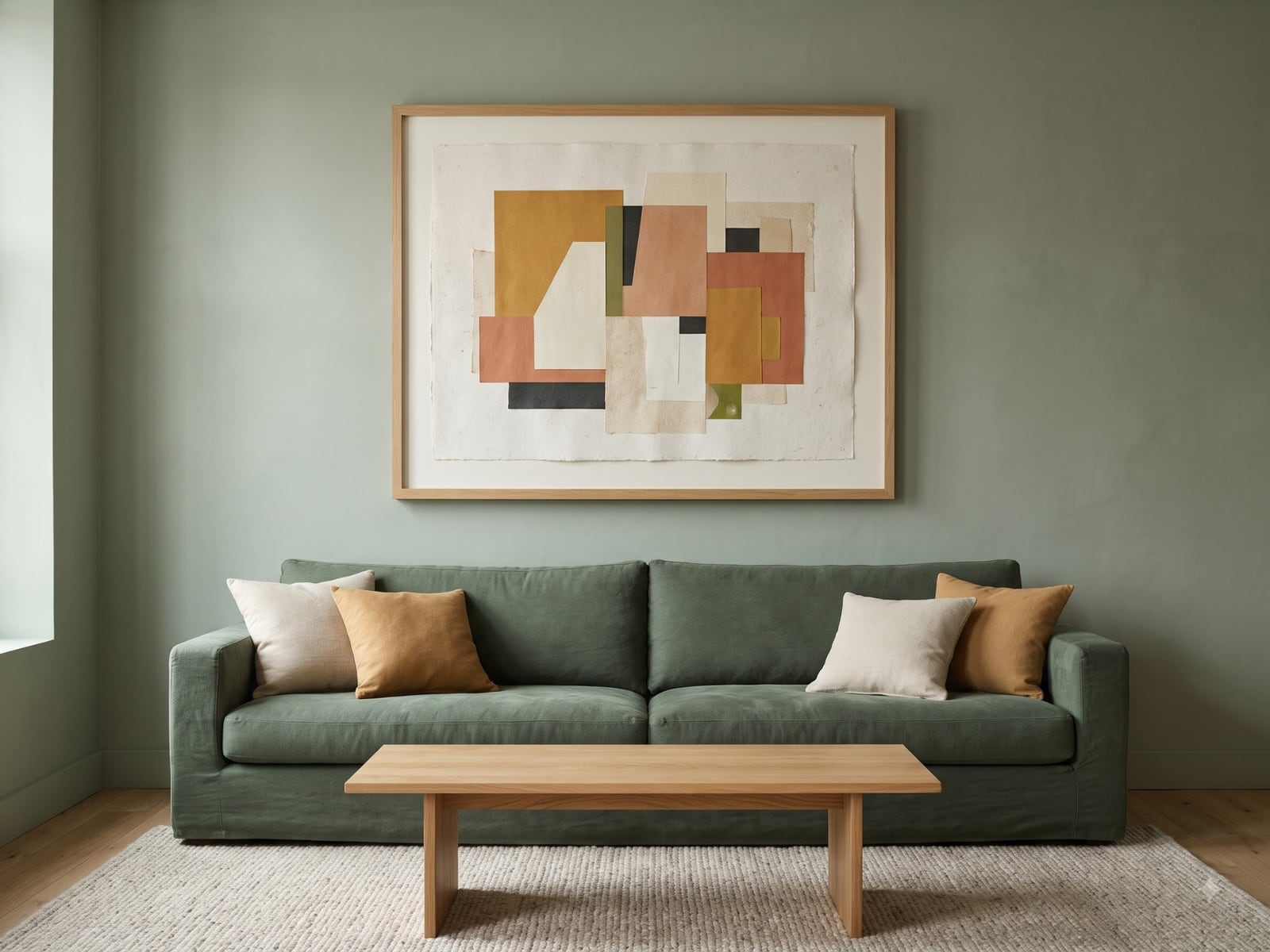
A room can become overmatched when every soft furnishing is green and every accessory tries to echo it. Artwork offers another route. A large abstract piece with ochre, clay, cream and soft charcoal gives a green sofa a warmer context. The colours relate without pretending to be a matching set.
In the framed-art example, the restrained sofa and wall let the artwork carry several warm tones at once. That is more interesting than asking the painting to repeat the upholstery exactly. A dark frame might help one room; pale wood may be more appropriate beside oak or walnut. Check its width against the sofa, and hang it where it reads as part of the seating arrangement instead of floating alone near the ceiling.
Your own original artwork can be used for the same lesson. Treat it as decoration in the article, not as an Amazon listing or a product with invented specifications. Concept imagery cannot establish the print’s actual colour, paper stock or frame quality.
Make the room practical: TV, lighting and everyday space
Real living rooms have screens, storage and awkward pathways. Pretending otherwise does not make the design more beautiful; it just makes it less useful.
A TV can sit above a simple wooden console while green upholstery carries the room’s character. Keep the screen completely off in the editorial photograph so it does not introduce fake interface graphics or compete with the materials. Seat placement matters more than making the media wall look perfectly symmetrical. When mounting a television, check viewing height from the position where you actually sit. Samsung recommends using seated eye level as the starting point for living-room TV mounting and checking placement against window glare. 3
Then look at lighting at three useful levels: overhead light for the room, a floor or table lamp near seating, and a gentle background glow if needed. The point is not to use every kind of lamp. It is to avoid a room where the only available choices are a bright ceiling fixture or near-darkness.
Check the lamp’s reach and direction against the chair. Make sure a floor lamp’s base will not sit in the walking route. For sofas, check usable seat depth rather than the overall depth alone. For tables, make sure there is enough space to stand up and move around the corners. Beautiful placement should survive ordinary movement.
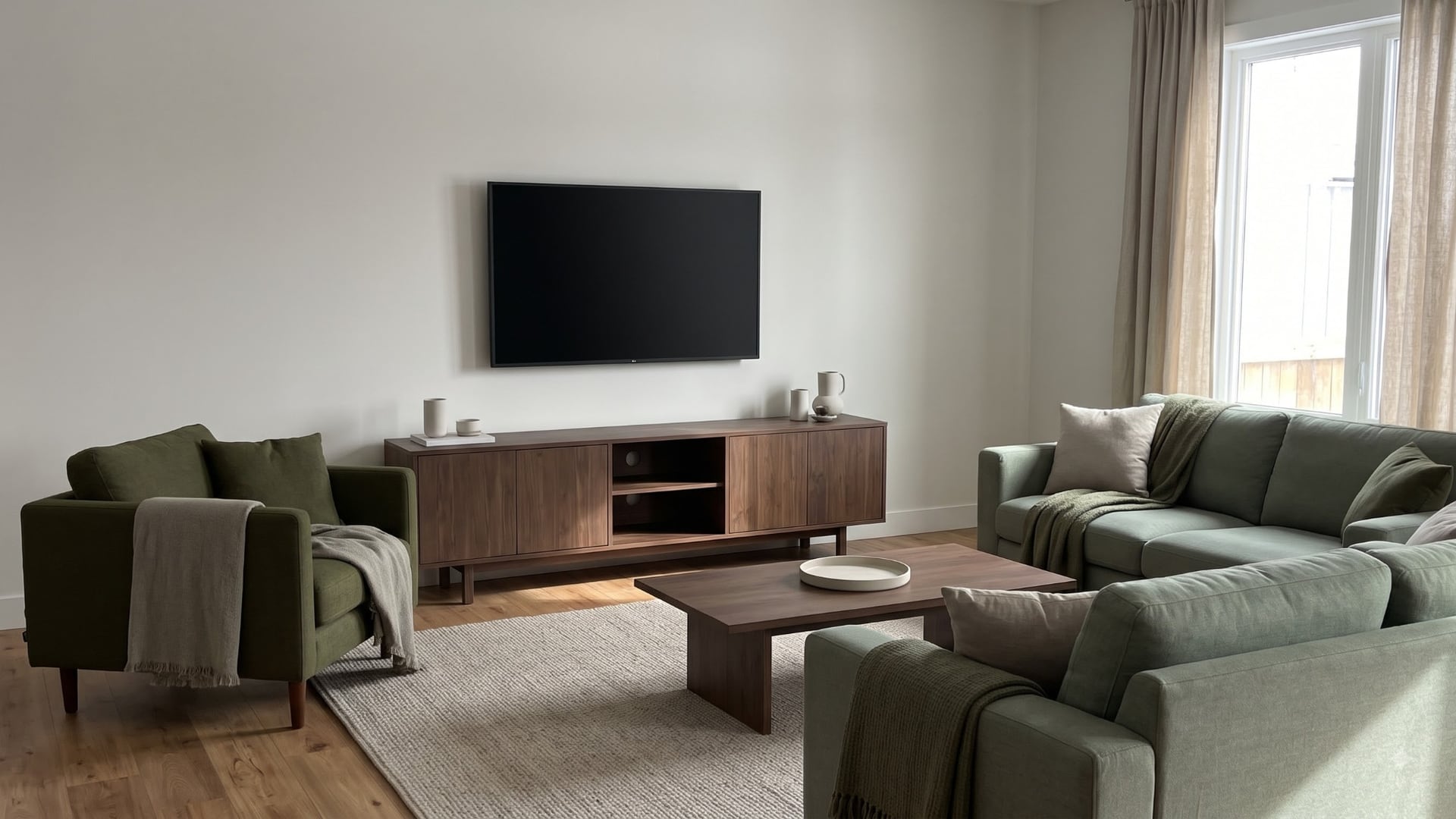
Three green schemes, matched to what you already own
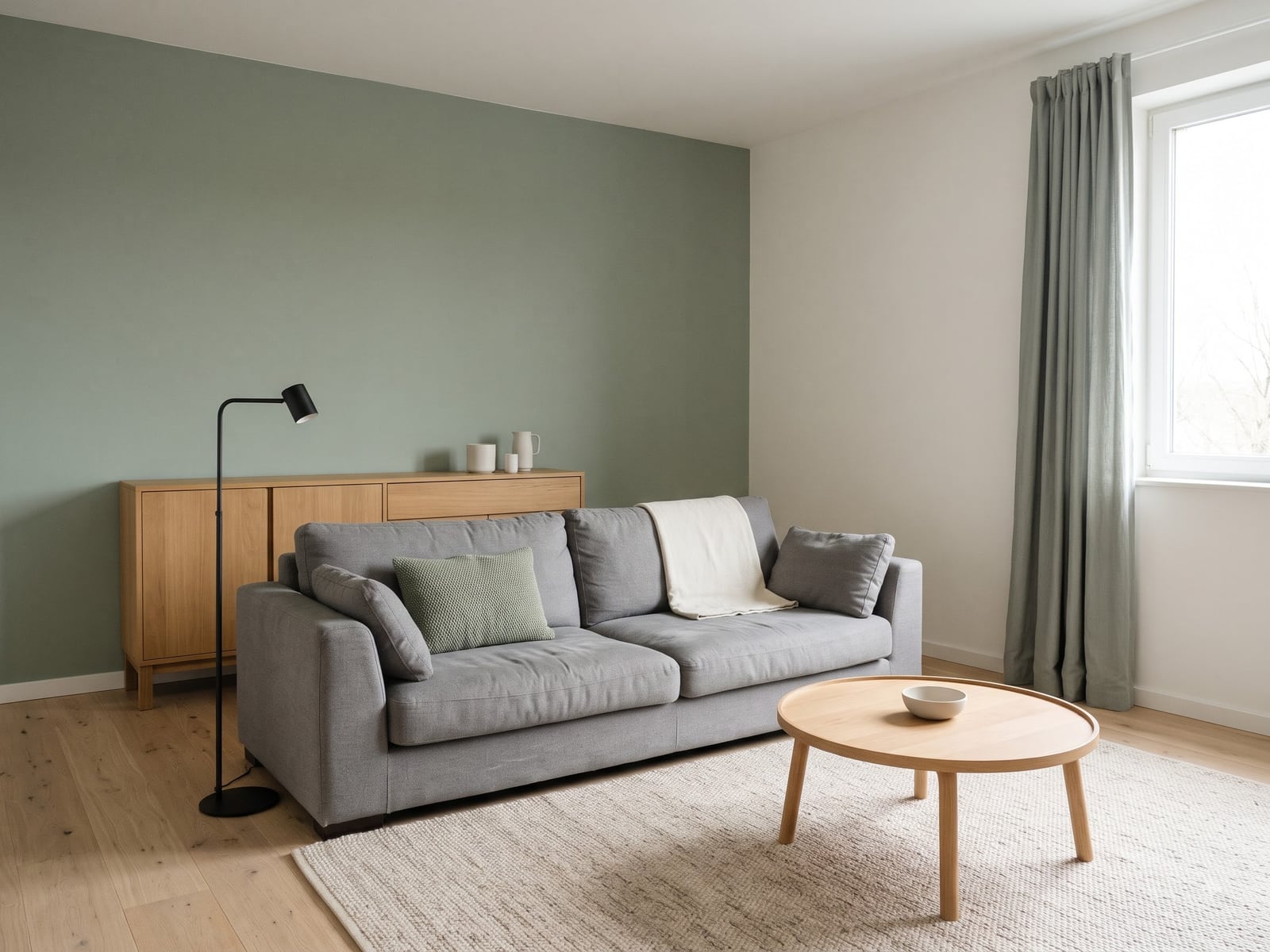
1. Keeping a gray sofa: sage, charcoal and warm wood
Keep: your gray sofa and the existing oak or walnut furniture. Change: test a soft sage wall plane or muted green rug; choose one, then see if the room needs the other. Watch for: a yellow-leaning green next to very cool gray upholstery—it may make both colours look less intentional.
A restrained sage wall adds colour without demanding a new sofa. Use an off-white rug or textured neutral cushions to keep the gray and green from merging into a cool wash. Warm wood becomes the bridge between them.
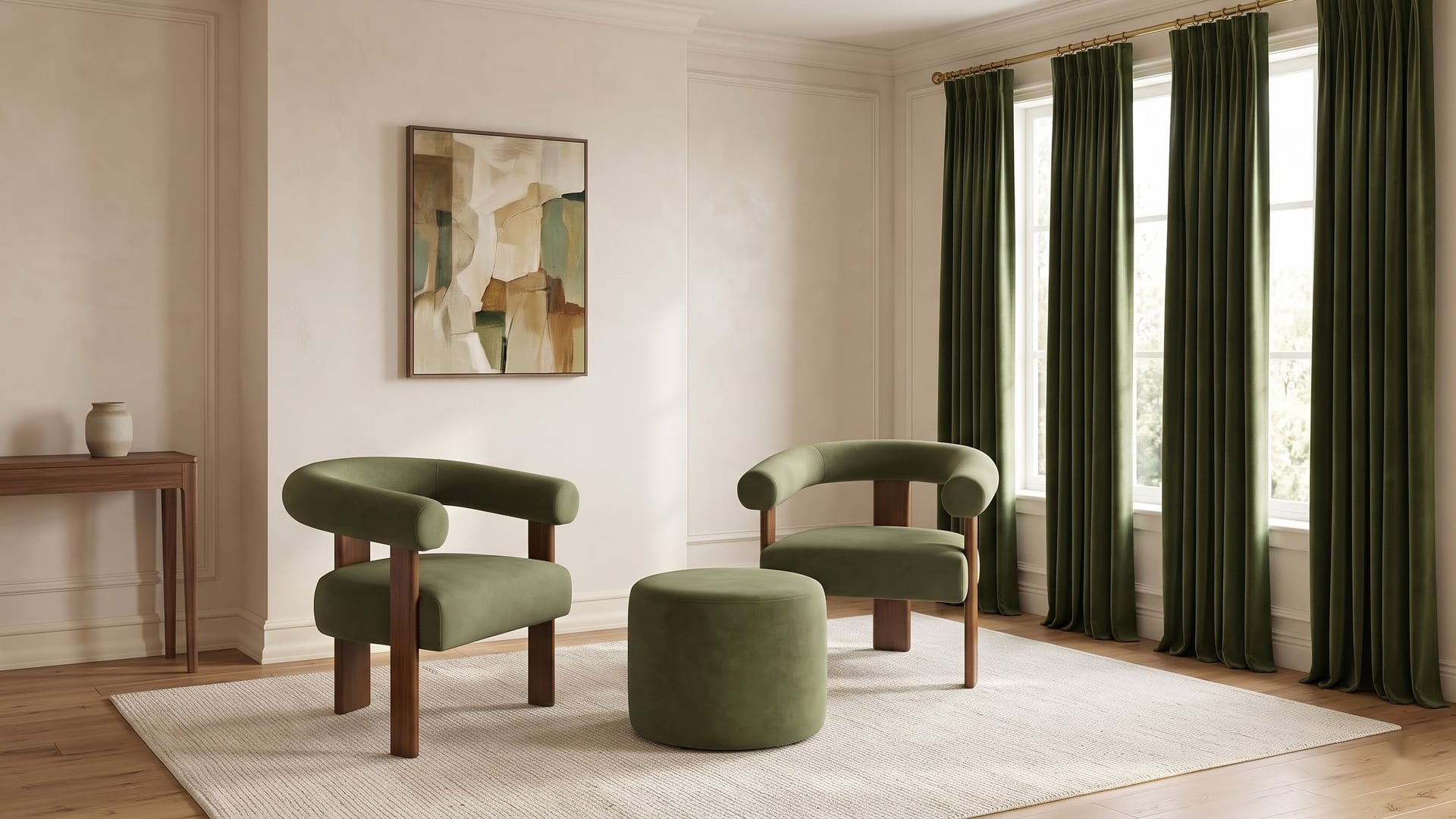
2. Keeping cream seating: olive, oatmeal and a patterned green rug
Keep: cream or warm-beige seating and natural wood. Change: bring in olive through a generous patterned rug or full-length curtains. Watch for: buying a rug that is too small or curtain panels that don't have enough fabric to hang fully.
This is one of the gentlest ways to try green. The sofa stays bright, the floor carries the pattern, and a small green lamp or chair can repeat the colour away from the rug without turning the room into a themed display.
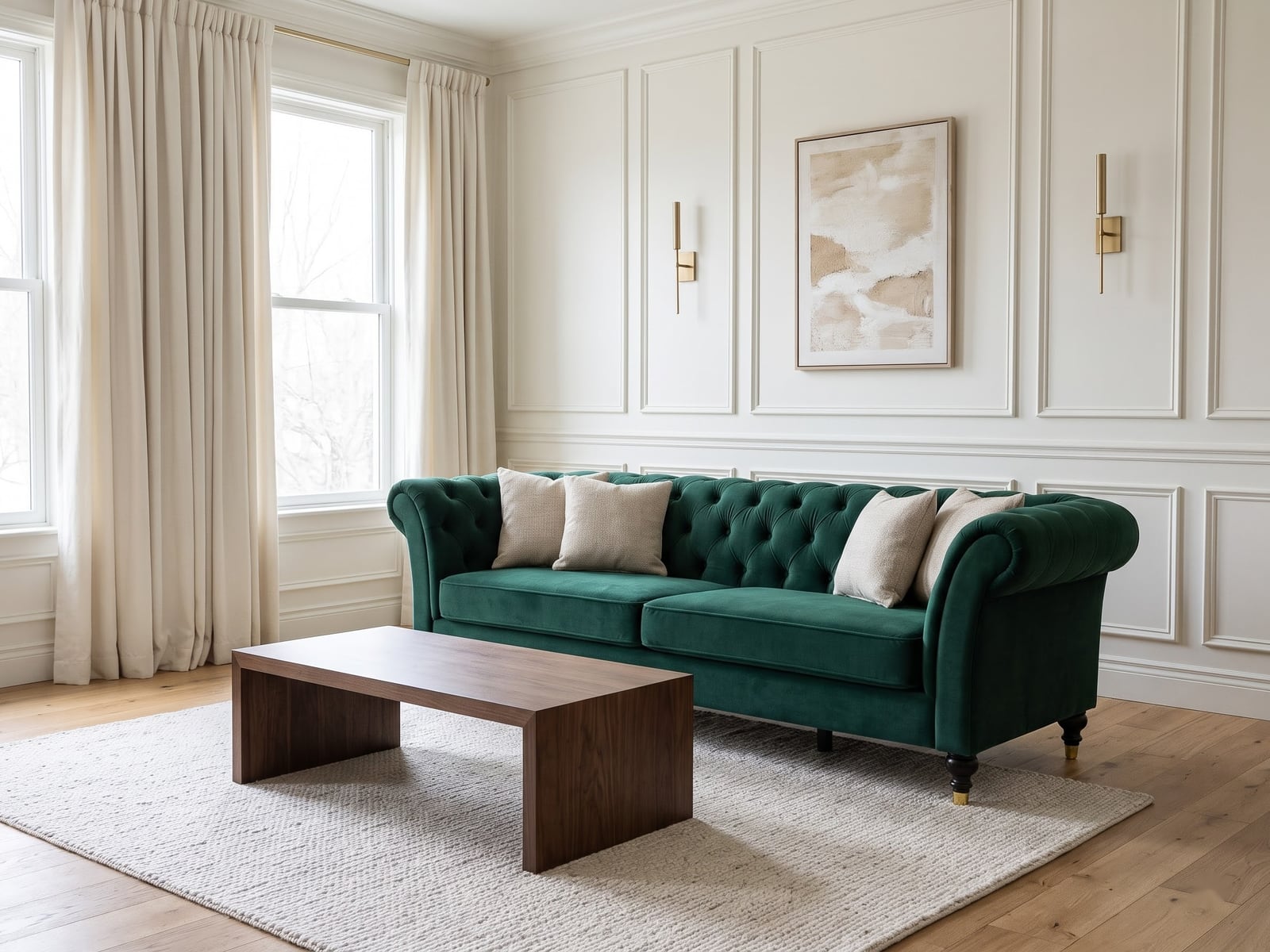
3. Already own a green sofa: forest, warm white and contrasting wood
Keep: the green sofa. Change: choose a lighter neutral rug, introduce a walnut or natural-wood table, and consider original abstract art with ochre or terracotta. Watch for: piling several near-identical greens together until the sofa disappears against the wall.
This is the more layered, atmospheric route. A green panelled wall can work behind the sofa, but adjust its depth or finish so each element remains visible. If the upholstery is richly textured, let the wall be quieter. If the wall has pronounced panelling, keep the rug simple.
Look again after dark
Daylight can hide a poor lighting plan. A deep green sofa may look luminous by a window and almost black when the only lamp is behind it. Curtains that feel soft in the afternoon can turn into one large dark shape at night.
Compare the same room in day and evening light without changing its furniture. You should still be able to distinguish the sofa from the wall, the rug from the floor and the reading chair from the corner around it. If everything merges, add useful light or a contrasting surface before adding another decorative object.
And remember that the colour of a lamp base is not the same as the colour of its light. A sage ceramic lamp may illuminate the room warmly, coolly or somewhere in between depending on its light source. Always check bulb and dimmer compatibility against the actual product.
The buying check before you click
Before buying anything for a green living room, write down what problem that item solves. A larger rug might fix the entire seating arrangement. Curtains could improve privacy and soften a blank wall. A chair might give the room a second useful seat—or make an already narrow path unusable.
For each item, check the specific product configuration and dimensions. A sofa listing’s photograph may show more modules than the selected variation includes. A rug comes in several sizes, and the photo may not show the one you selected. Curtain listings can refer to one panel or two. A product render cannot verify fabric feel, real-world shade, or washability.
The 2026 U.S. Houzz & Home study found that among renovating homeowners, rugs and pillows or throws were the most common interior decor purchases (48% and 47%), followed by artwork (42%). That fits a practical approach: improve the substantial pieces you actually use before collecting more tiny accessories. 4
Start with what is staying. Choose the place green should lead. Make the surrounding pieces support it. Then take measurements and check the room in the light you really live with. That is how the colour stops being an idea in a photograph and starts to feel like your room.
Measure first
Draw the true footprint of the furniture and the remaining walking paths before committing to scale.
Check the variant
Confirm chair count, chaise orientation, rug size, and curtain-panel quantity in the actual retail listing.
Sample in person
A convincing image does not prove colour, comfort or cleaning performance under your room's lamps.