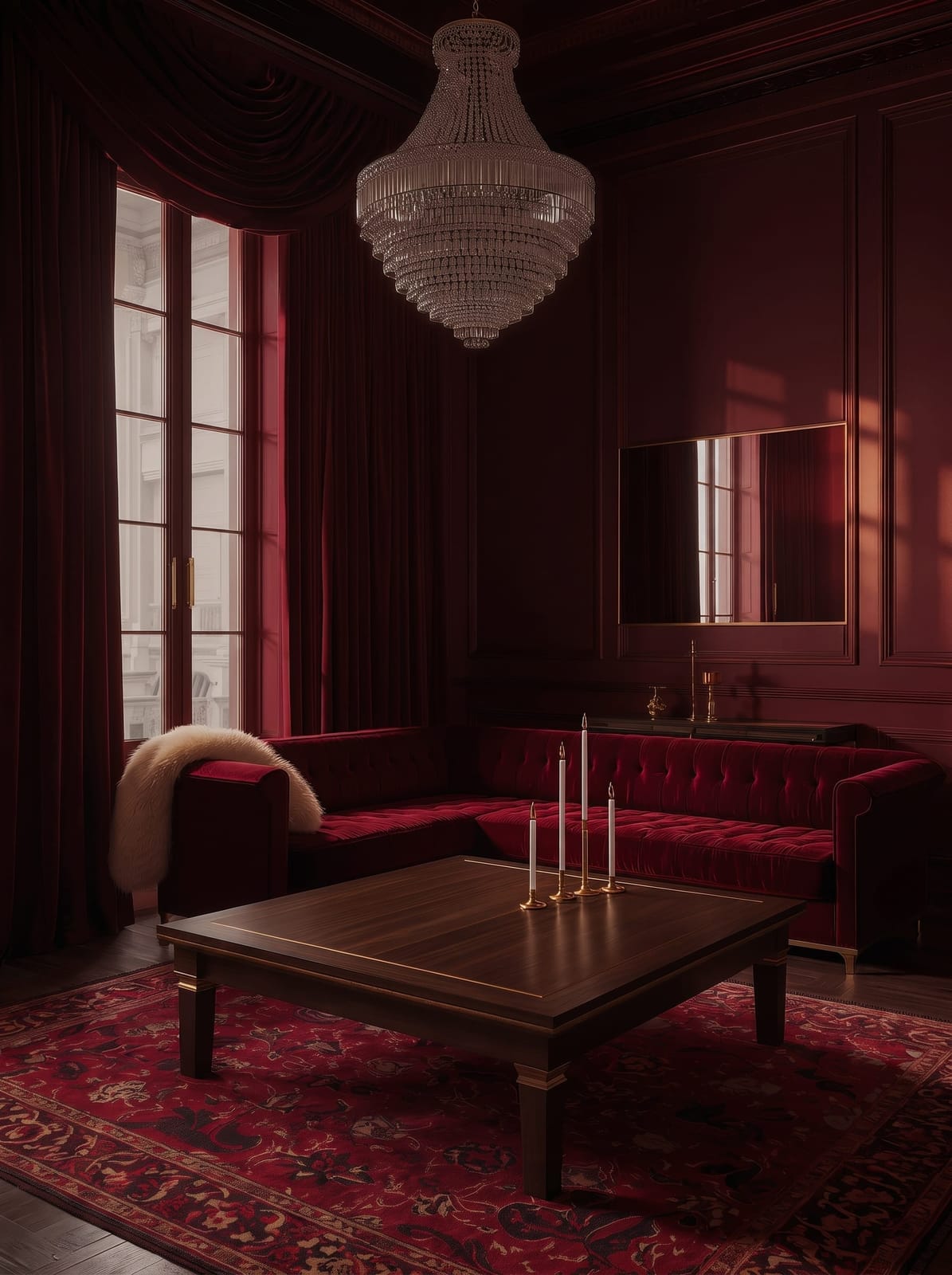
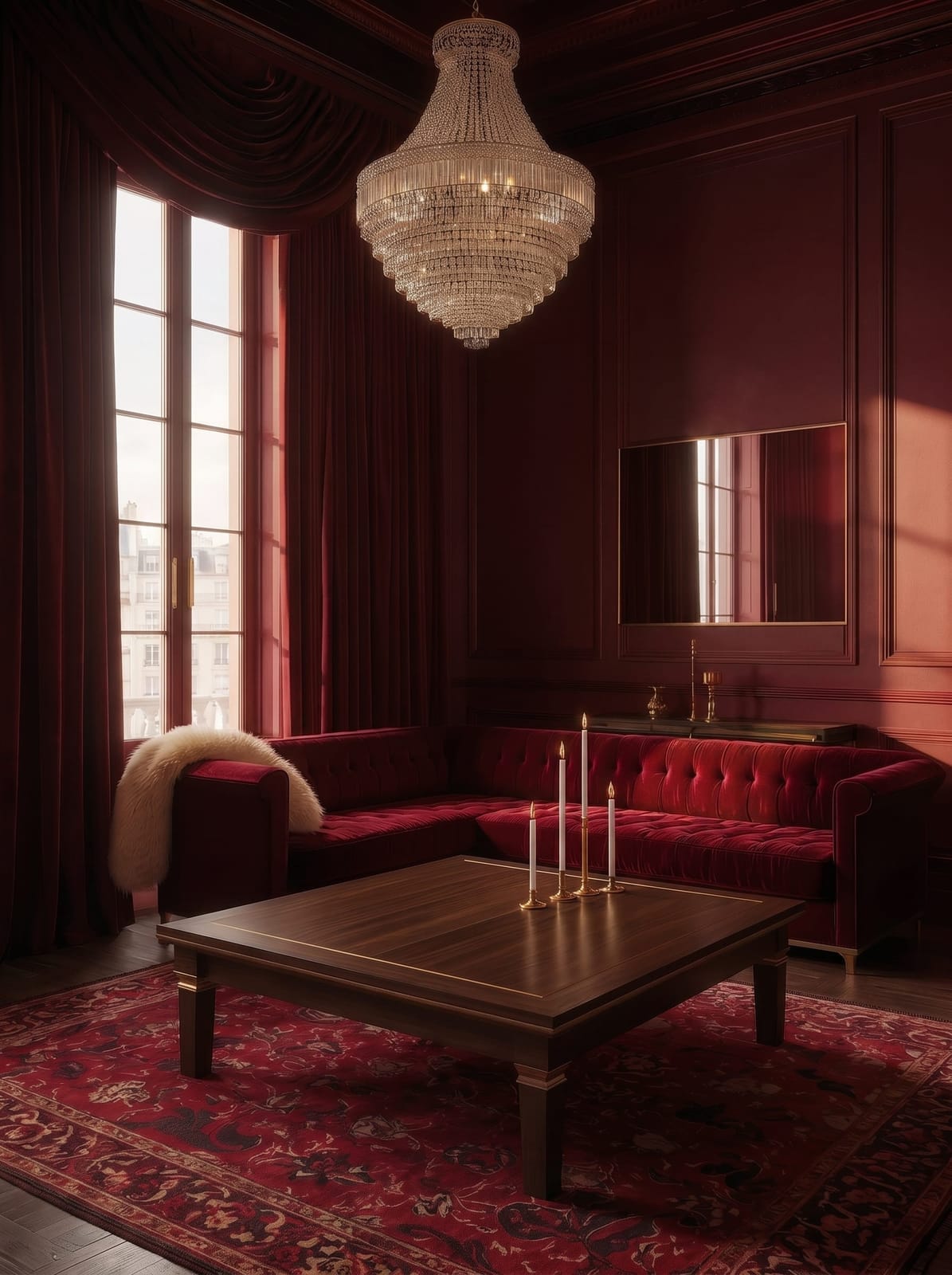
Some rooms are built to expand. The formal parlor lounge is built to enclose.
In a world dominated by open floor plans and pale minimalism, the traditional parlor lounge acts as a deliberate return to the sensory richness of historic interiors. It is a space designed for conversation, reading, and the slow unwinding of the day. The color palette is deep and monolithic: wine-red walls, burgundy velvet, dark walnut, and glints of polished brass. By enveloping the room in a single, deeply saturated hue, the boundaries of the space recede, and the interior shifts from a mere living room to a protected, candlelit sanctuary.
At the heart of this moody composition is the tension between light and texture. Velvet absorbs light, while crystal and brass multiply it. By layering these opposing materials, the room develops a rich, three-dimensional complexity that reveals itself slowly as the sun drops.
The Architecture of Saturation: Designing with Burgundy Velvet
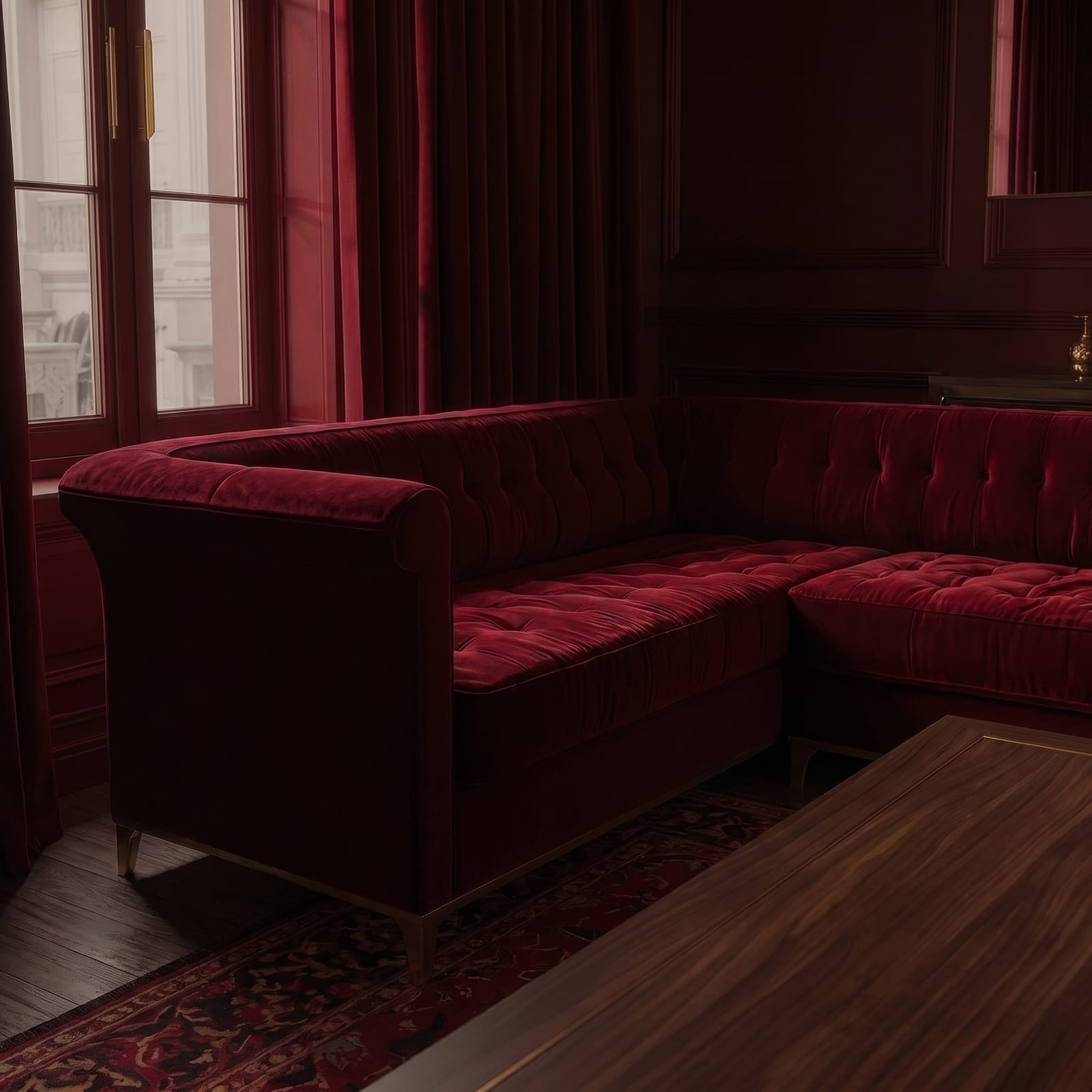
Designing with a highly saturated piece like the Mercer41 Chesterfield Sectional requires a departure from standard decorating rules. Velvet is a pile fabric, meaning its surface is composed of densely woven loops that have been cut to create a soft, directional nap. The color of any velvet piece is not fixed—it shifts depending on the angle of the light and the direction the nap is brushed. Run your hand across a velvet cushion and you will see two colors emerge: the compressed fibers darken, while the lifted fibers catch the light and appear brighter. This optical quality, called chatoyancy, is what gives velvet its depth and its reputation for luxury.
In a room flooded with direct, harsh sunlight, this effect can work against the fabric. The nap reflects too much light, making the velvet look shiny, almost plasticky. In a moody parlor space, however, where light is filtered through curtains or enters obliquely through tall windows, the velvet pile behaves like a canvas. Deep shadows pool in the button tufting. Soft highlights trace the rolled arms and the piped seams. The sofa becomes a piece of landscape, changing appearance as the day progresses.
The L-shaped configuration of a Chesterfield sectional is particularly effective in a parlor setting because it defines the perimeter of the conversation zone without requiring additional armchairs. The gold-finished metal legs introduce a fine metallic line at the base, lifting the visual mass of the upholstery just enough to prevent it from feeling ponderous. This small detail coordinates with the brass in the mirror frame and the candlestick holders, threading a metallic warmth through the lower register of the room.
The Ground Plane: Why a Persian Rug Anchors the Room
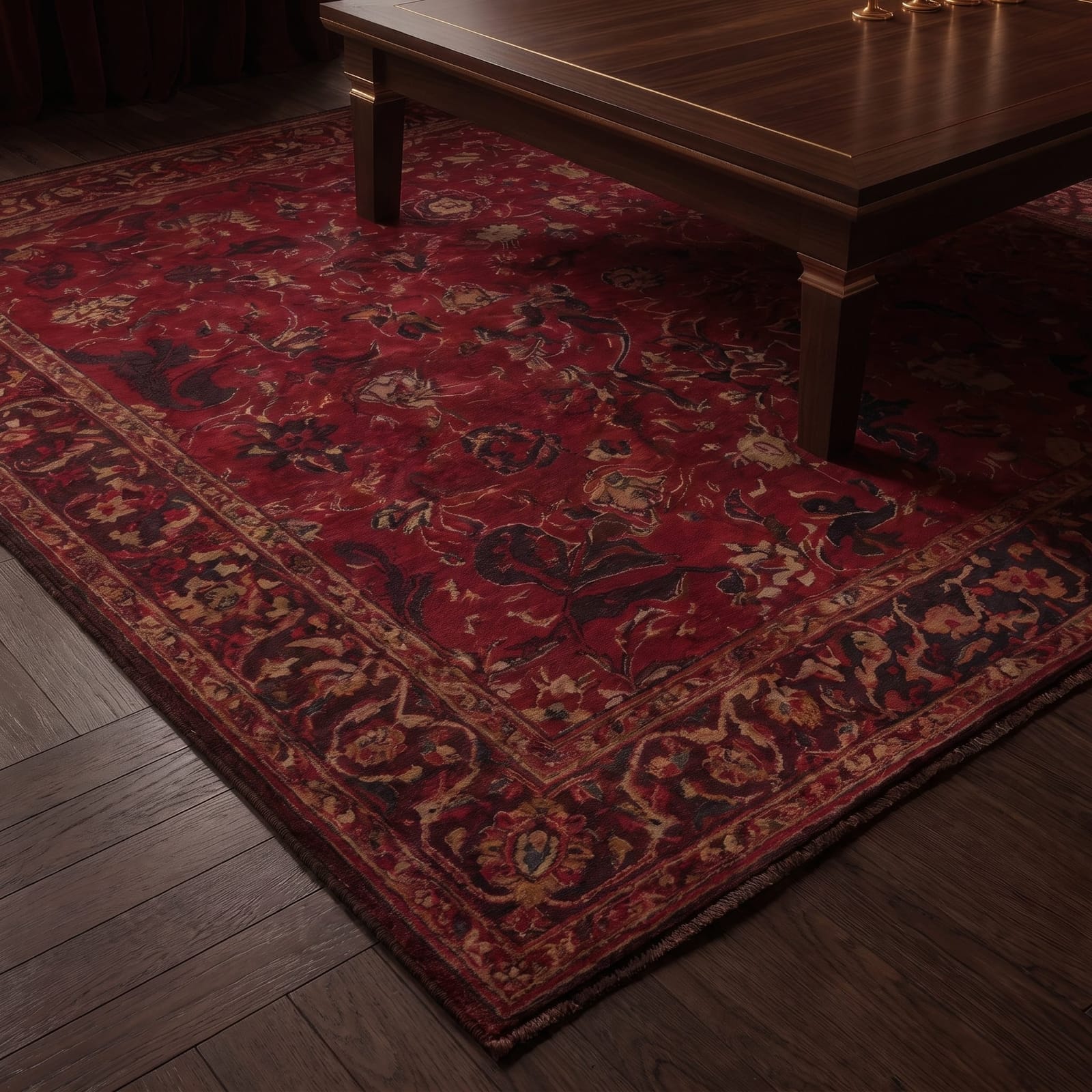
To prevent the sofa from appearing like an island in a sea of empty space, the floor plane must be similarly anchored. The Astoria Grand Medallion Kashan Rug achieves this by carrying traditional Persian motifs in matching crimson, navy, and cream. The intricate floral patterns act as a visual ground, repeating the red tones of the sofa and walls while breaking them up with small-scale detail that rewards close looking.
A Persian rug in this context does more than fill the floor. It establishes a historical register. The Kashan pattern—characterized by a central medallion surrounded by scrolling vine and palmette borders—carries centuries of weaving tradition. In a room filled with contemporary reproductions, the rug’s visual vocabulary signals permanence and inherited taste, even when the rug itself is a modern production piece. The wool fibers introduce a matte, woven texture that balances the low-sheen pile of the velvet above it, creating a material dialogue between two different textile traditions.
The size of the rug matters as much as the pattern. It should be large enough that the front legs of the sectional rest on its surface, anchoring the seating group into a defined zone. The coffee table sits fully on the rug. This creates a layered platform effect: the dark hardwood floor frames the rug, the rug frames the table, and the table frames the candlestick arrangement. Each layer nests within the one below it, giving the room a quiet sense of architectural order.
On the walls, the saturation continues. Painting the walls, trim, and crown molding in a matching plum or deep wine shade absorbs the visual bulk of the large sectional. Rather than contrasting against its background, the sofa integrates into it. The room becomes a cohesive envelope, allowing the smaller brass and crystal accents to emerge as focal points against the monochromatic field.
Layering Light: Crystal and Candlesticks
In a dark room, lighting must be treated as an architectural material rather than a utility. A single overhead downlight will ruin the atmosphere of a moody space by casting harsh shadows and flattening textures. Instead, the parlor lounge relies on a layered system of sparkling, scattered ambient light that operates at three distinct heights: ceiling, wall, and table.
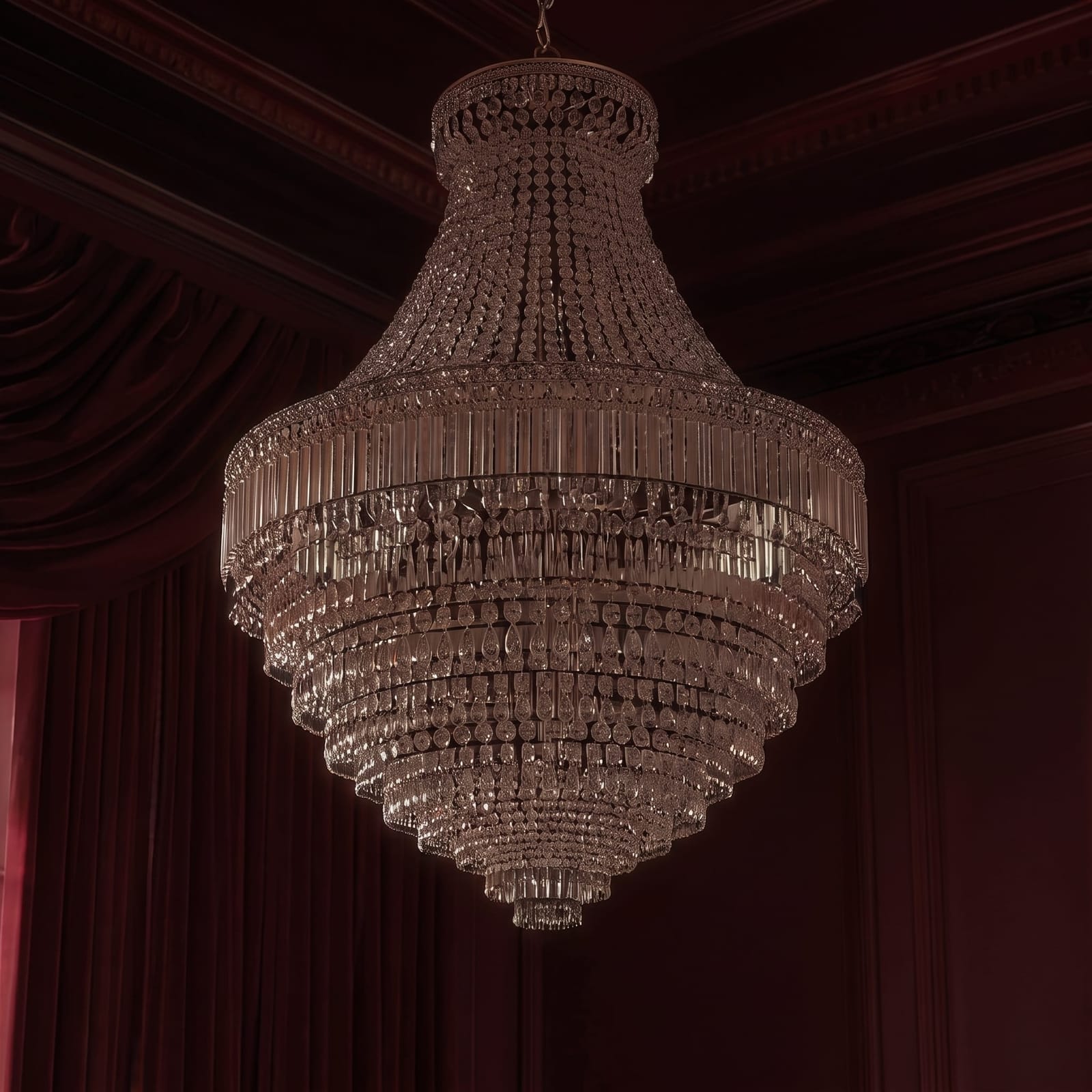
Suspended from the center of the room, the House of Hampton Empire Chandelier serves as the primary visual anchor. The tiered concentric brass bands and cascading crystal drops do more than illuminate the space; they bend and refract light, splitting it into a constellation of tiny points that dance across the dark walls and ceiling. Even during the day, when the bulbs are off, the unlit crystals catch the changing natural light from the windows, bringing a quiet kinetic movement to the upper third of the room. At night, with the seven candelabra bulbs dimmed low, the chandelier transforms the ceiling zone into a shimmering canopy.
The empire silhouette—widening at the middle and tapering to a point at the base—is important because it distributes visual weight vertically. A flat, flush-mount fixture would disappear against a dark ceiling. The chandelier’s hanging depth and tiered profile give it presence, making the ceiling plane feel occupied and intentional rather than forgotten.
At eye level, the lighting becomes more intimate. On the low George Oliver Mid-Century Coffee Table, a staggered grouping of Astoria Grand Vintage Brass Candle Holders introduces the soft, irregular flicker of open flame. The warmth of polished brass catches the candlelight and returns it to the room with a golden glow that no electric source can replicate. Because the candle holders vary in height—some barely six inches, others reaching over a foot—they create a dynamic vertical silhouette that keeps the table surface feeling composed rather than cluttered. Grouping them in an asymmetric cluster, slightly off-center on the table, allows the remaining surface to accommodate a small stack of books or a tray without the arrangement feeling crowded.
The third layer of light is reflective rather than emissive. The KOHLER Essential Rectangle Mirror mounted on the wall does not produce light, but it captures and redistributes it. Positioned to catch the refraction of the chandelier overhead and the flicker of the candlesticks below, the mirror expands the visual depth of the parlor, creating the illusion of a second room hidden within the dark walls. The thin brushed gold frame is deliberately restrained—just a fine metallic line that signals the mirror’s edge without competing with the more elaborate crystal fixture above.
The Weight of Wood: Grounding the Parlor
While velvet, crystal, and brass supply the drama, the parlor lounge requires organic materials to ground it. Without the earthy weight of natural wood, a highly styled room can begin to feel theatrical or cold—all surface and no substance.
The choice of walnut for the coffee table is deliberate. Walnut carries deep, complex grain patterns with reddish-brown undertones that coordinate naturally with burgundy velvet without matching it too closely. Where oak would feel too rustic and mahogany too formal, walnut occupies a middle register: warm, refined, and quietly modern. The clean, rectangular lines of the table provide a geometric counterweight to the soft tufting of the sectional above it and the circular tiers of the chandelier overhead.
By keeping the table low and long, the center of the room remains open, allowing the red Persian rug beneath it to tell its own story through the visible border pattern that frames the table legs. The walnut surface functions as a dark tray, displaying the brass candle holders and whatever objects accumulate over the course of an evening—a glass, a book, a pair of reading glasses—while anchoring the seating group into a single, cohesive conversation circle.
The brass accents on the table’s edges echo the brass of the mirror frame, the gold legs of the sectional, and the warm metal of the candlestick bases. This threading of a single metal tone through multiple objects is what prevents the room from feeling like a collection of unrelated pieces. Brass becomes the connective tissue of the material palette.
The Mirror as Spatial Architecture
A common mistake in dark rooms is treating mirrors as purely decorative. In a parlor lounge, a well-placed mirror is spatial architecture. It does not simply reflect—it constructs a second version of the room that exists only in glass.
The KOHLER Essential mirror, hung horizontally on the wall opposite the windows, performs several functions simultaneously. It captures the afternoon light that enters the room and projects it deeper into the space, reaching corners that direct light would never touch. It reflects the chandelier, doubling the number of visible crystal drops and creating a symmetry between the real fixture and its ghost. And it reflects the occupants of the room back to themselves, a subtle psychological effect that makes the space feel populated and alive even when only one person is sitting on the sectional.
The thin brushed gold frame is important precisely because of what it does not do. A heavy, ornate mirror frame would compete with the chandelier for decorative attention. A frameless mirror would look unfinished against the paneled walls. The slim metal border signals intention—this mirror was chosen and placed, not merely hung—without drawing the eye away from what it contains.
Designing for the Dusk
The formal parlor lounge is a reminder that some of the most successful spaces are those that embrace constraint. By refusing to cater to the daytime hours, this room gains an extraordinary authority when the sun sets.
As the natural light fades and the crystals of the chandelier begin to glow, as the candle flames steady and the brass warms to a deeper gold, the burgundy velvet, dark walnut, and polished metal come together to create a space that feels entirely separated from the outside world. The walls, the sofa, the rug, and the curtains all belong to the same color family, and in low light, their boundaries dissolve. The room becomes not a collection of furniture but a continuous atmosphere—warm, enclosed, and deliberate.
This is a room that does not need to be refreshed. The velvet will soften with age. The walnut will deepen. The brass will develop a quiet patina. The Persian rug, if it is wool, will grow more supple underfoot as the fibers relax over years of use. Every material in this room was chosen because it improves with time, and the room itself is designed to be more beautiful in its fifth year than on the day it was completed.
For anyone drawn to spaces that feel enclosed rather than exposed, warm rather than bright, and built for the slow hours between dinner and sleep, the parlor lounge is not a decorating trend. It is a permanent mode of living.
Sources & Details
Explore the complete source list for this room, from the anchor pieces to the smaller finishing details.
Source note: Some links in this source list may be affiliate links, which means we may earn a commission at no extra cost to you. As an Amazon Associate I earn from qualifying purchases.
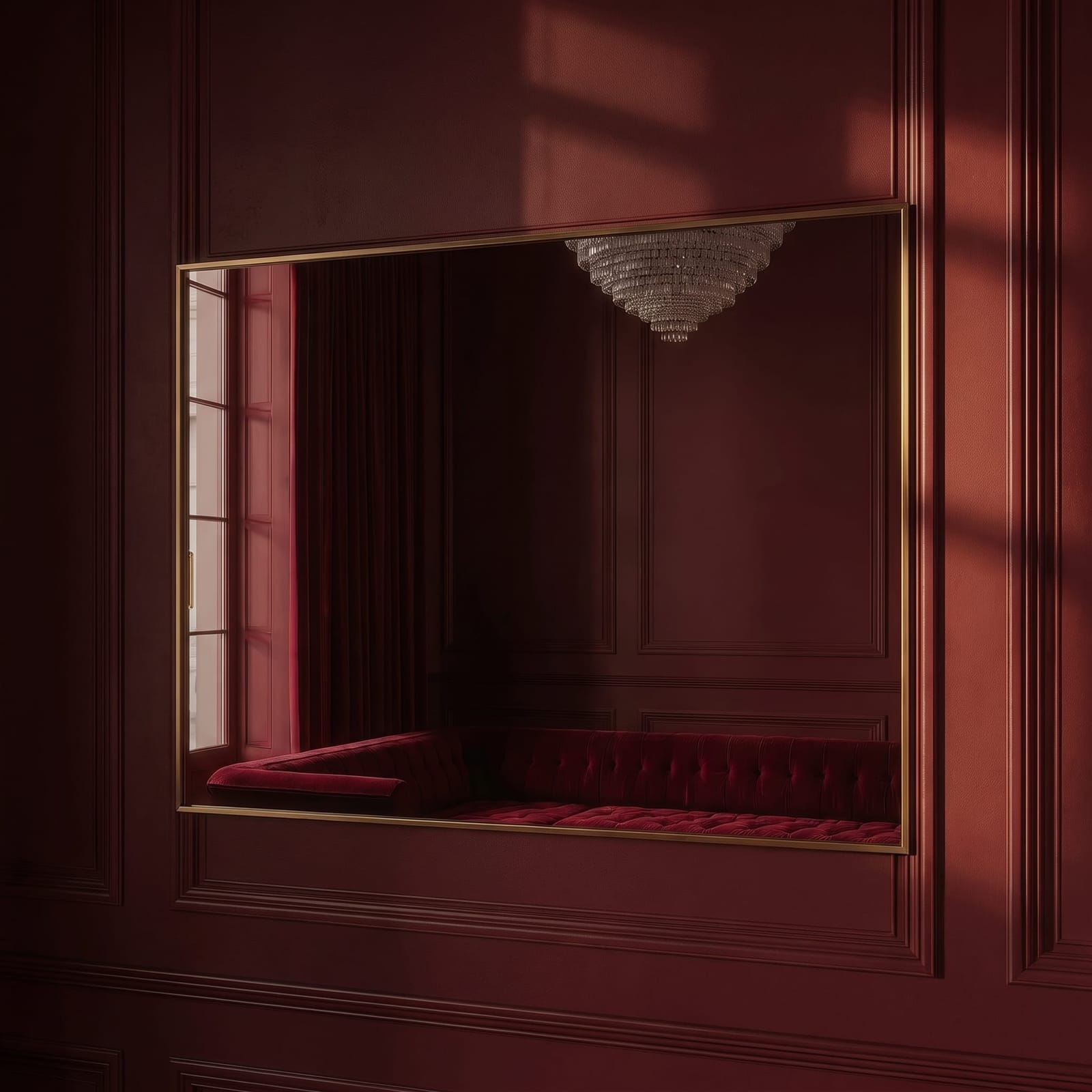
Slim Brushed Gold Rectangular Mirror
22" x 34" rectangular wall mirror in a Moderne Brushed Gold finished metal frame.
A thin brushed gold mirror hangs on the parlor wall, reflecting ambient lighting and expanding the moody space.
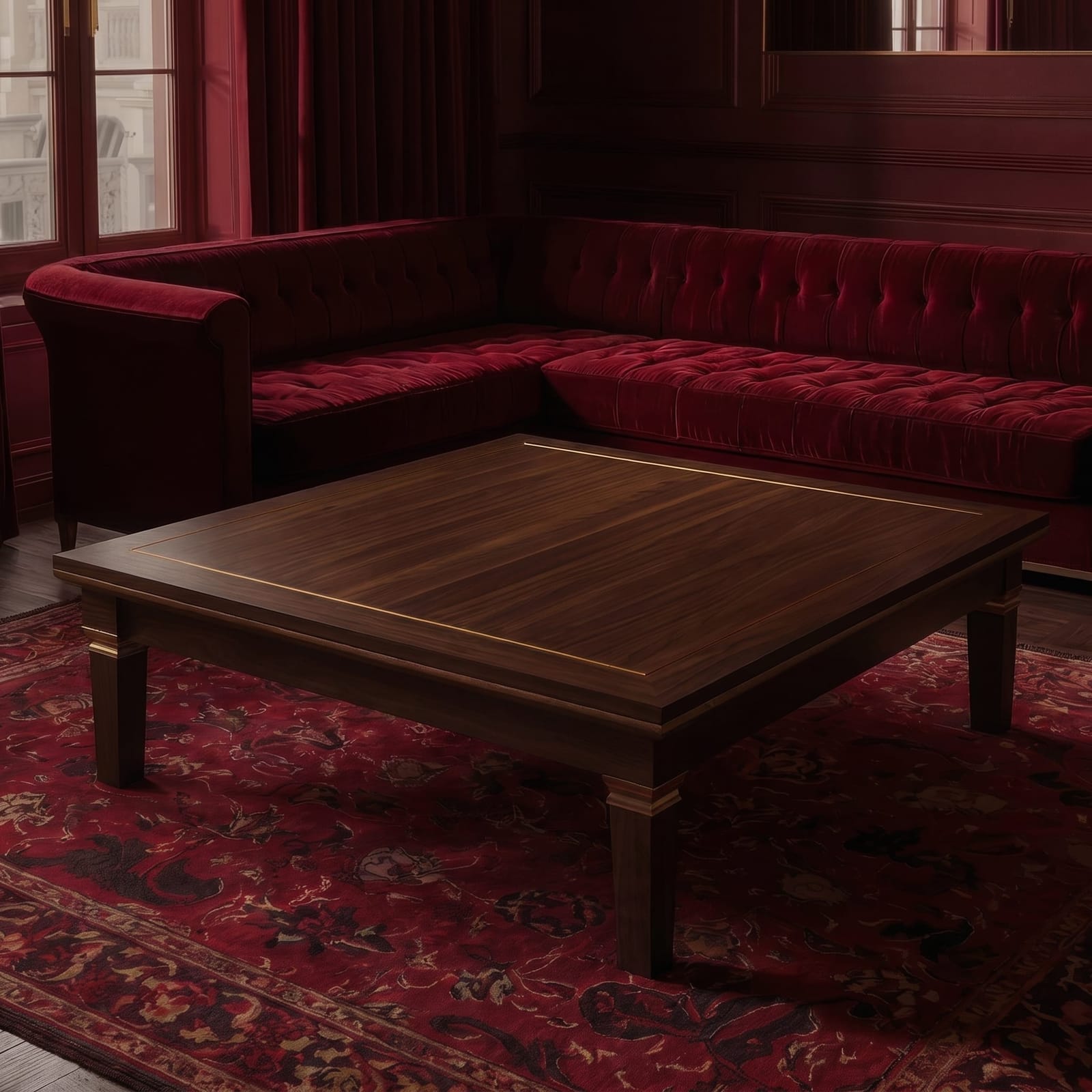
Mid-Century Walnut Coffee Table
Rectangular walnut finish coffee table featuring clean-lined silhouette and brass metal accents.
A low rectangular walnut coffee table provides dark wood grain contrast against the red Persian rug.
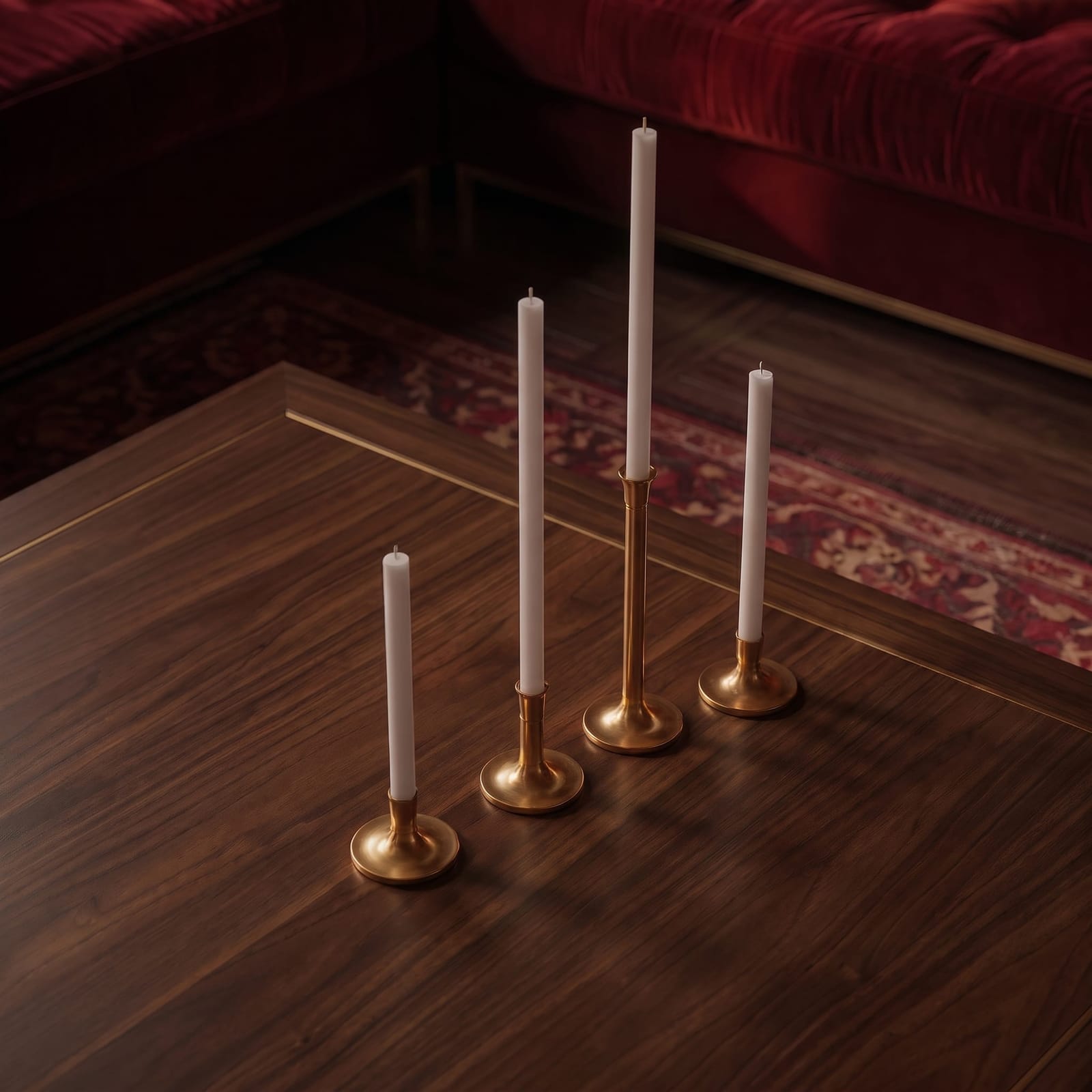
Vintage Solid Brass Candle Holders
Set of 6 Victorian-style solid brass taper candlestick holders of staggered heights.
Varying heights of warm solid brass candlesticks add romantic, flickering candlelight to the parlor scene.
Frequently Asked Questions
How do you coordinate a burgundy velvet sofa without overwhelming the room?
A burgundy velvet sofa is a major architectural statement, not a quiet neutral. The secret to integrating it is color saturation throughout the room rather than isolating it. Against white walls, a wine-red sofa can look starkly disconnected. Painting the walls in a matching, deep jewel tone—like dark plum, charcoal, or deep forest green—absorbs the sofa's visual weight and makes the room feel cozy rather than high-contrast. If dark walls aren't possible, anchor the sofa with a traditional red Persian area rug that repeats the crimson tones while dispersing them across the floor plane, and pull in warm woods like walnut to ground the composition.
What is the best way to clean and maintain a velvet sectional?
Genuine and high-quality velvet sofas are surprisingly durable but require regular, gentle maintenance. Vacuum the sectional weekly using a soft brush attachment to lift dust and prevent fibers from matting down. For spilled liquids, act immediately: blot—never rub—the area with a clean, dry white cloth to absorb moisture. If the velvet pile becomes flattened, use a handheld fabric steamer on a low setting, keeping it a few inches away, and gently brush the fibers against the grain with a soft-bristled brush to restore the loft and nap.
How do you choose a chandelier height for a formal parlor?
For a formal parlor or living room where people stand and walk, the bottom of the crystal tiered chandelier should hang at least 7 feet (84 inches) above the finished floor to allow adequate clearance. If the chandelier is positioned directly over a central coffee table, you can drop it slightly lower to 6.5 feet (78 inches) to create a more intimate lighting zone, provided it doesn't block sightlines across the room. Make sure the fixture's diameter is roughly 1/12th the width of the room (for example, a 24-inch fixture for a 12-foot wide parlor).
Should a parlor mirror be hung vertically or horizontally?
It depends on the height of your ceilings and the wall space. Hanging a brass framed rectangular mirror vertically draws the eye upward, highlighting ceiling height, crown moldings, and pendant lighting like chandeliers. Hanging the mirror horizontally, especially above a console or fireplace mantel, widens the room visually and reflects more of the ambient seating area. In a moody parlor, position the mirror opposite or adjacent to your primary light source to bounce soft candlelight and chandelier reflections throughout the room.
How do you group brass candle holders on a coffee table?
Group candlesticks in odd numbers—groups of three or five work best—and stagger their heights. Staggering the candlesticks creates a dynamic silhouette that prevents the arrangement from looking static or clinical. Position them slightly off-center on your walnut rectangular coffee table, leaving room for books or trays. Keep the candle colors neutral (like cream or white) to let the warm brass and flickering flames command the visual focus.
What paint colors work best with burgundy velvet furniture?
The most successful wall colors for rooms with burgundy velvet furniture fall into two categories. The first is tonal matching: painting the walls in a shade from the same family—deep plum, oxblood, or dark wine—so the sofa blends into the envelope rather than contrasting against it. This creates the immersive, moody parlor effect. The second approach is deep neutrals: charcoal, dark olive, or midnight navy. These colors are dark enough to absorb light alongside the velvet but introduce enough chromatic difference to let the sofa read as a distinct object. Avoid cool whites, pale greys, and pastel tones, which create too much contrast and make the burgundy look heavy rather than rich.
What style of rug pairs best with a burgundy velvet sofa?
A traditional Persian or Kashan rug in deep reds, navy, and cream is the strongest pairing because it distributes the burgundy tone across the floor plane rather than concentrating it on a single piece. The intricate patterns of a hand-knotted or machine-woven Persian rug break up the visual weight of the solid velvet and add a layer of historical texture that reinforces the parlor aesthetic. For a more contemporary approach, a solid dark charcoal or chocolate wool rug works as a neutral ground, letting the sofa command attention without competing pattern. Avoid light-colored or high-contrast geometric rugs, which can make the room feel disjointed.
Is a crystal chandelier too formal for a modern living room?
Not at all—the context determines the formality. A tiered crystal empire chandelier hung in a room with white walls, marble floors, and gilded furniture reads as formal and traditional. The same chandelier hung in a room with dark painted walls, a velvet sectional, and warm wood reads as moody and atmospheric. The crystals serve a functional purpose beyond decoration: they refract and scatter light in a way that no other fixture material can replicate, creating ambient sparkle that softens the darkness of a moody room without introducing harsh direct light. In a modern context, the chandelier becomes a textural element rather than a status symbol.