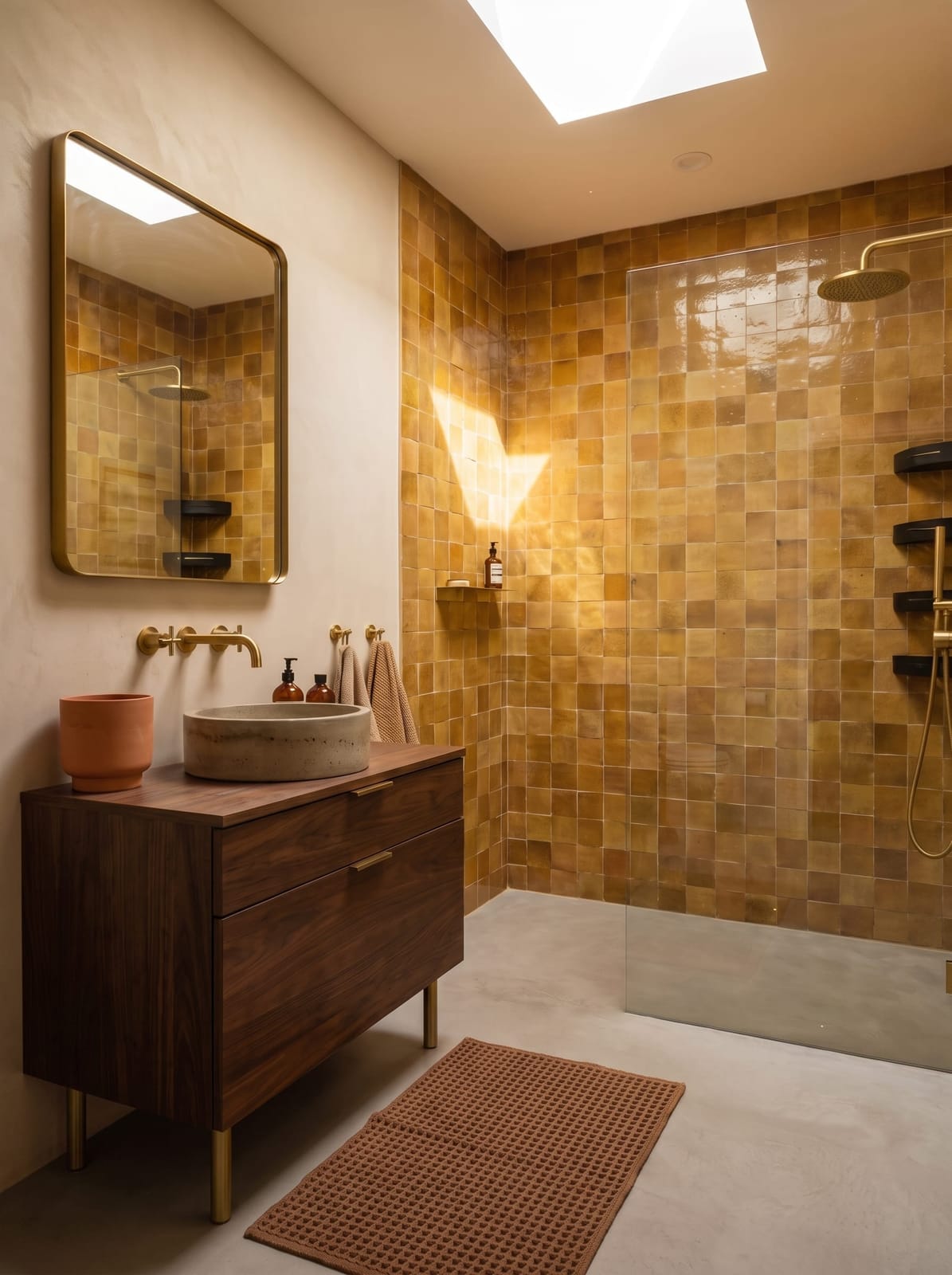
There is a particular quality to golden light falling on golden tile. It is not reflection in the ordinary sense — not a bounce, not a glare. It is closer to absorption and re-emission, the way a surface takes light in and sends it back changed, warmer, softer, slightly thicker than when it arrived. That is what happens in this bathroom. The zellige tiles that cover the vanity wall are glazed in a deep ochre — not quite yellow, not quite amber, somewhere in the territory between saffron and raw honey — and under the skylight at midday, the wall does not just catch the light. It holds it. The room fills with a warm, diffused glow that has no single source, no hard edge, no glare. It simply arrives, and stays.
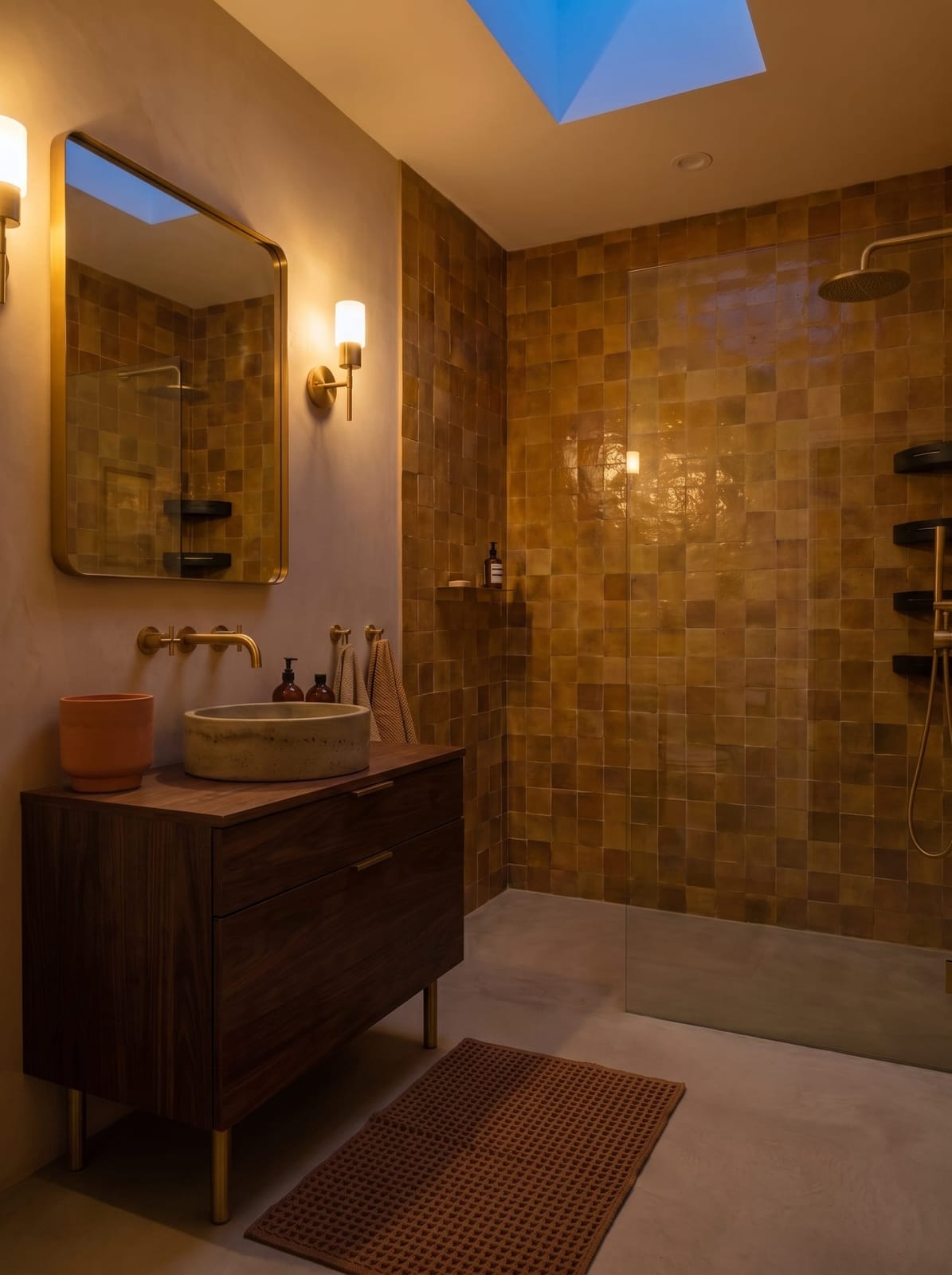
This is a bathroom designed around the behavior of handmade materials under changing light. The zellige tiles shift from pale gold to deep burnt amber between morning and evening. The walnut vanity darkens and deepens as the overhead light moves to side light. The concrete vessel sink, matte and still under the brightest conditions, begins to show its subtle surface texture only when the sconces take over at dusk. Nothing in this room looks the same at two different hours. And that slow visual drift — that refusal to settle into a fixed appearance — is the quality that separates a room built from handmade materials from one built from engineered ones.
The Zellige Wall and Its Light
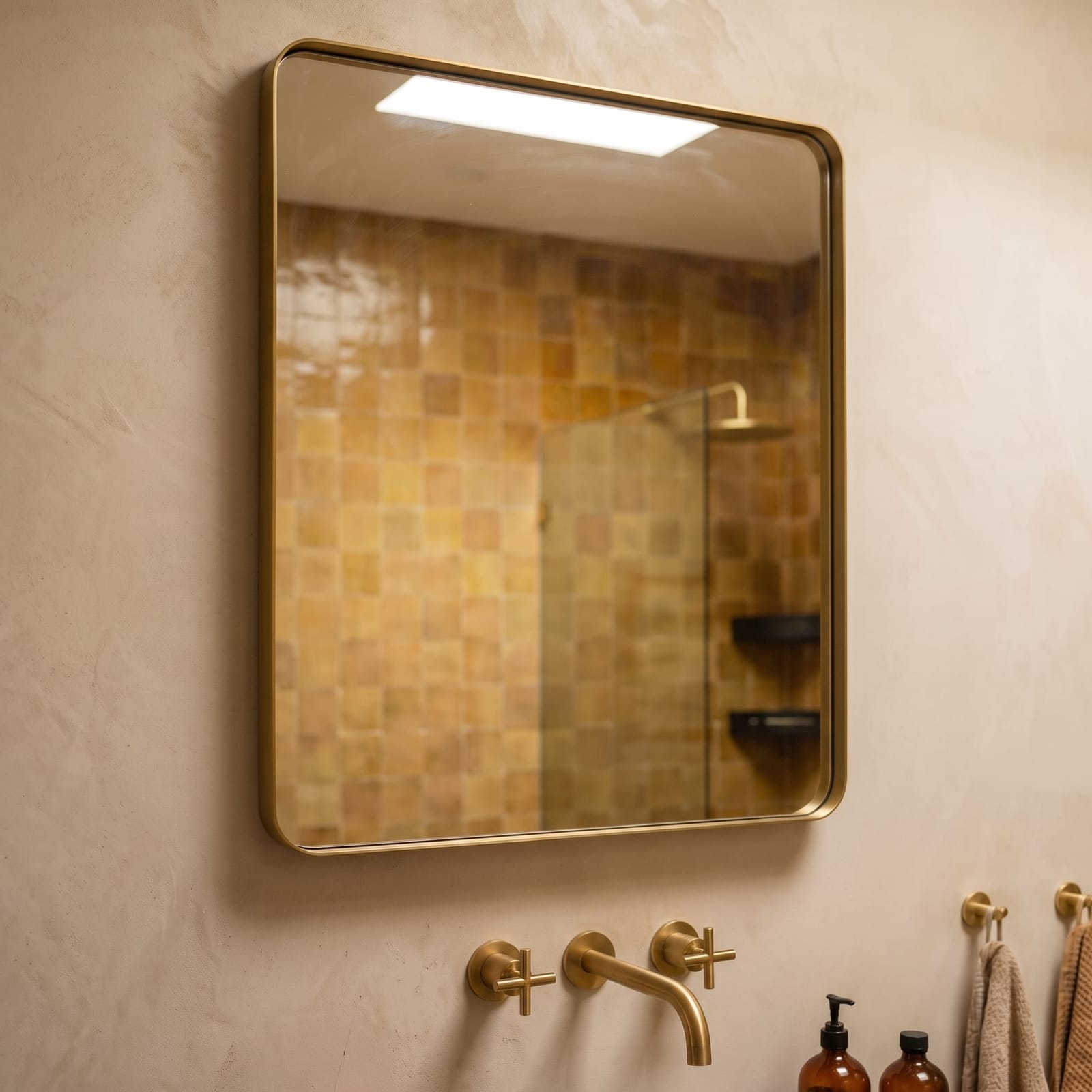
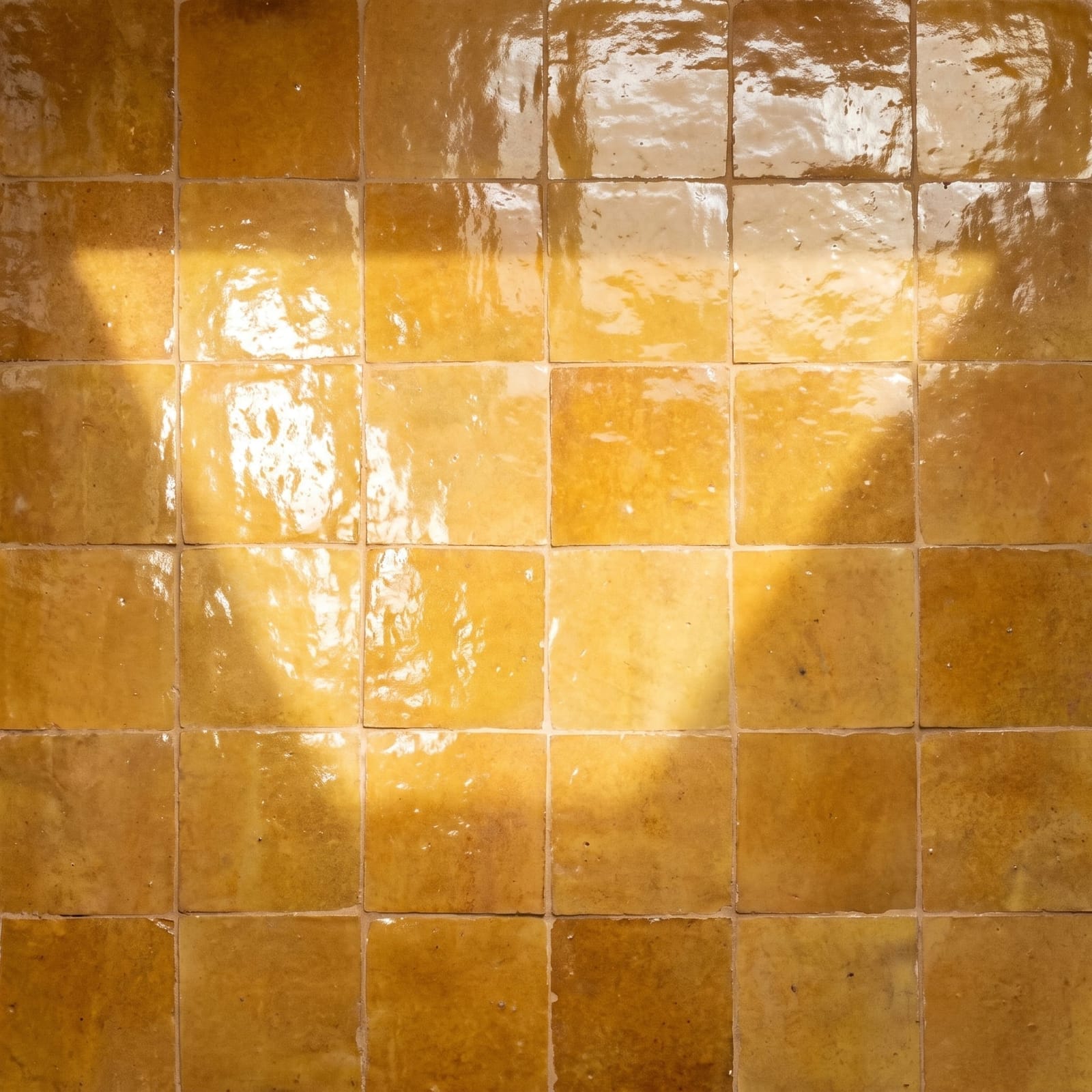
The feature wall behind the vanity is covered, floor to ceiling, in 4×4-inch Moroccan zellige tiles glazed in a goldenrod ochre. Each tile was hand-molded from raw clay, dipped in a mineral glaze, fired in a wood-fueled kiln, and chiseled to size by hand. No two tiles share exactly the same color, thickness, or edge profile. The glaze pooled thicker in some centers, creating small islands of deeper amber. It ran thinner at some edges, revealing the raw terracotta body beneath. In places, the glaze crackled during cooling, leaving a fine web of hairline fractures called crazing that will darken gradually over years of use, recording the passage of time directly into the surface.
This irregularity is not an accident. It is the product of a manufacturing process that has remained essentially unchanged in Morocco since the tenth century, and it produces a surface quality that no factory tile can replicate. When light hits a machine-made tile, it bounces cleanly off a flat, uniform plane. When light hits zellige, it scatters. The undulating surface sends reflections in slightly different directions from each tile face, creating a shimmering, almost liquid effect across the full wall. Under the skylight at noon, the wall appears bright and alive, shifting between pale saffron and warm honey as you move across the room. Under the wall sconces at dusk, the same surface deepens to burnt amber and dark gold, and the shadows between tiles become visible as a subtle grid of dark lines tracing the hand-cut edges.
The tiles are set with thin grout joints in a warm sand tone that nearly disappears into the tile edges. This is deliberate. Wide, contrasting grout lines would impose a geometric grid over the organic irregularity of the glaze, turning a shimmering surface into a mosaic of framed squares. The narrow, color-matched joints allow the eye to read the wall as a continuous, breathing skin rather than a collection of individual pieces.
The Vanity as Anchor
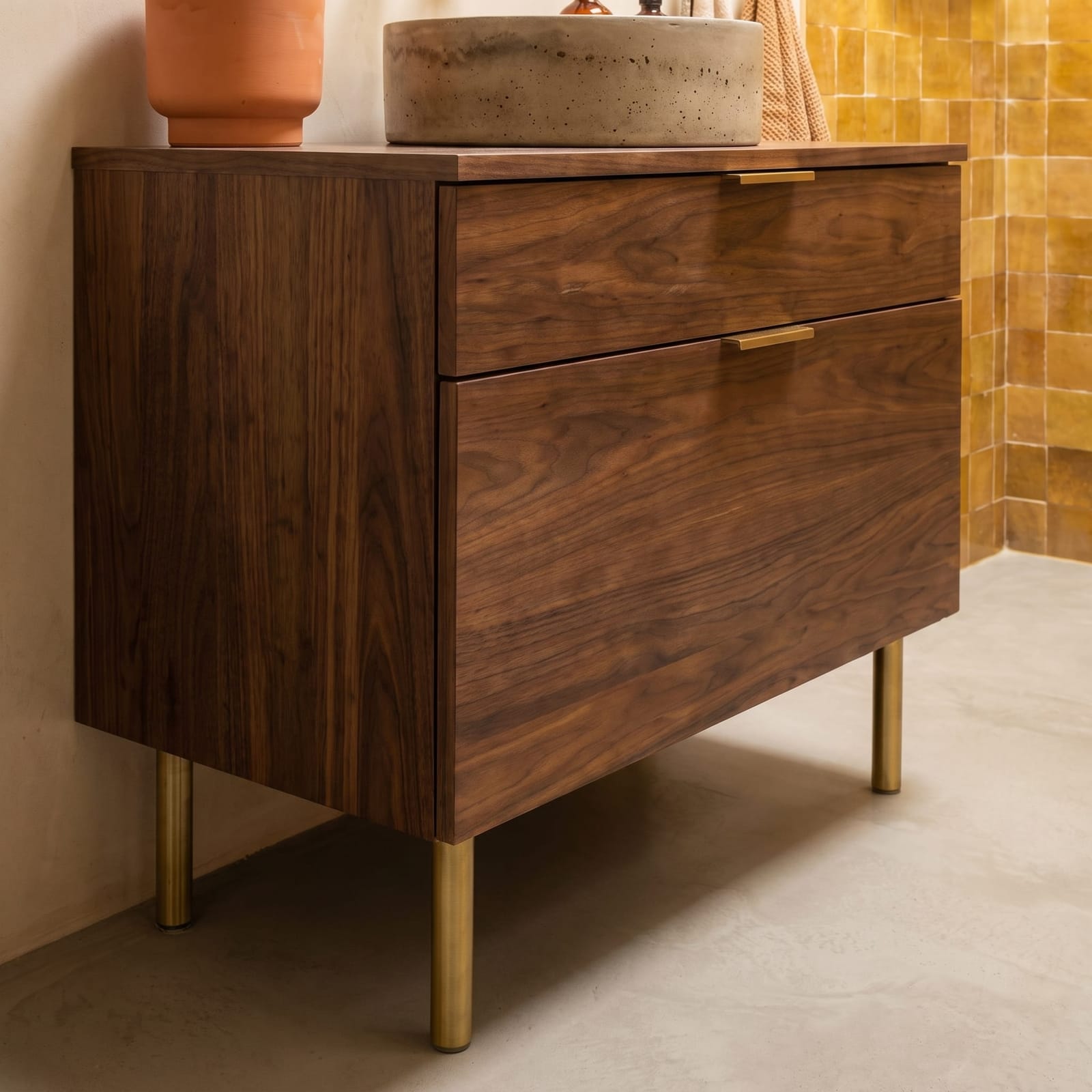
Against this luminous backdrop, the floating walnut vanity provides the room’s gravitational center. Wall-mounted at hip height with no legs touching the floor, the cabinet creates a band of open space between the vanity bottom and the concrete floor — a visual gap that makes the room feel larger than its footprint and allows the zellige tile to continue uninterrupted below the cabinet.
The walnut itself is a study in quiet depth. The grain runs horizontally across two wide drawer fronts, the cathedral patterns of the heartwood creating subtle, organic arcs that echo the gentle curves of the mirror above and the vessel sink below. The wood is finished in a clear matte sealant that protects without glossing — no lacquer shine, no orange peel, just the natural surface of the walnut rendered durable. Under daylight, the wood reads as a warm, medium brown with amber undertones. Under evening light, the same surface shifts toward deep chocolate, and the grain contrast between heartwood and sapwood becomes more pronounced.
The choice of walnut rather than oak, teak, or any lighter timber is not arbitrary. Walnut sits in the exact middle of the tonal range between the bright golden zellige above and the neutral concrete floor below. It is dark enough to anchor the composition — to give the eye a resting place between the active shimmer of the tiles and the matte stillness of the floor — but warm enough to belong to the same color family. A light wood would have created a jarring tonal break. A very dark wood — wenge, ebony — would have created a heavy band that blocked the visual flow from tile to floor. Walnut threads the needle.
Concrete at Rest
On the vanity deck sits a round vessel sink formed from handmade concrete in a soft ash grey finish. The sink is the quietest object in the room. While the zellige shimmers and the walnut grain moves, the concrete simply sits — still, smooth, slightly cool to the touch, utterly unreflective. Its color is a quiet, light grey with the cool mineral quality of raw ash stone, close to the tone of natural limestone but without the veining or fossil inclusions. The rim is perfectly round, rising about four inches above the vanity surface, and the interior curves to a flat drain opening at the center.
The material itself matters. Concrete is heavy. A concrete basin has the permanence of stone. It does not move when you lean on the rim. It does not ring when you set a glass on the edge. It absorbs sound rather than amplifying it, and that dampening quality — that sense of mass and stillness — gives the vanity area a gravity that lighter materials cannot provide.
The matte finish is the critical detail. In a room where the zellige tiles already supply abundant visual energy through their glossy, light-catching glaze, a shiny sink would have created competition — two reflective surfaces fighting for attention in the same visual field. The matte concrete defers. It accepts light without sending it back, creating a zone of calm on the counter that lets the tile wall remain the room’s undisputed focal point.
Brass Between the Surfaces
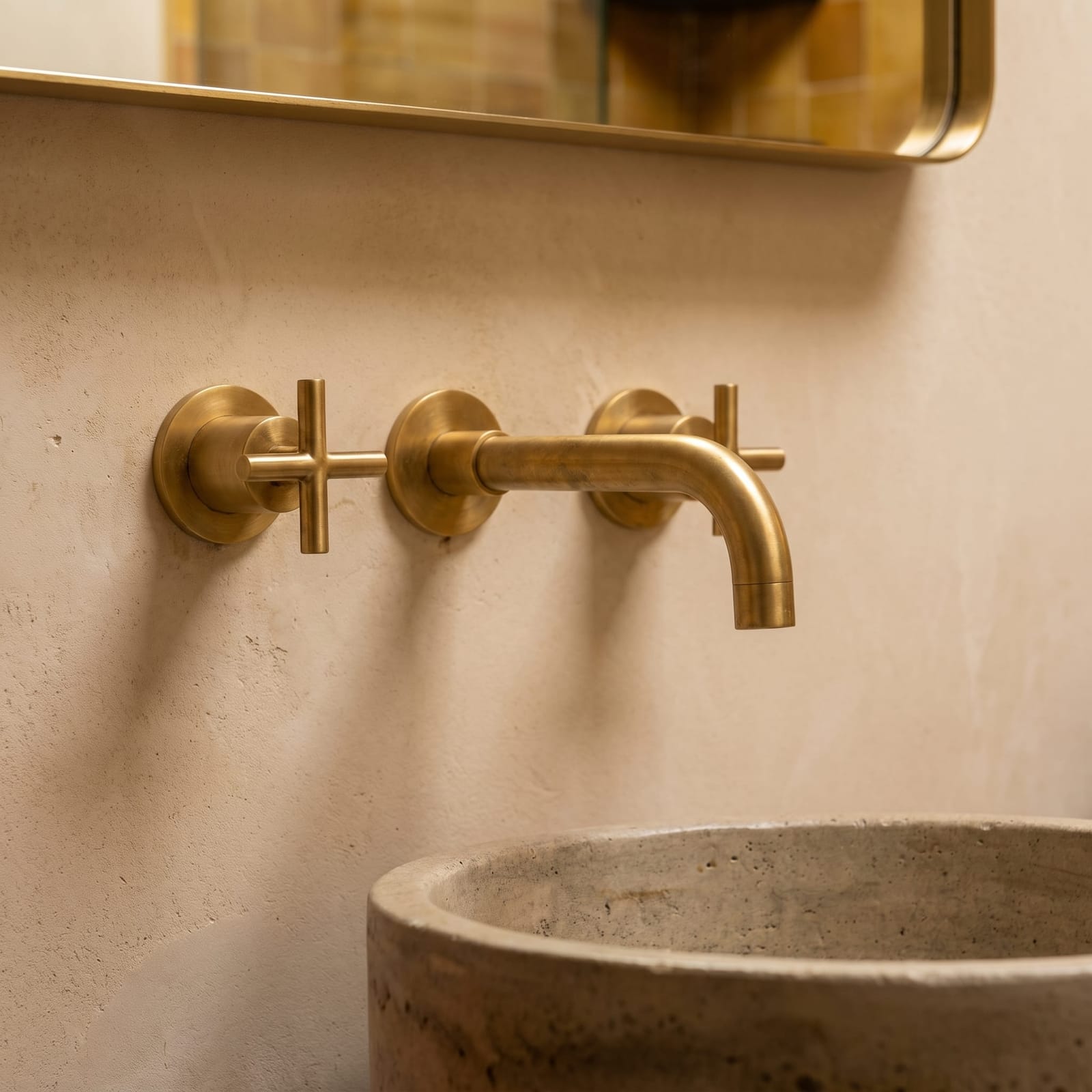
The wall-mounted faucet emerges from the zellige tiles above the sink: two cross handles flanking a curved spout, all finished in brushed gold. The faucet is small relative to the tile wall behind it, but it plays a critical role in the room’s material hierarchy. It is the only metallic surface in the composition, and its warm gold tone creates a visual bridge between the bright ochre of the zellige glaze and the dark amber of the walnut grain.
Wall-mounting the faucet — rather than installing a deck-mounted unit through the vanity top — was essential to the design. A deck faucet would have punctured the clean plane of the walnut counter, introducing hardware holes, an escutcheon plate, and supply connections into the narrow space between the sink rim and the tile wall. By routing the plumbing through the wall, the counter remains entirely clear: just the walnut surface and the concrete bowl, uninterrupted. The faucet becomes part of the tiled wall rather than part of the vanity, and the distinction between horizontal and vertical surfaces stays clean.
Above the faucet, centered over the sink, a brass-framed mirror with softly rounded corners reflects the zellige wall behind the viewer, doubling the perceived depth of the tile surface. The frame is thin — perhaps a centimeter of brushed brass — and its warm tone matches the faucet below, creating a quiet vertical axis of gold that organizes the wall from mirror to faucet to sink. This axis is the spine of the composition. Everything in the room aligns to it or defers to it.
The Floor and Its Softness
Below the floating vanity, the floor is smooth concrete, sealed to a matte finish that coordinates with the vessel sink above. The monolithic floor surface creates a sense of continuity — the same material language in two different applications, one horizontal, one curved — that ties the room together at its base.
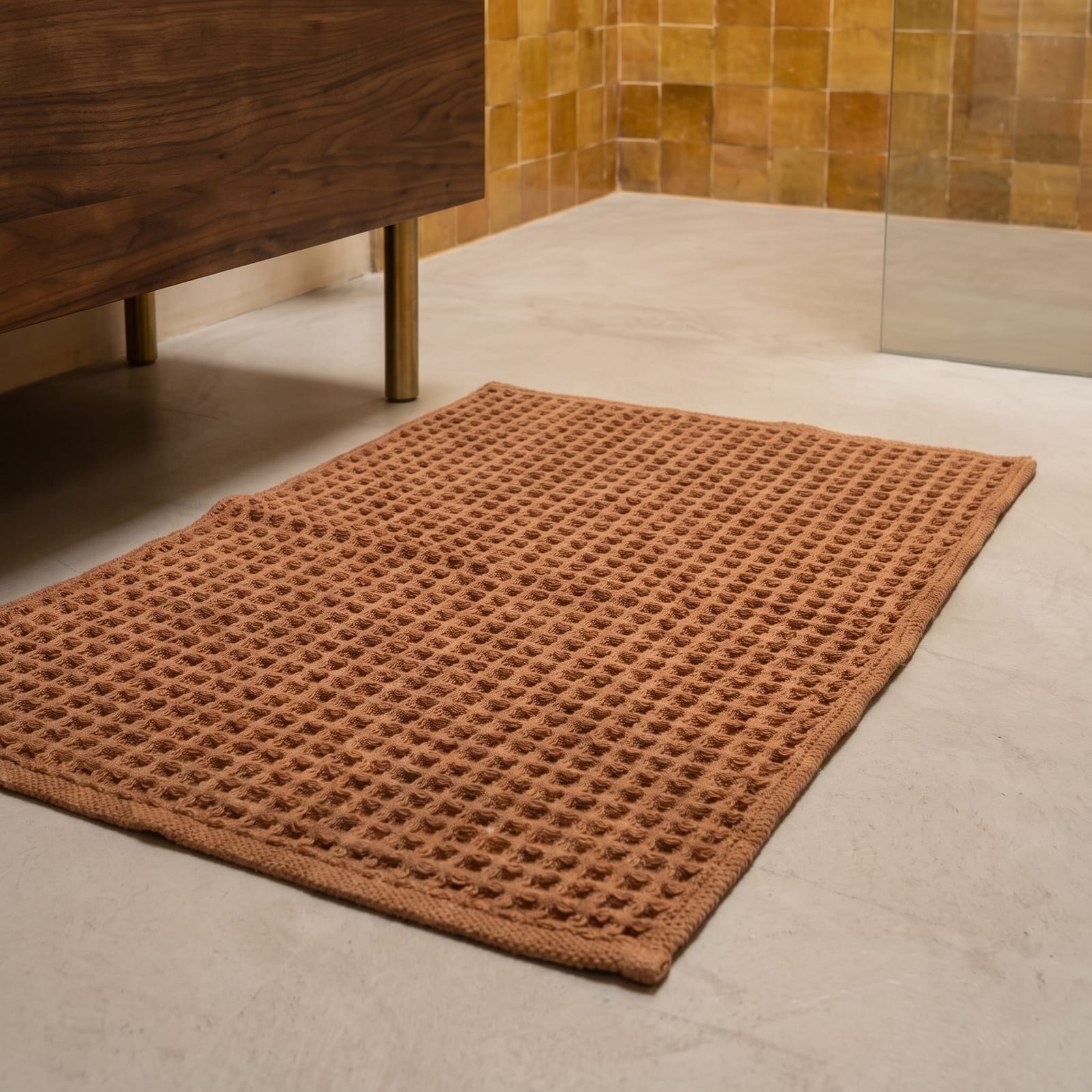
Stepping out of the shower or bath, your feet meet a warm brown loop-textured cotton bath mat. The dimensional woven loops create a dense, tactile texture that absorbs water rapidly and dries quickly. But the mat is not here only for function. It is here for texture. In a room where every other surface is rigid — tile, wood, concrete, brass — the bath mat is the single piece of soft, pliable material. It introduces the yielding quality that the room needs to feel inhabitable rather than sculptural.
The warm brown color of the mat was chosen to connect the floor plane to the warm palette above. It sits between the golden ochre of the zellige tiles and the dark chocolate of the walnut vanity, pulling the color story down from the walls to the ground. Without it, the neutral concrete floor would feel detached from the warmth above — a cool, gray foundation under a warm room. The mat closes that gap. It brings warmth underfoot, where you feel it most directly.
How the Room Changes
The most revealing test of a material-driven bathroom is what happens when the light shifts. Under the skylight at midday, this room is bright, golden, almost radiant — the zellige tiles flash with wet highlights, the walnut grain reads clearly, the concrete sink casts a small, sharp shadow on the counter. The mood is alert, clean, mineral.
At dusk, when the overhead skylight dims and the wall sconces take over, the same room becomes something else entirely. The zellige tiles deepen to burnt amber and dark honey. The walnut vanity darkens to near-espresso, its grain almost invisible in the warm side light. The concrete sink, now lit from the sides rather than above, reveals a subtle surface texture — tiny air pockets, faint trowel marks — that was invisible under direct light. The brass faucet and mirror frame catch the sconce light and glow, becoming the brightest objects in the room.
This transformation is not decorative. It is structural. It means the bathroom does not have one character but two — a daytime version and an evening version — and the transition between them is continuous, gradual, and entirely controlled by the natural behavior of the materials under changing light. No dimmer switch, no color-changing LED, no programmatic intervention. Just clay, wood, concrete, and brass, responding to the sun.
Sources & Details
Explore the complete source list for this room, from the anchor pieces to the smaller finishing details.
Source note: Some links in this source list may be affiliate links, which means we may earn a commission at no extra cost to you. As an Amazon Associate I earn from qualifying purchases.
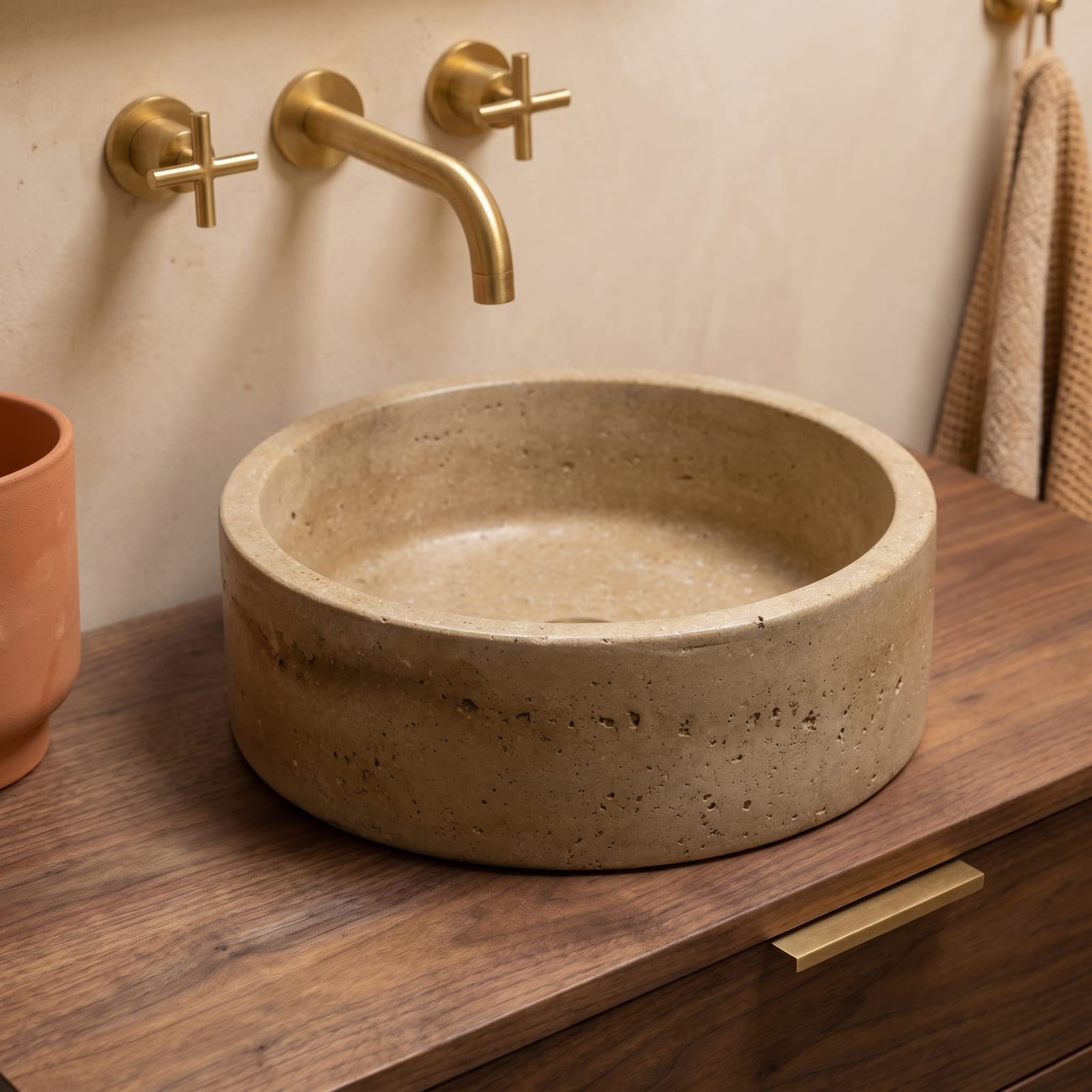
Concrete Vessel Sink
15-inch circular handmade vessel sink crafted from light grey concrete in an ash finish.
A sandy matte concrete sink adds low-profile mineral weight and curves to the flat vanity top.
Goldenrod Glazed Zellige Tile
4x4-inch handmade glazed ceramic zellige tiles with rich color variegation in a Goldenrod yellow tone.
Authentic ochre-yellow glazed Moroccan clay tiles frame the vanity with a shimmery, handmade texture.
Warm Brown Waffle Bath Mat
21x34-inch textured weave cotton bath rug in warm brown terracotta, Casaluna collection.
A honeycomb waffle bath rug in deep terracotta orange coordinates with the warm wood and tile accents.
Frequently Asked Questions
Why pair golden zellige tiles with a walnut vanity?
Glazed ochre zellige tiles produce a luminous, shimmering surface that actively bounces light around the room. That energy needs a counterweight. Walnut wood, with its deep chocolate-brown grain and substantial visual density, absorbs and anchors the reflective shimmer of the tile wall without competing with it. The amber undertones inside walnut grain are close relatives of the golden-yellow glaze, so the two materials read as members of the same warm family rather than contrasting elements. The result is a bathroom that feels simultaneously bright and grounded — the tiles provide the glow, and the wood provides the gravity.
How do you style a concrete vessel sink on a wood vanity?
A matte concrete vessel sink works on a walnut vanity because it introduces a third texture — raw mineral — between the glossy zellige tiles behind and the warm timber surface below. Place the sink slightly off-center if possible, leaving enough countertop visible for a soap dish or small stoneware tray. Keeping the faucet wall-mounted rather than deck-mounted is essential: it frees the countertop entirely, allowing the concrete bowl to sit as a clean sculptural object rather than competing with hardware for visual attention. The ash grey tone of the concrete creates a quiet bridge between the golden tiles and the dark walnut, softening the transition.
What is the best way to maintain a concrete vessel sink?
Modern composite concrete sinks arrive pre-sealed with a penetrating water-resistant coating that prevents moisture absorption, staining, and mineral buildup. For daily cleaning, use mild soap, warm water, and a soft microfiber cloth. Avoid acidic cleaners like vinegar or citrus-based sprays, which can etch the sealer over time. Every six to twelve months, apply a thin coat of food-safe concrete wax or impregnating stone sealer to refresh the protective barrier. If hard-water deposits appear, a paste of baking soda and water applied with a soft brush will lift them without damaging the matte finish.
Does a wall-mounted faucet work with a floating vanity?
Yes, wall-mounted faucets align beautifully with floating vanities because they continue the minimal, airborne theme of the room. By routing plumbing lines directly through the wall substrate rather than the cabinet deck, the vanity countertop remains completely flat and clean. This accentuates the space-saving look of a floating vanity and makes wipe-downs effortless.
How does a textured bath mat contribute to the room's design?
In a bathroom dominated by hard, smooth surfaces — glazed tile, polished concrete floor, sealed walnut veneer — a textured loop-weave bath mat introduces the one texture the room cannot generate on its own: soft, dimensional fabric. The raised texture of the weave creates a tactile underfoot surface that absorbs water rapidly and dries quickly. Choosing a warm brown terracotta shade for the mat bridges the color gap between the golden zellige wall and the dark walnut vanity, pulling the warm palette down to floor level without introducing a rug that competes with the mineral surfaces above it.
What grout color works best with golden zellige tiles?
For golden or ochre zellige tiles, a grout in the warm sand or pale honey family produces the most cohesive result. The goal is to let the natural glaze variation of the handmade tiles dominate the visual field rather than overlaying a grid of contrasting grout lines. White grout creates a high-contrast lattice that draws attention to the joints rather than the glaze. Dark charcoal grout can work in small accent areas but risks making a full wall feel heavy. A warm neutral grout — slightly lighter than the darkest tile tone — disappears into the edges and allows the zellige surface to read as a continuous, shimmering skin rather than a mosaic of individual squares.
Can you use zellige tiles in a wet shower zone?
Yes. Zellige tiles are fired clay with a glass-based glaze, making them inherently waterproof on the face surface. They have been used in Moroccan hammams — the wettest possible environment — for centuries. For shower installations, the critical factor is not the tile itself but the substrate and waterproofing membrane behind it. Use a cement board or foam backer with a liquid-applied or sheet waterproofing membrane, and set the tiles with a polymer-modified thinset mortar. The grout joints should be sealed with a penetrating grout sealer after curing. With proper substrate preparation, glazed zellige tiles will perform reliably in a daily-use shower for decades.