There is a category of kitchen that professional designers call the alcove—a compact culinary space carved from a larger room, defined not by four walls and a door but by a change in ceiling height, a peninsula return, or simply the depth of the cabinetry itself. The alcove kitchen does not try to be a showroom. It tries to be a workshop: tight, warm, well-lit, and organized around the arm’s reach of the person standing at the counter.
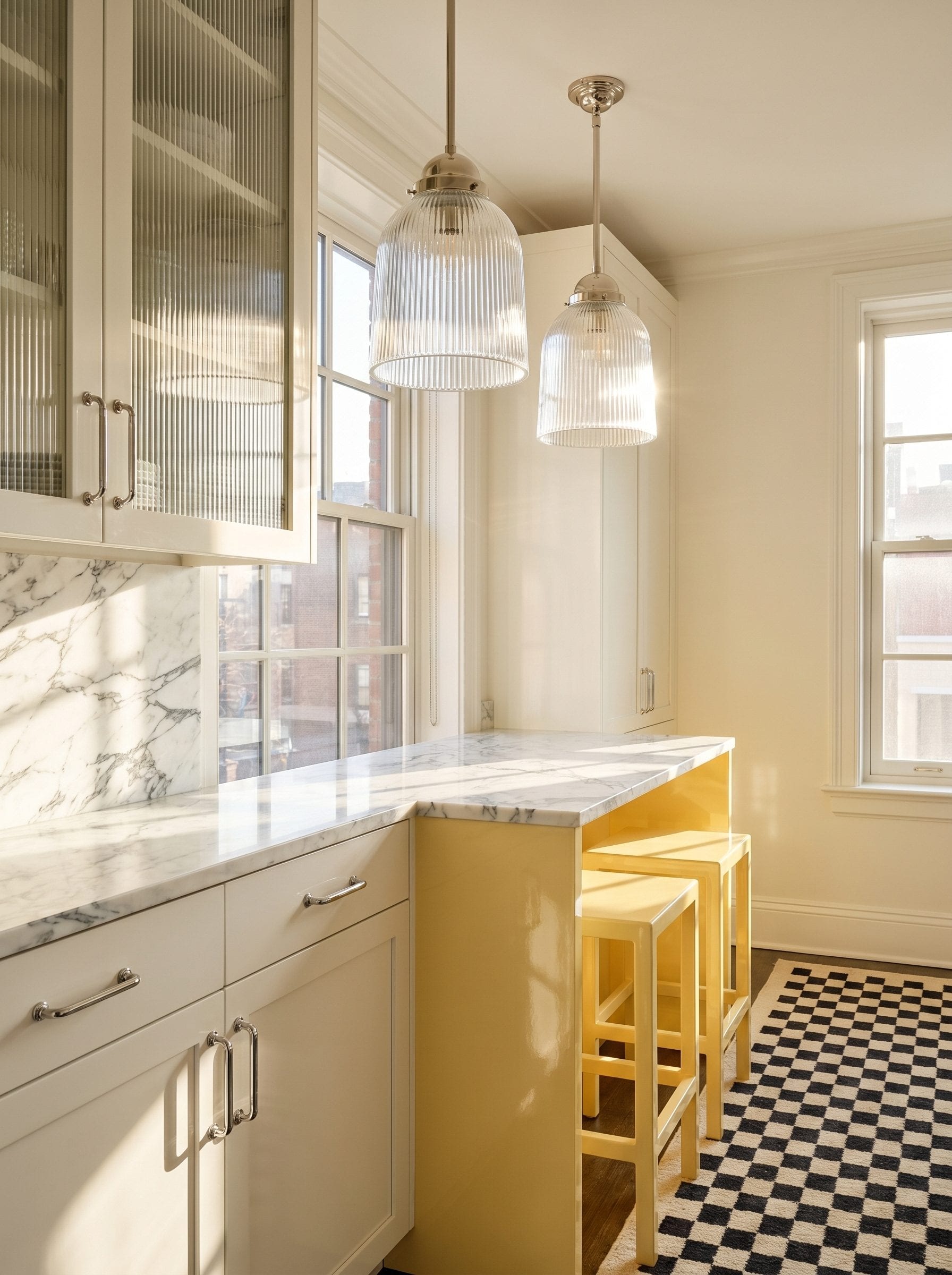
The butter yellow marble kitchen belongs to this tradition. Here, a compact run of shaker-style cabinetry has been finished in a soft, desaturated butter yellow—the color of heavy cream poured into morning sunlight—and fitted with polished white marble surfaces, reeded glass upper cabinet doors, and straight polished nickel bar pulls that catch every shift in the room’s light. A ribbed glass pendant hangs overhead. A black and cream checkered runner anchors the floor. A pair of yellow backless stools tuck beneath the peninsula, their rounded forms echoing the warmth of the cabinetry behind them. The space is perhaps eight feet deep and twelve feet wide, and it contains everything a kitchen needs to contain: heat, storage, surface, and light.
Why Butter Yellow Works in a Kitchen Alcove
Yellow is the most misunderstood color in residential design. Bright yellows—sunflower, canary, marigold—command enormous visual energy. They vibrate. They compete with every other surface in the room. In a large, open kitchen with high ceilings and abundant natural light, a saturated yellow can work as a joyful accent wall or a single painted island. In a compact alcove, it overwhelms.
Butter yellow solves this by refusing to be loud. The hue is desaturated almost to the point of neutrality—pushed far enough toward cream that it reads as warm rather than colored. On a paint chip, butter yellow might look timid. On a full run of floor-to-ceiling cabinetry, it transforms. The desaturation allows the color to act as a warm envelope rather than a focal point: the walls glow softly rather than shout, and every other material in the room—stone, glass, metal, textile—registers more clearly against the quiet golden field.
In a compact kitchen, this warmth is essential. Cool-toned kitchens in small footprints tend to feel clinical. White cabinets under overhead lighting in a tight space produce a bright, flat, almost institutional atmosphere—the room reads as clean but uninhabited. Butter yellow introduces the visual equivalent of a warm lamp left on in an empty room: the space feels occupied, cared for, and ready to be used, even before anyone stands at the counter. The cream undertone prevents the yellow from reading as retro or juvenile, which is the risk with any yellow that strays too close to the nineteen-seventies harvest-gold palette. This is not a nostalgic color. It is a tinted neutral that happens to carry warmth.
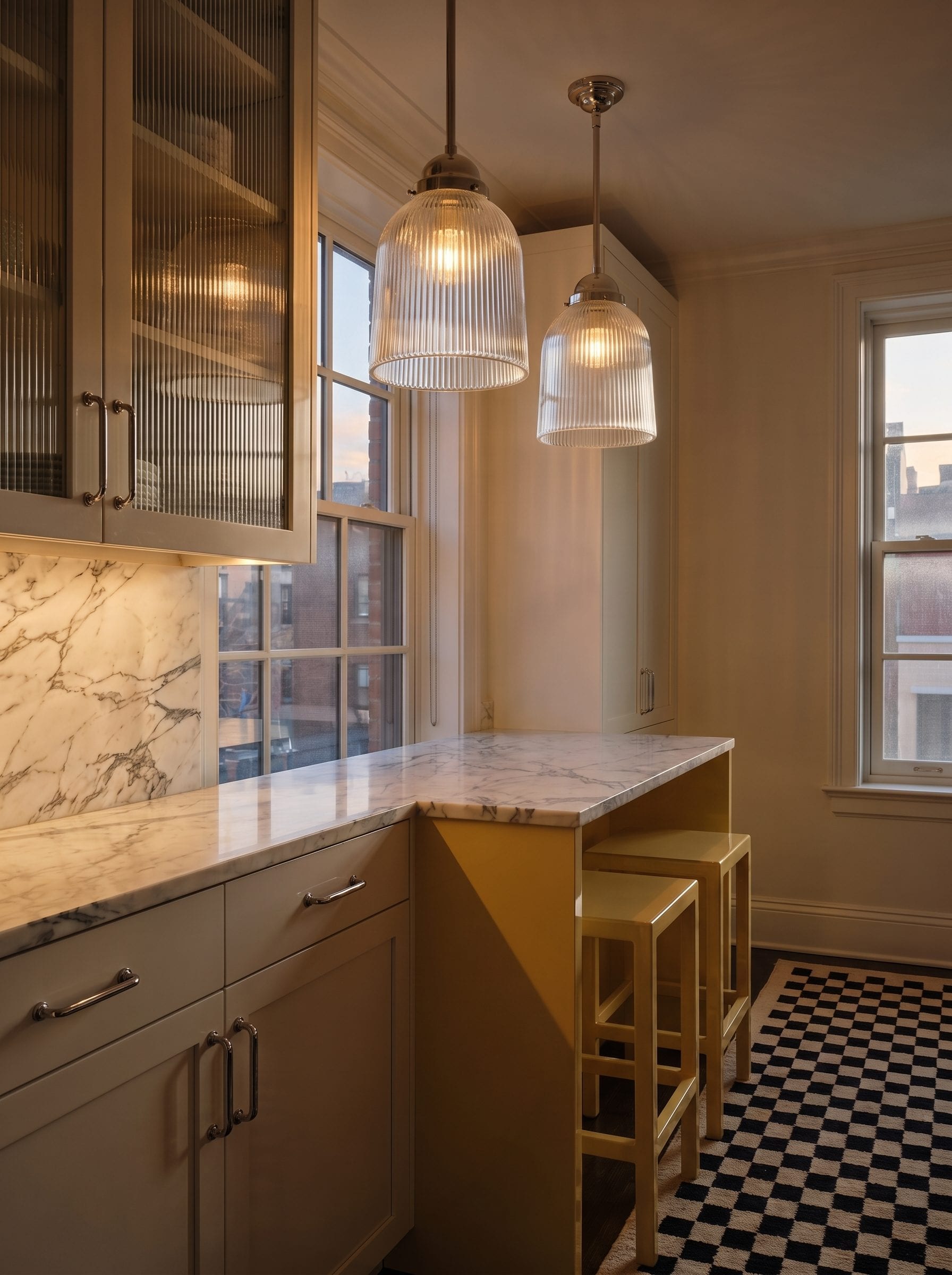
The practical advantage of butter yellow in a kitchen alcove is its behavior under changing light. During morning hours, when natural light enters at a low, warm angle, the cabinetry amplifies the golden cast—the entire alcove reads as sun-washed, even on overcast days. At midday, under the flat, blue-white wash of overhead fixtures, the cream undertone predominates and the cabinets settle into a quieter, almost ivory register. At dusk, under the amber glow of a pendant light, the yellow deepens to something approaching light caramel—warm, saturated, and enveloping. The color moves through three distinct moods in a single day, which is exactly the kind of dynamism that makes a small space feel rich rather than repetitive.
Pairing Butter Yellow with Cream Cabinetry
The butter yellow kitchen does not use a single shade. The lower cabinets, upper frames, and peninsula face are all finished in the same warm yellow, but the room’s visual palette extends into cream, ivory, and warm white through the stone surfaces and ceiling. This tonal layering—yellow into cream into white—creates a vertical gradient that lifts the eye upward and prevents the compact alcove from feeling monochromatic.
The shaker-style cabinet doors provide the structural language. The flat center panel and raised stile-and-rail frame introduce a clean, repeating rectangle across every surface—a grid of shadow lines that gives the cabinetry architectural rhythm without ornamentation. The butter yellow finish sits on these shaker panels as a quiet lacquer, smooth enough to reflect ambient light in a soft, diffused sheen rather than a sharp gloss. The surface is not mirror-flat—it has just enough texture to read as painted rather than laminated, which gives the cabinetry an honest, handmade quality that sits well in the English cottage tradition.
Below the countertop, the cabinetry is dense: drawers stacked in graduated sizes, a bank of doors concealing deep storage, and a peninsula return that provides additional counter space on the room side. This is a kitchen designed for serious use, not for display, and the tight packing of functional storage into the lower cabinets is what allows the upper portion of the room to remain visually open. Every pot, pan, and appliance that can be stored behind a closed door reduces the clutter competing with the warm, quiet palette above.
Seating at the Alcove: The Counter Stool
In a compact alcove, backless counter stools in a pale tonal finish provide functional seating while echoing the warm, desaturated yellow cabinetry and grounding the workspace.
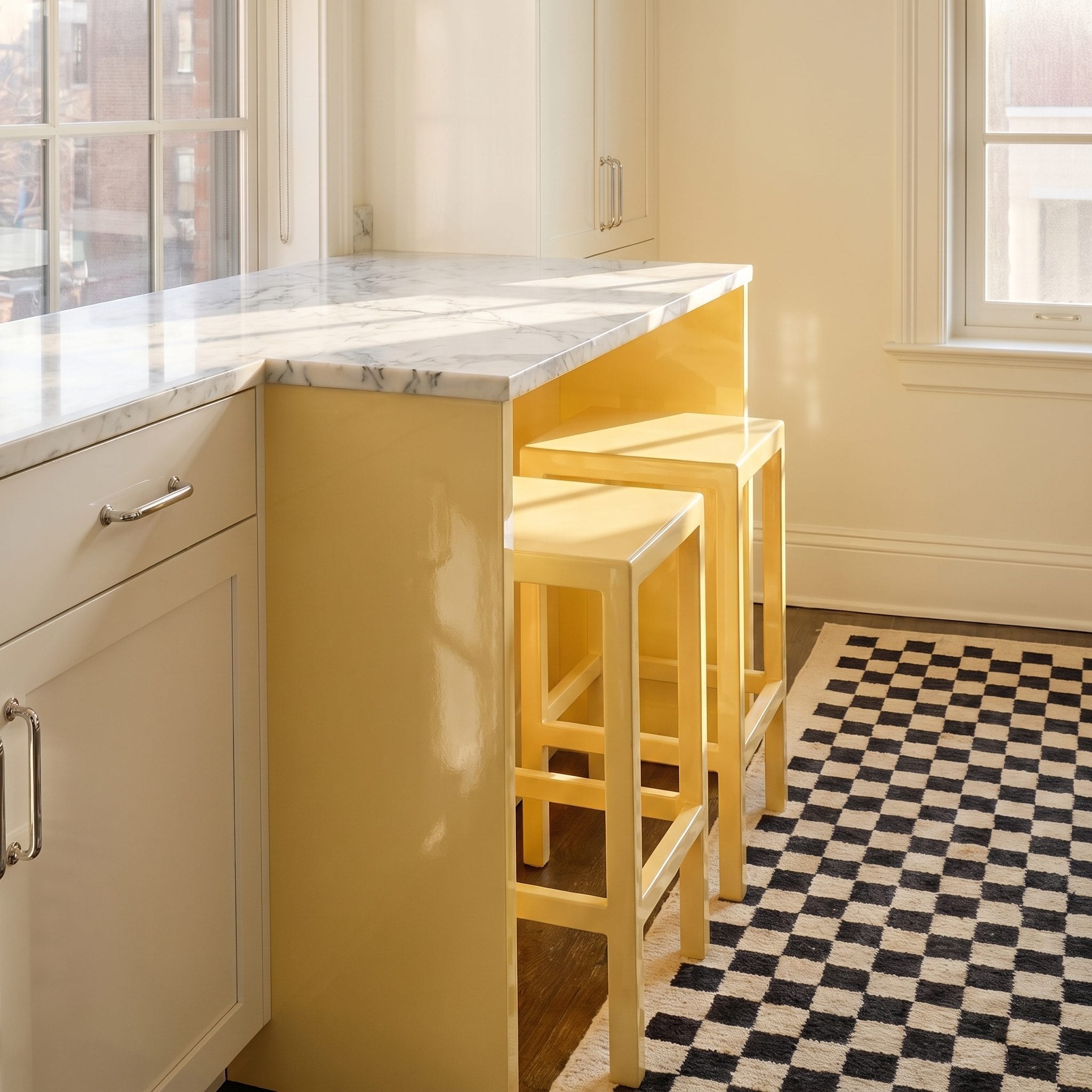
Pale seating continues the warm cabinetry palette while the checkerboard floor adds contrast.
Using Reeded Glass Cabinet Doors for Soft Storage
The upper cabinets are where the butter yellow kitchen makes its most distinctive material choice. Instead of solid shaker panels or open shelving, the upper doors are fitted with reeded glass inserts—vertically ribbed glass panels that diffuse the view of the cabinet interior into a soft, blurred impression of shapes and colors rather than a clear display of every stacked plate and cereal box.
Reeded glass occupies a useful middle ground in kitchen design. Open shelving looks beautiful in photographs and chaotic in daily life—it demands that every item on every shelf be chosen, placed, and maintained as a display object. Solid doors solve the clutter problem but make the upper cabinets read as heavy blocks of color that press down on the room, particularly in a compact alcove where the ceiling is close. Reeded glass resolves both problems simultaneously. The vertical ribbing obscures content well enough that a reasonably organized shelf of white dishes and glassware reads as a soft, luminous field behind the glass—present but not demanding attention. At the same time, the glass allows ambient light and interior cabinet lighting to filter through the panel, which reduces the visual weight of the upper cabinets and makes the top third of the kitchen feel lighter and more open.
The linear texture of the reeded glass introduces the room’s strongest pattern element above counter height. Each vertical rib catches light at a slightly different angle, creating a gentle, shimmering movement across the cabinet face as the viewer shifts position or as the light source changes throughout the day. This optical animation is subtle—not distracting, not decorative, simply alive—and it provides a material counterpoint to the flat, smooth shaker panels below. The eye registers the difference between lower and upper cabinets not as a jarring contrast but as a textural conversation: solid below, transparent above, warm yellow throughout.
Choosing Marble Surfaces Without Making the Kitchen Feel Cold
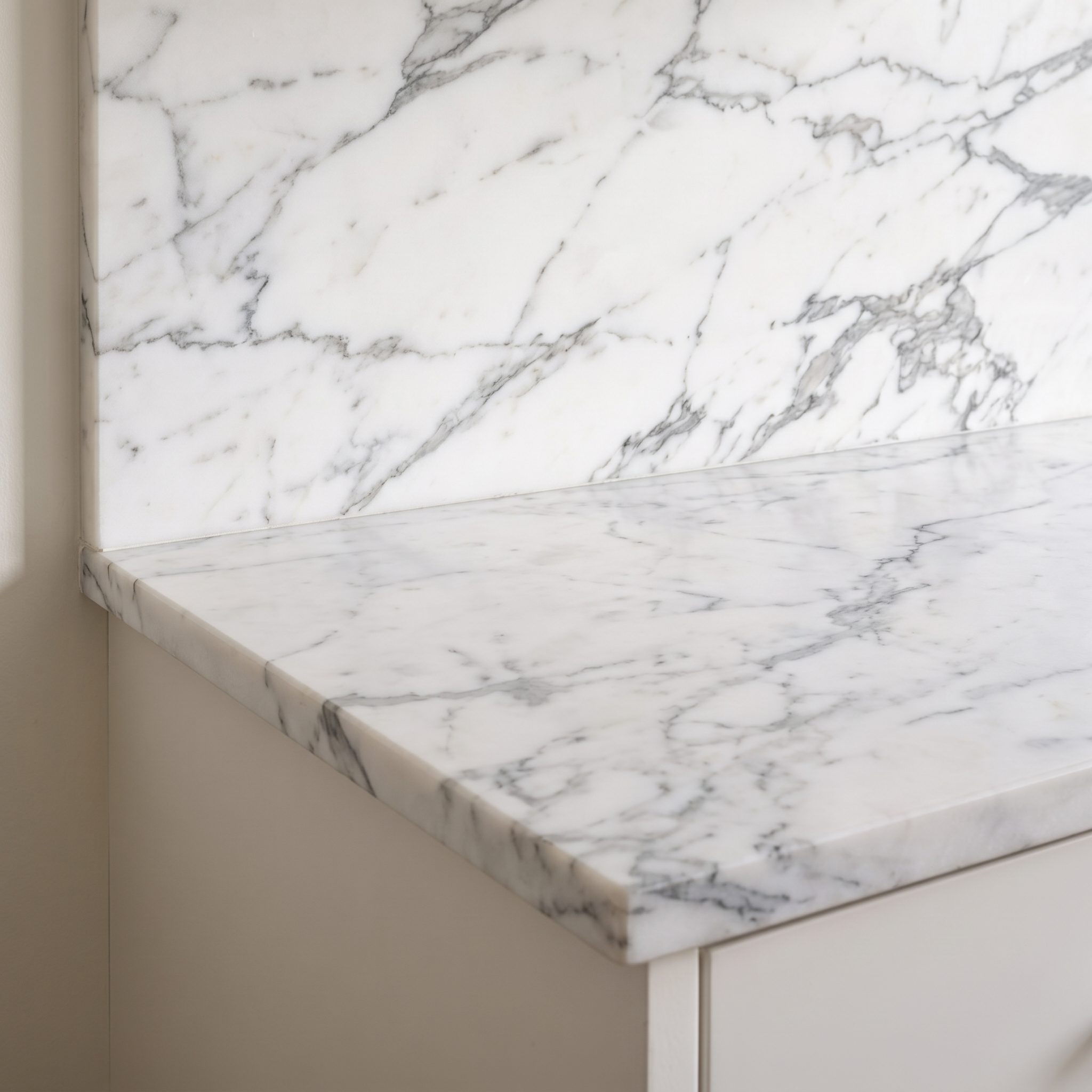
The countertops and backsplash provide the kitchen’s primary cool-toned surface. A polished white marble with soft grey veining sweeps across the work surface and continues up the wall as a slab backsplash, creating a single unbroken plane of stone that runs from the front edge of the counter to the underside of the upper cabinets. The polished Carrara-style marble used as the material direction for this kitchen is characterized by its warm white field—not a stark, blue-white paper tone, but a creamy, slightly golden base that prevents the stone from reading as cold against the butter yellow cabinetry.
The veining is the detail that makes the marble work in a warm kitchen. Each grey line running through the white field introduces a thread of cool contrast—enough to establish the stone as a separate material from the warm cabinetry, but not so much that the counter surface feels like a different room. The polished finish adds a layer of reflectivity that bounces whatever light enters the alcove back into the space, which is critical in a compact kitchen where natural light may enter from only one direction. A matte or honed surface would absorb that light and produce a quieter, flatter reading—beautiful in a larger kitchen with abundant windows, but potentially too subdued in a tight alcove that needs every lumen it can capture.
The slab backsplash detail—where the stone continues up the wall without a transition joint or a change in material—is what elevates the kitchen from a decorated space to an architectural one. The continuous stone surface reads as structural rather than applied, as though the marble was always there and the cabinets were built around it. This perception of permanence is what separates a kitchen that feels designed from one that feels assembled from catalog selections. The slab backsplash also eliminates a grout line at the counter-to-wall junction, which simplifies cleaning in the area most prone to cooking splatter.
Polished Nickel Hardware in a Warm Yellow Kitchen
Hardware is the kitchen’s jewelry—the small, repeated detail that either integrates quietly into the composition or breaks it apart. In a butter yellow kitchen, the hardware finish carries disproportionate influence because every pull, knob, and hinge plate is surrounded by the same warm field of color. The wrong metal reads immediately: too cool, too warm, too bright, too dull.
The polished nickel bar pulls selected for this kitchen sit at the ideal temperature point. Polished nickel is not chrome—it lacks chrome’s blue-cool cast, which can read as clinical and institutional against warm paint colors. It is not brass—it lacks the heavy golden warmth that can disappear into a yellow field and make the hardware invisible. Polished nickel occupies the narrow band between the two: bright enough to register as a distinct accent, warm enough to harmonize with the surrounding color, and reflective enough to catch light and return it as a soft, silver-gold gleam along the cabinet face.
The straight bar profile and clean post mounts keep the hardware architecturally restrained. There are no decorative curves, no scrolled backplates, no period-revival ornamentation. Each pull is a simple horizontal line that reinforces the grid of shadow lines already established by the shaker stile-and-rail frames. This repetition of horizontal parallels—pull, rail, pull, rail—creates a steady visual rhythm across the lower cabinetry that reads as orderly and calm. The hardware does not draw attention to itself. It organizes the attention that is already there.
The high reflectivity of the polished finish serves a second purpose in the alcove. Each pull acts as a tiny mirror, catching the warm ambient light and scattering it in small, bright points across the cabinet face. In a compact kitchen where large windows or skylights may not be available, these micro-reflections contribute meaningfully to the room’s overall brightness. The pulls become small light sources in their own right—not illuminating, exactly, but sparkling, in the way that water catches sunlight and throws it across a ceiling.
Lighting the Niche with a Ribbed Glass Pendant
The pendant light is the butter yellow kitchen’s single suspended object—the only element that occupies the vertical center of the room between the counter and the ceiling. In a compact alcove, this position carries enormous visual weight. The pendant must be large enough to register as a deliberate design element, not a builder-grade afterthought, but small enough that it does not crowd the already tight vertical space between the work surface and the upper cabinets.
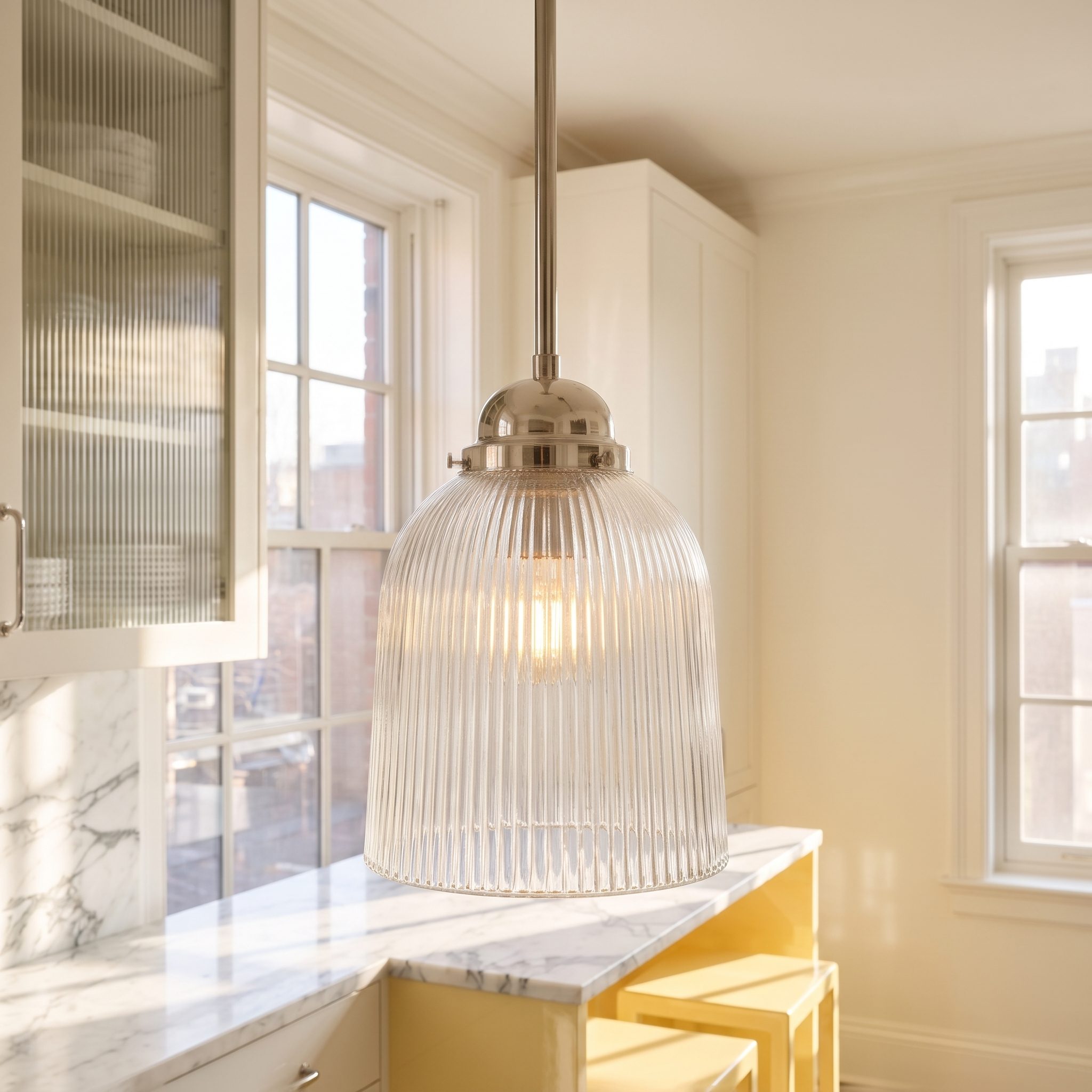
The ribbed glass pendant addresses this balance with a fluted bell shade in clear glass, suspended from a polished nickel stem. The ribbed texture of the shade performs the same light-diffusing function as the reeded glass cabinet doors above: it scatters the bulb’s direct light into a softer, more even wash that wraps the countertop rather than spotlighting it. The vertical ridges of the glass create a gentle, shimmering surface that catches and refracts ambient light even when the pendant is switched off, making the fixture read as a sculptural glass object rather than a utilitarian light source.
The clear glass is critical to the design. An opaque shade—ceramic, metal, fabric—would block the sightline through the pendant and divide the upper portion of the kitchen into two visual zones: above the shade and below it. In a compact alcove where every inch of vertical space matters, this division would make the ceiling feel lower and the room feel more compressed. The clear ribbed glass allows the eye to travel through the pendant to the ceiling beyond, maintaining the full vertical depth of the space. The polished nickel stem and canopy tie the pendant to the hardware below, creating a vertical thread of cool metal that runs from the drawer pulls through the pendant rod to the ceiling mount.
The warm glow that the pendant casts at dusk is what completes the butter yellow kitchen’s transformation from a daytime workspace into an evening room. The ribbed glass filters the bulb’s output into a warm, amber-toned wash that saturates the yellow cabinetry and deepens the grey veining in the marble. The kitchen, which reads at noon as bright and efficient, reads at eight in the evening as candlelit and intimate—a small, warm room where the stone glows and the glass shimmers and the yellow walls lean in.
Grounding the Room with a Black and Cream Checkered Runner
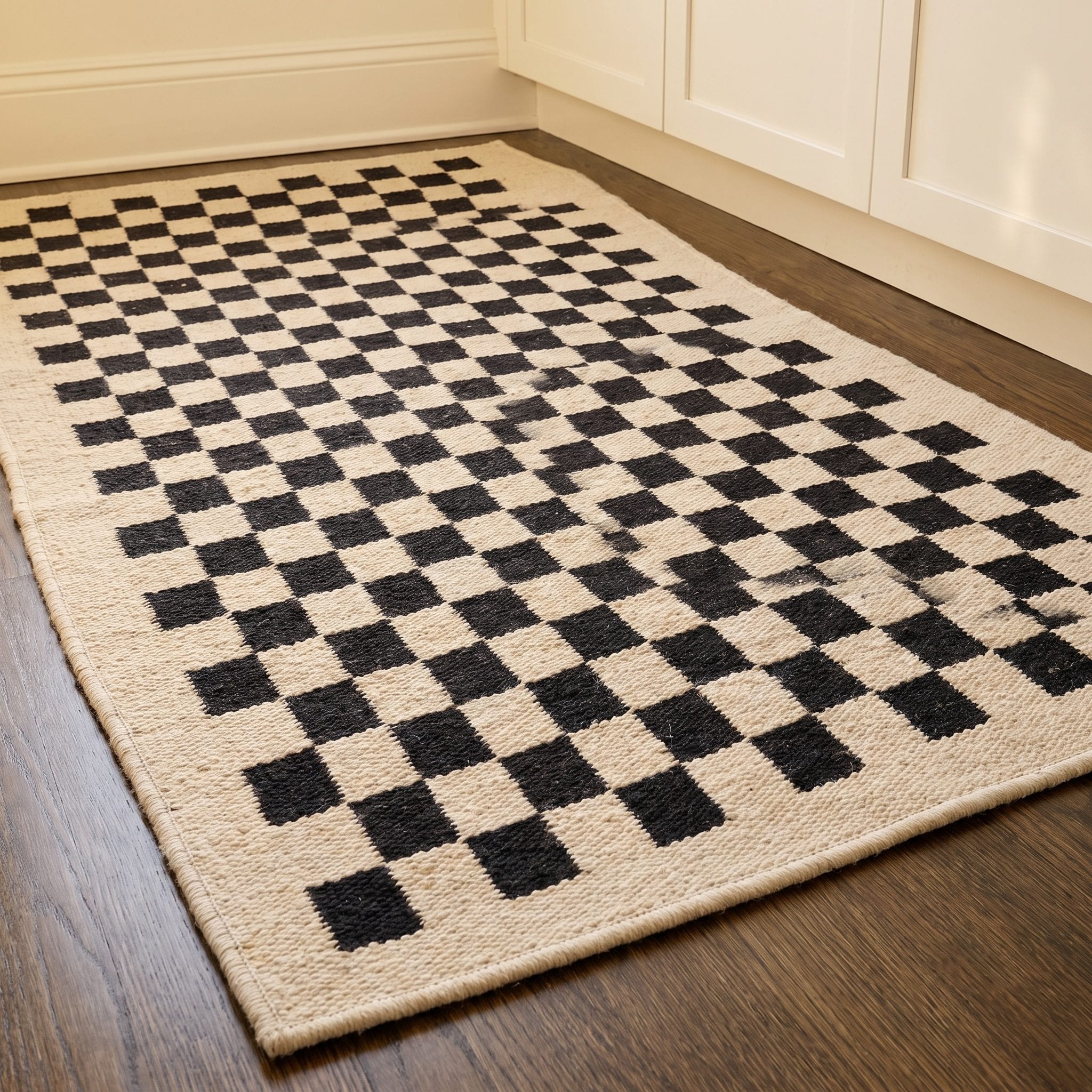
The floor is the butter yellow kitchen’s most unexpected surface. In a room built from soft, warm, natural materials—cream stone, golden wood, clear glass, warm metal—the black and cream checkered runner introduces the first and only note of high-contrast geometry. The effect is immediate and structural: the runner anchors the walking path, defines the working zone in front of the counter, and prevents the warm palette from tipping into sweetness by providing a graphic, almost architectural counterweight at floor level.
The checkered pattern is one of the oldest floor treatments in Western domestic architecture—it appeared in medieval tile floors, colonial American entryways, and Parisian bistro kitchens long before it entered the vocabulary of contemporary interiors. Its persistence is functional: the repeating square grid creates a visual order that the eye reads as stable, grounded, and deliberate. In the butter yellow kitchen, this stability is essential. Without a strong floor element, the warm cabinets, warm stone, and warm pendant light would produce a room that feels pleasant but unmoored—a soft cloud of golden tones floating above a bare hardwood floor. The checkered runner pushes back against that softness with a crisp, black-and-cream geometry that says: this room has structure.
The practical construction addresses the demands of a working kitchen floor. The flatweave profile sits close to the ground, low enough that cabinet doors and drawers open over it without catching. The synthetic blend resists staining from cooking oils, wine, and the inevitable splashes that accompany daily meal preparation. The machine-washable construction means the runner can be pulled up, washed, and returned to service without professional cleaning—a necessity for a kitchen textile that absorbs the full daily impact of cooking, foot traffic, and gravity.
Runner placement in the alcove follows the working path: centered between the counter face and the peninsula return, extending from one end of the lower cabinet run to the other. The runner should stop a few inches short of any perpendicular threshold or transition strip, leaving a frame of exposed floor at each end that defines the textile as a deliberate placement rather than a wall-to-wall installation. The exposed floor margins at the sides—four to six inches on each side of the runner—keep the rug from touching the cabinet toe kicks, which would make the alcove feel narrower and the rug feel like an afterthought.
Dusk in the Butter Yellow Kitchen
As the afternoon light drops and the window over the sink shifts from warm white to the deep amber of golden hour, the kitchen undergoes its daily transformation. The pendant comes on—a single ribbed glass bell glowing from within, its fluted surface casting thin lines of light and shadow across the marble backsplash.
The butter yellow cabinets, which read at midday as a quiet, sunlit cream, deepen now into something richer—a warm golden tone that approaches the color of raw honey. The shaker panels gain dimension as the low-angle pendant light rakes across their flat centers and catches the raised edges of each stile and rail, throwing thin shadows that were invisible under the flat overhead light of noon. The cabinetry looks more architectural in this hour, more deliberately crafted, as though the warmth of the color were revealing structural details that daylight had flattened.
The marble countertop shifts from its daytime bright white to a softer, warmer register. The grey veining, subtle and recessive in direct sunlight, stands out now in sharper relief—each line of mineral pigment darkened against the warm glow of the surrounding stone. The polished surface catches the pendant light and throws a diffused amber reflection upward toward the upper cabinets, where the reeded glass panels scatter it into a hundred tiny vertical lines of warmth. The upper cabinets shimmer—not brightly, not dramatically, but with a quiet, living movement that makes the glass feel like water.
The polished nickel pulls along the lower cabinets catch the pendant light in small, sharp points—a constellation of bright silver dots against the deepening golden field. The checkered runner, its black-and-cream squares muted in the low light, grounds the scene with a steady geometric anchor that holds the warm, glowing surfaces above in place.
The yellow backless stools tucked beneath the peninsula catch the last horizontal light from the window, their curved forms glowing softly against the dark floor. The kitchen is at its best in this hour—not a workspace, not a display, but a warm room where the marble holds the light, the glass scatters it, and the yellow walls return it as a soft, steady glow. A place where the counter is still warm from the afternoon sun. A place that says: sit down, the evening is just beginning.
Frequently Asked Questions
Is butter yellow a timeless kitchen color or just a trend?
Butter yellow has a longer pedigree than most kitchen colors currently circulating on social media. It appeared in Georgian and Federal-era American kitchens, persisted through the cream-and-chrome palette of the nineteen-fifties, and resurfaced in the English country kitchens of the nineteen-eighties. What distinguishes the current iteration from past versions is the level of desaturation—today's butter yellows lean heavily toward cream, with enough warmth to read as colored but not enough chroma to register as bold. This places butter yellow in the same behavioral category as sage green or warm greige: a tinted neutral that carries personality without demanding attention. Colors that function as tinted neutrals tend to outlast trends because they cooperate with changing accessories, hardware finishes, and countertop materials rather than competing with them.
What colors pair well with butter yellow kitchen cabinets?
White and cream are the natural starting points—they let the yellow breathe without adding competing warmth. Cool-toned whites with a faint blue or grey undertone are particularly effective because they provide just enough contrast to define the boundary between the cabinet face and the countertop or backsplash without creating a jarring temperature clash. Beyond white, soft sage green, warm charcoal, and muted navy all work as accent or adjacent-room colors. The key principle is contrast in temperature rather than contrast in value: pair the warm yellow with a cooler tone so each surface reads as distinct, but keep both colors at a similar level of softness to avoid one overwhelming the other.
Can butter yellow work in a small kitchen or alcove?
Butter yellow is one of the most effective colors for a compact kitchen precisely because of its warmth. Cool colors in small spaces can feel sterile and clinical—the walls read as close and hard. A warm, desaturated yellow absorbs some of that proximity and returns it as softness, making the walls feel like a glow rather than a boundary. The trick in a small kitchen is to balance the yellow with enough light-reflective surface area—polished marble, glossy tile, or glass-fronted cabinets—to prevent the warmth from tipping into heaviness. Reeded glass upper cabinets are particularly useful in a compact layout because they reduce the visual mass of the upper wall while letting interior cabinet lighting or ambient daylight filter through.
What countertop works best with butter yellow cabinets?
A white or light grey stone surface with cool-toned veining provides the strongest counterbalance to the warmth of butter yellow cabinetry. Polished Carrara-style marble is the classic pairing: its cool grey veining on a warm white field creates a natural temperature dialogue with the yellow cabinet faces. The polished finish adds a layer of reflectivity that bounces light across the work surface, which is especially valuable in a compact kitchen where natural light is limited. Honed or leathered stone finishes also work but will absorb more light and produce a quieter, more muted effect. Avoid warm-toned stones like golden granite or honey onyx—they double the warmth of the cabinetry and flatten the color contrast in the room.
Does reeded glass work for kitchen cabinet doors?
Reeded glass is one of the most practical semi-transparent options for kitchen cabinetry. The vertical ribbing diffuses the view of cabinet contents enough to hide the visual clutter of mismatched dishes, cereal boxes, and stacked containers, while still allowing light to pass through the panel and soften the solid mass of the upper cabinet run. Unlike clear glass, which demands that every shelf be styled for display, reeded glass asks only that the contents be roughly organized—the ribbing does the rest. The linear texture also introduces a subtle architectural pattern to the upper wall that can echo other vertical elements in the room, such as a fluted glass pendant shade or the grain lines in a natural stone backsplash.
What hardware finishes complement butter yellow cabinetry?
Polished nickel is the most versatile choice for butter yellow kitchens because it sits at the precise midpoint between warm and cool on the metal spectrum. Unlike polished chrome, which has a distinctly blue-cool cast that can look clinical against yellow, polished nickel carries a faint golden undertone that harmonizes with the cabinetry while still reading as a cool, bright accent. Brushed nickel and satin nickel are softer alternatives that reduce the reflectivity—useful if the kitchen has strong direct sunlight that might create glare off polished surfaces. Unlacquered brass is another option, but it can disappear against butter yellow if the brass and paint tones are too close in warmth. The safest approach is to hold a hardware sample against the painted cabinet face in natural light before committing.
What rug works in a butter yellow kitchen?
A machine-washable flatweave runner in a high-contrast pattern is the practical and aesthetic ideal for a working kitchen. The flatweave profile sits low enough that cabinet doors and drawers clear it without catching, and the synthetic or blended fiber construction resists staining from the inevitable splashes and spills of daily cooking. A black and cream checkered pattern is a particularly effective pairing with butter yellow because it introduces a bold graphic element at floor level that anchors the warm, soft surfaces above. The strong geometry of the check pattern prevents the kitchen from reading as too sweet or too soft—it adds an edge of structure that balances the warmth of the yellow and the smoothness of the marble.
How do you make a yellow kitchen feel elevated instead of cute or retro?
The difference between a yellow kitchen that reads as elevated and one that reads as kitschy comes down to material quality and restraint. The yellow itself must be desaturated—closer to cream than to sunflower—so it functions as a warm neutral rather than a statement color. Every material that touches the yellow should be either natural or architecturally refined: polished stone rather than laminate, reeded glass rather than clear acrylic, solid metal hardware rather than hollow stamped pulls. Keep decorative objects minimal—a few pieces of stoneware, a cutting board, a single vase—and let the material surfaces do the visual work. The kitchen should feel warm because of its color, not busy because of its accessories.