Most hallways in residential floor plans are treated as nothing more than the distance between two doors. They receive the builder’s standard white paint, a coat hook, and perhaps a mirror that nobody stops to use. The corridor is understood as pure transit—a space you move through, not a space you occupy.
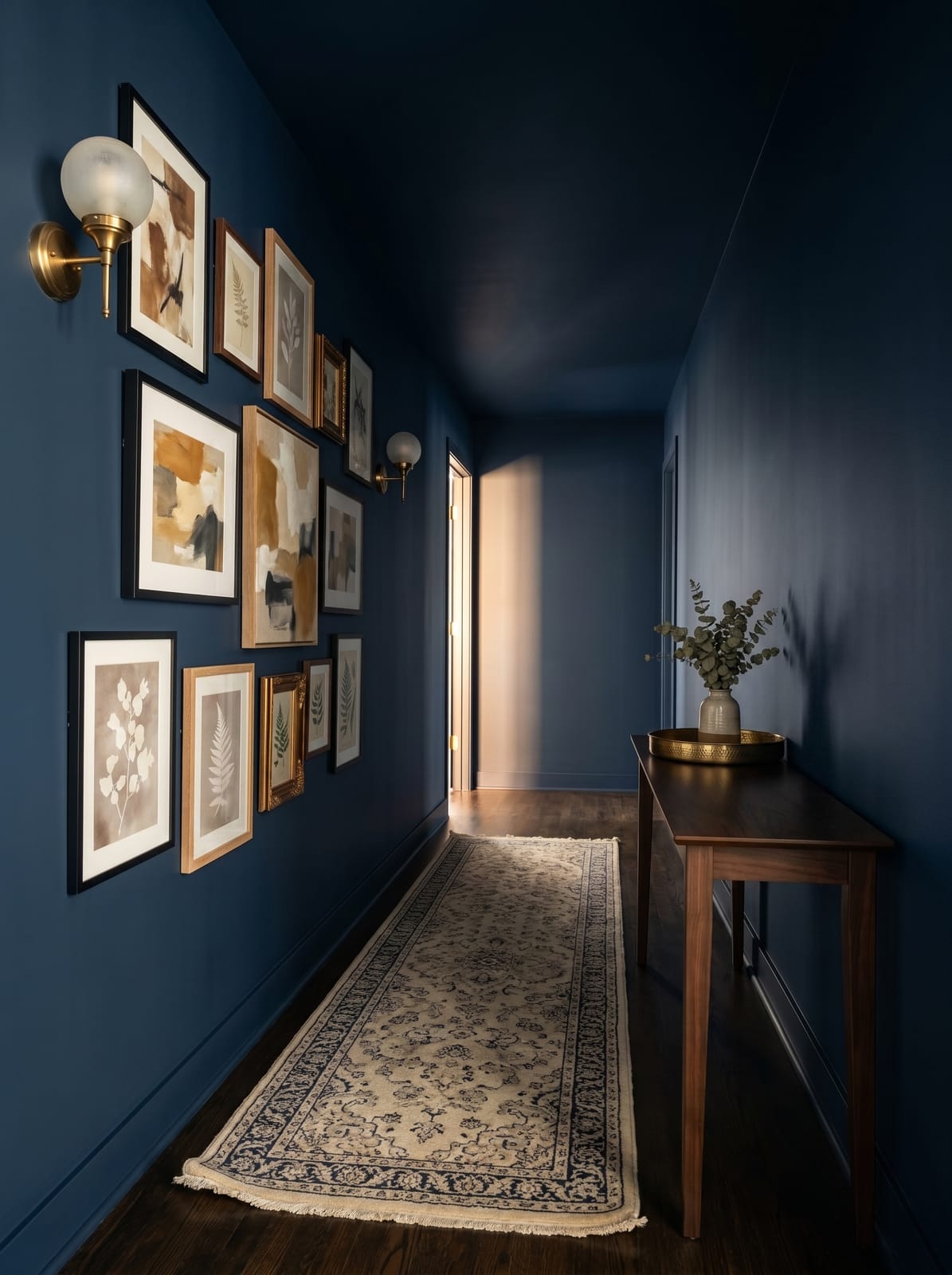
The navy gallery hallway challenges that assumption. Here, a narrow corridor between the front door and the living room has been painted in a saturated navy blue that swallows the walls into a single deep plane of color, transforming the passageway into a moody, gallery-like interior that rewards slow movement and close looking. Against that dark envelope, a slim walnut console table provides a landing surface anchored by symmetrical aged brass globe sconces. A curated gallery wall hangs above. A traditional cream-and-navy runner grounds the floor. The hallway is no longer a corridor. It is a room—compressed, deliberate, and warm.
Why Navy Works in a Narrow Hallway
The conventional wisdom for narrow spaces is to paint them white—open them up, bounce light around, make them feel larger than they are. This advice is not wrong, exactly, but it solves for the wrong problem. A white hallway feels larger because it feels emptier. The walls recede into a bright, featureless wash. Nothing stops the eye. Nothing invites it to stay.
Navy does the opposite. A deep, saturated blue-black pulls the walls inward, yes, but it also gives them substance. The surfaces gain depth and weight. They become something to look at rather than something to look past. In a narrow corridor, this shift is transformative: instead of feeling like a compressed white tube, the hallway reads as a deliberately intimate passage—the kind of space you encounter in a nineteenth-century townhouse library or a well-designed hotel corridor, where darkness signals intention rather than neglect.
The physics of light absorption support this intuition. White walls in a tight corridor create a visual ping-pong effect, bouncing overhead light between parallel surfaces and amplifying every fixture, every window reflection, every shadow cast by passing bodies. The result is a space that feels bright but restless—too much visual information compressed into too few square feet. Navy paint absorbs the majority of that bouncing light, quieting the corridor and creating a stable, uniform darkness that the eye can rest against. Warm objects placed within that darkness—brass, walnut, cream linen—begin to glow by contrast, their warm tones amplified by the cool blue field behind them.
The critical requirement is that the navy must be paired with warm, focused lighting. A dark hallway lit only by a distant overhead fixture will read as a tunnel. The solution is wall-mounted sconces positioned at standing eye height—sixty to sixty-six inches from the floor—that cast focused, warm-toned light across the painted surface. The navy paint catches and holds the amber glow in a soft halo around each fixture, creating controlled pools of warmth along the corridor’s length. The hallway becomes not uniformly dark but rhythmically lit—bright at the sconces, deeper between them, drawing the eye forward in a measured cadence.
Choosing a Slim Walnut Console Table
The console table is the functional anchor of the entryway hallway. It provides the landing surface that every front door demands—a place for keys, a tray for mail, a surface that says you have arrived. In a narrow corridor, the console must perform this job without obstructing the passage, which means depth is the controlling dimension.
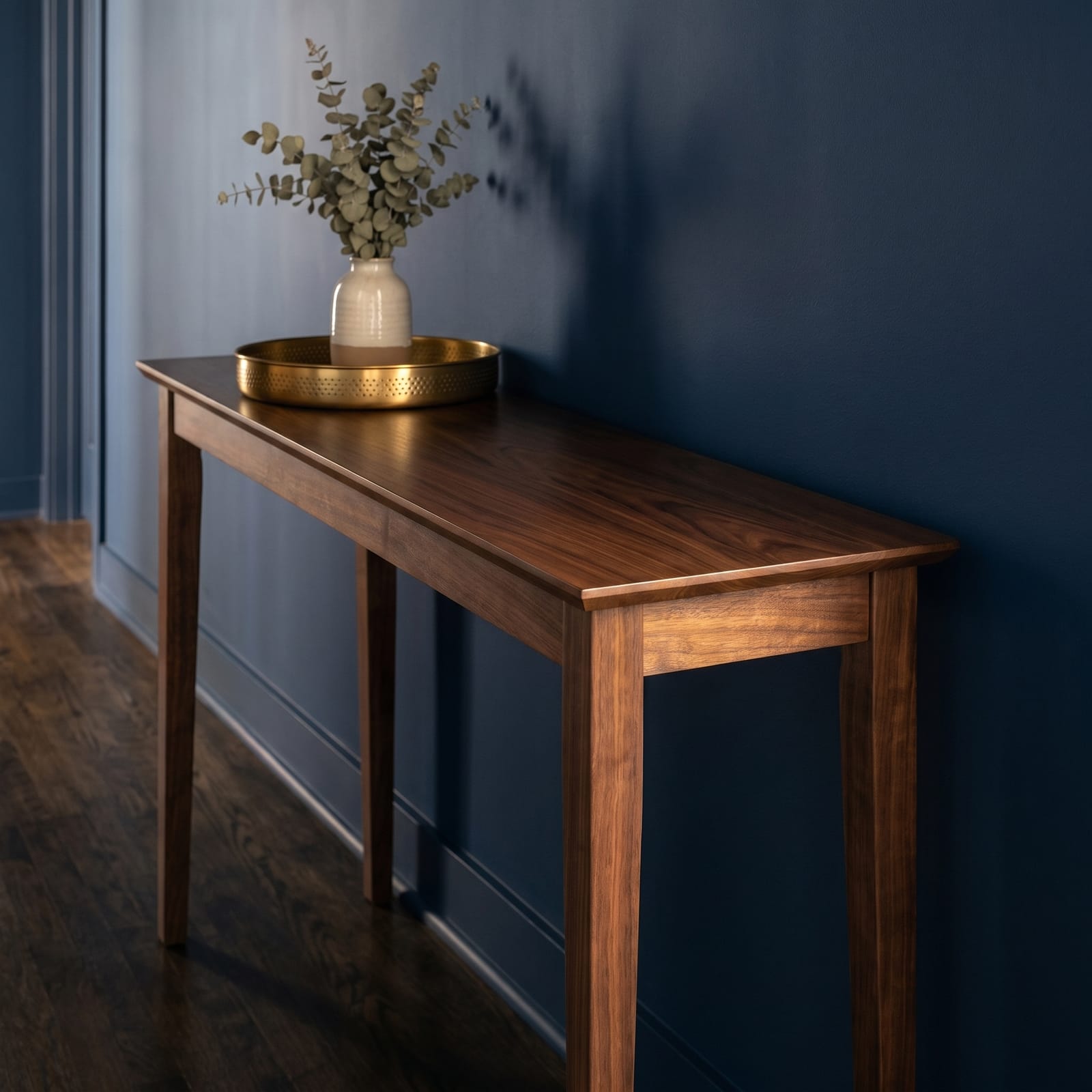
The FUNEWBO Mid-Century Modern Walnut Console Table addresses this constraint with a forty-three-inch length and a narrow depth that keeps the tabletop flush against the wall while preserving comfortable walking clearance. The top is finished in walnut veneer over MDF—a combination that delivers the full visual warmth and directional grain of natural walnut without the seasonal expansion and contraction that solid hardwood undergoes in the fluctuating humidity of a doorway zone. The surface reads as rich, warm, and quietly figured: chocolate grain lines flowing across an amber field, the kind of tonal complexity that flat-pack laminates cannot replicate.
Below the top, four splayed tapered legs angle outward in the classic mid-century silhouette. This geometry is not merely stylistic. Splayed legs plant their feet wider than the tabletop’s footprint, providing lateral stability against the inevitable bump of a hip or the drag of a grocery bag. But they also angle inward at floor level compared to straight legs, reducing the obstruction in the walkway zone where ankle clearance matters most. The visual effect is lightness—the table appears to float above the runner rug rather than press down onto it, which is essential in a narrow space where every piece of furniture risks making the corridor feel obstructed.
The absence of a lower shelf is a deliberate editorial choice for a hallway console. Shelves below the tabletop invite storage, and storage in an entryway becomes accumulation: stacked shoes, tangled bags, forgotten packages. A clean, open leg structure keeps the floor visible beneath the table, preserving the visual depth of the corridor and allowing the runner rug’s pattern to flow uninterrupted from one end of the hallway to the other.
Styling the Console: Brass-Tone Tray, Ceramic Vase, and Greenery
The console tabletop is the most visible horizontal surface in the entryway—the first thing a guest’s eye lands on after the front door closes. The styling principle here is curation through restraint: a small number of objects, each chosen for its material contribution to the room’s palette, arranged with enough negative space between them to read as placed rather than piled.
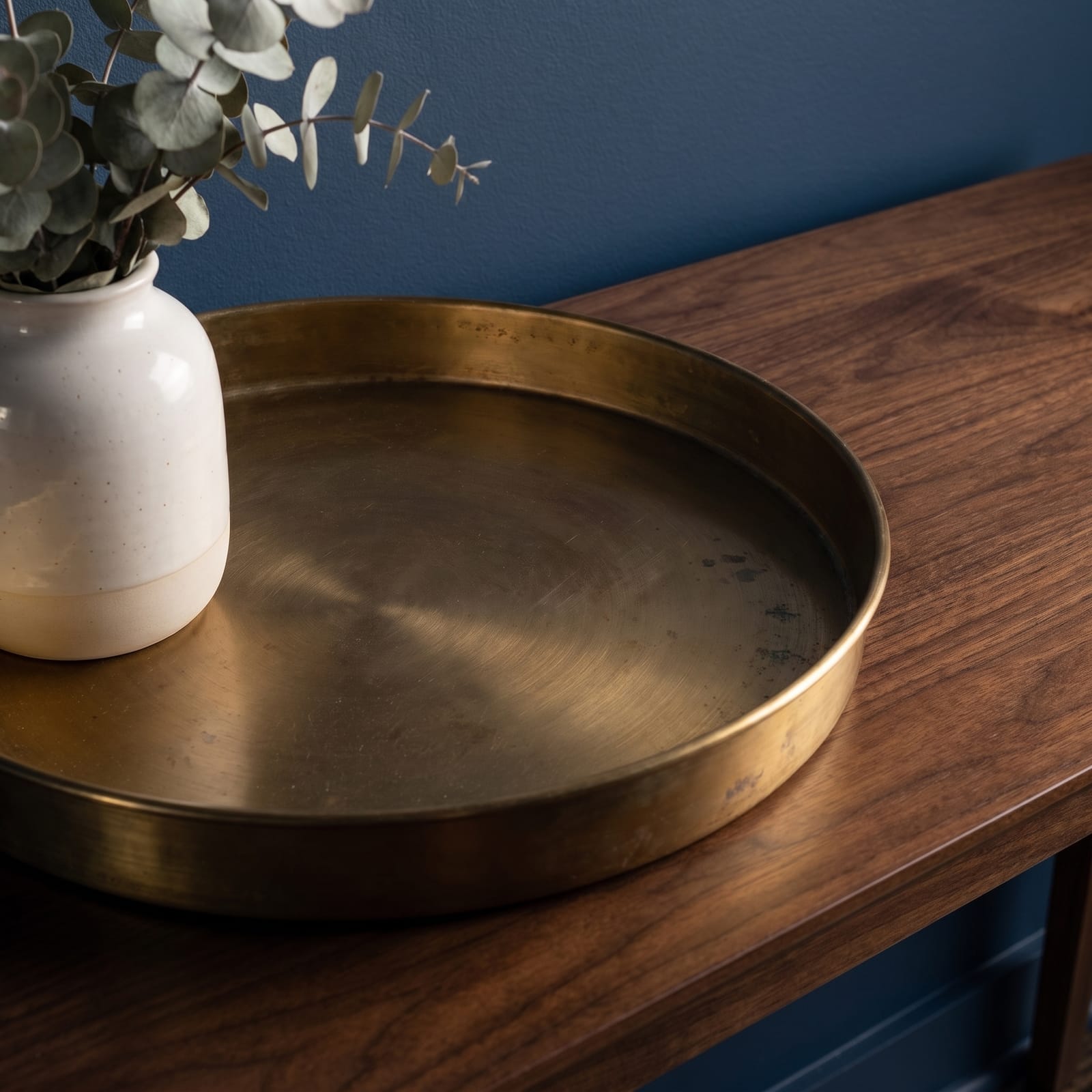
The organizing object is the i-lan Deep Gold Stainless Steel Serving Tray, a fourteen-inch round tray with a polished brass-tone finish and a low raised rim. Placed slightly off-center on the walnut surface, the tray serves two purposes. Functionally, it corrals the small objects that accumulate at a front door—keys, sunglasses, a watch removed before washing hands—containing them within a defined circle so they do not scatter across the tabletop. Aesthetically, the round form introduces the console’s only curved geometry, breaking the rectangular dominance of the table, the frames above, and the corridor walls. The warm brass-tone finish catches the glow of the sconces overhead, creating a small, focused pool of reflected warmth on the otherwise matte walnut surface.
At the opposite end of the console stands the Torre and Tagus Lilo White Reactive Glaze Ceramic Bud Vase. The vase is finished in a reactive crackle glaze—a kiln technique in which the glaze layer contracts at a different rate than the clay body during cooling, producing a controlled network of fine hairline fractures beneath the smooth outer surface. Each piece emerges from the kiln with a unique pattern of crackling, which means the surface is never perfectly uniform. In the navy hallway, this textural irregularity matters: the vase catches the directional sconce light along its curved form, and the crackle pattern scatters that light in unpredictable micro-reflections that give the ceramic a handmade, almost geological quality. The warm off-white tone provides the console’s lightest note, pulling the eye immediately and establishing a vertical anchor point against the dark wall behind.
A few stems of preserved eucalyptus, arranged loosely in the vase’s narrow neck, complete the tabletop composition. The silvery-green leaves introduce the entryway’s only botanical element—organic, asymmetric, and slightly wild against the ordered geometry of the tray, the console legs, and the gallery frames above. Preserved stems require no water, no sunlight, and no maintenance; they hold their shape and color for months, providing consistent height and movement on the console surface without the weekly upkeep of fresh flowers. The greenery also softens the hard material transitions in the hallway—brass to walnut to ceramic—by introducing an element that belongs to none of those categories, a natural form that sits quietly outside the designed palette.
Building a Gallery Wall with Breathing Room
The wall space above the console is the hallway’s primary vertical canvas—the surface that establishes whether the corridor reads as a curated interior or an empty passage with furniture pushed against the wall. A gallery arrangement transforms this surface into an intentional composition, but the success of the arrangement depends entirely on spacing and restraint.
The governing principle is breathing room. In a narrow hallway, the instinct is to fill the wall—to hang frames edge to edge, covering as much navy paint as possible. This instinct produces visual claustrophobia. The wall becomes a solid block of competing images, each frame fighting its neighbor for attention, the dark paint visible only as a thin border between objects. The gallery reads as dense and anxious rather than curated and calm.
The corrective is generous spacing. Two to three inches between frames, measured edge to edge, allows each piece to register as an individual object with its own boundary of dark wall around it. The navy paint is not empty space to be filled—it is the mat that separates and presents each frame, the same way a museum mat separates a photograph from its frame. Six to eight inches of clear wall between the outer edge of the gallery group and any adjacent architectural element—a sconce mount, a door casing, a crown molding return—prevents the arrangement from feeling cramped against its boundaries.
The center of the gallery grouping should sit at fifty-seven to sixty inches from the finished floor, which positions the visual midpoint at average standing eye height. This placement is a museum convention adopted by residential designers because it ensures that the art occupies the natural sightline—you look at it without looking up or down. In a hallway you walk through rather than sit in, this standing-height center is essential. Art hung too high forces the chin upward and reads as institutional. Art hung too low competes with the console tabletop for attention.
Frame finishes in the navy hallway benefit from tonal variety within a narrow range. A mix of thin black frames, warm wood frames, and matte white mats creates enough visual rhythm to keep the eye moving from piece to piece. Avoid heavy ornate gold frames in the gallery proper—the aged brass sconces already provide the hallway’s metallic accent, and doubling that accent on the wall risks tipping the composition from moody restraint into theatrical excess.
Lighting a Moody Entryway with Aged Brass Globe Sconces
The lighting strategy defines whether the navy hallway reads as atmospheric or simply dark. Overhead ceiling fixtures in a narrow corridor throw light straight down, creating a bright stripe on the floor and leaving the walls in shadow—exactly the opposite of what a dark-painted hallway needs. The walls are the room’s primary surface, the canvas on which every other element is displayed. The lighting must address the walls directly.
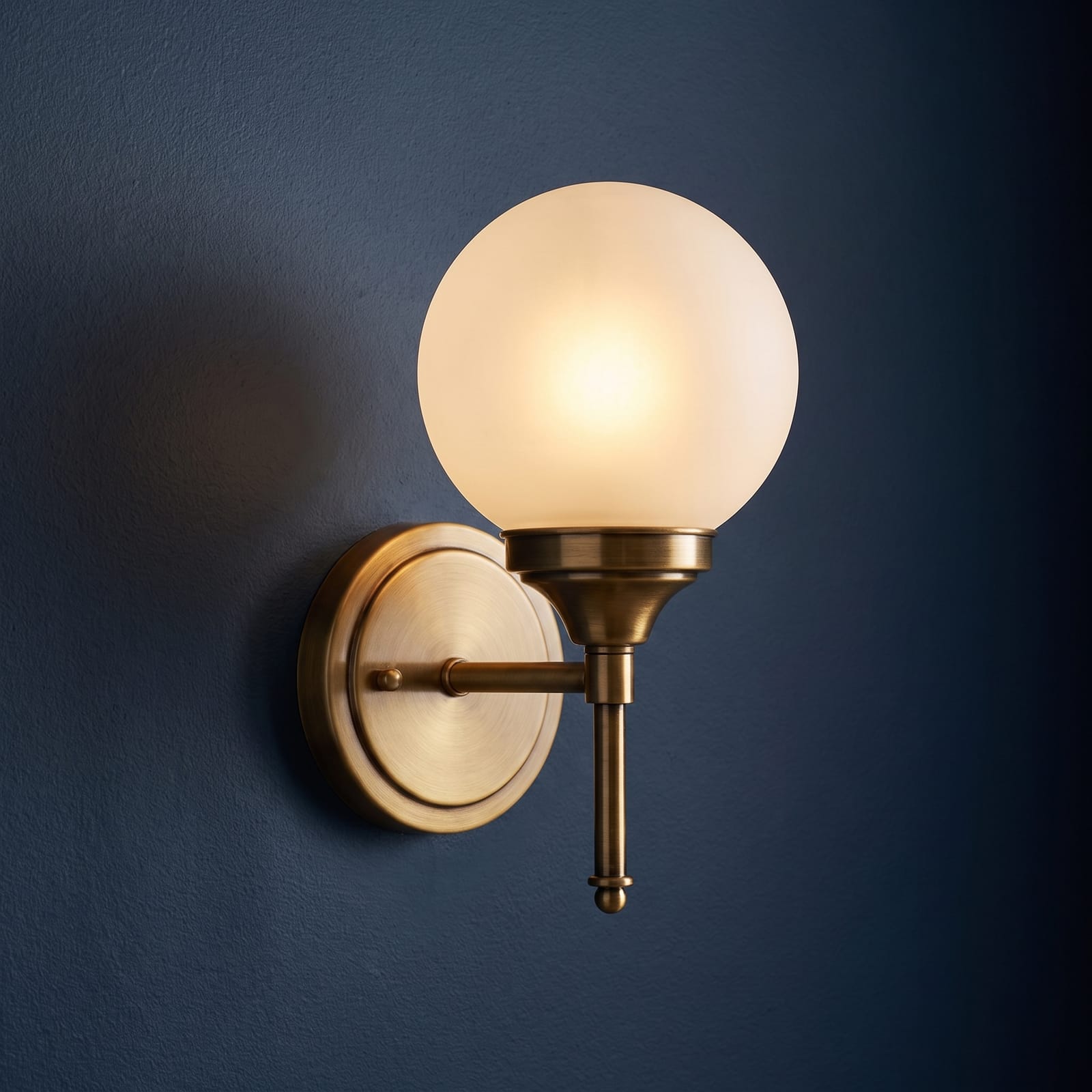
The Rejuvenation Allenglade Single Sconce in Aged Brass provides that wall-directed illumination. Each fixture features a solid brass mount in an aged brass finish—a surface treatment that suppresses the high-polish shine of new brass, replacing it with a muted, golden warmth that has the appearance of metal handled over decades. The aged finish is not merely decorative. In a dark hallway, polished brass creates sharp, mirror-like reflections that read as bright points of glare against the matte navy paint. Aged brass diffuses its reflections across the metal’s slightly textured surface, producing a soft, even warmth that integrates with the wall rather than punctuating it.
The shade is a frosted opal glass globe—a sphere of translucent glass that scatters the bulb’s directional light into a uniform, milky glow in all directions. The frosted glass performs the same function as a fabric lampshade in a living room: it converts a point source of light into a field, wrapping the corridor in a soft, shadowless warmth rather than casting a focused beam. The opal tint adds a faint amber warmth to the light output, which is critical in a navy hallway. Cool-white light against navy paint produces a sterile, almost clinical atmosphere—the corridor reads as a basement rather than a gallery. The opal glass’s warm filtration ensures that the light reads as candlelit, golden, and residential.
Flanking the gallery wall, the sconces should be mounted at sixty to sixty-six inches from the finished floor to the center of the fixture—positioning the globe at the same height as the standing eye. This placement creates an intimate spatial relationship between the viewer, the light source, and the art: you stand between two warm glowing orbs, their amber wash falling across the gallery frames at the same angle as your gaze. The hallway is not illuminated from above, like a corridor. It is illuminated from within, like a room.
Grounding the Hallway with a Navy and Cream Runner
The floor is the hallway’s most trafficked surface and its most overlooked design opportunity. Bare hardwood in a narrow corridor reads as utilitarian—a surface to walk across, not a surface to look at. A runner rug transforms the floor into the hallway’s horizontal anchor, defining the walkway, introducing pattern and texture, and creating a visual bridge between the dark walls above and the neutral floor below.
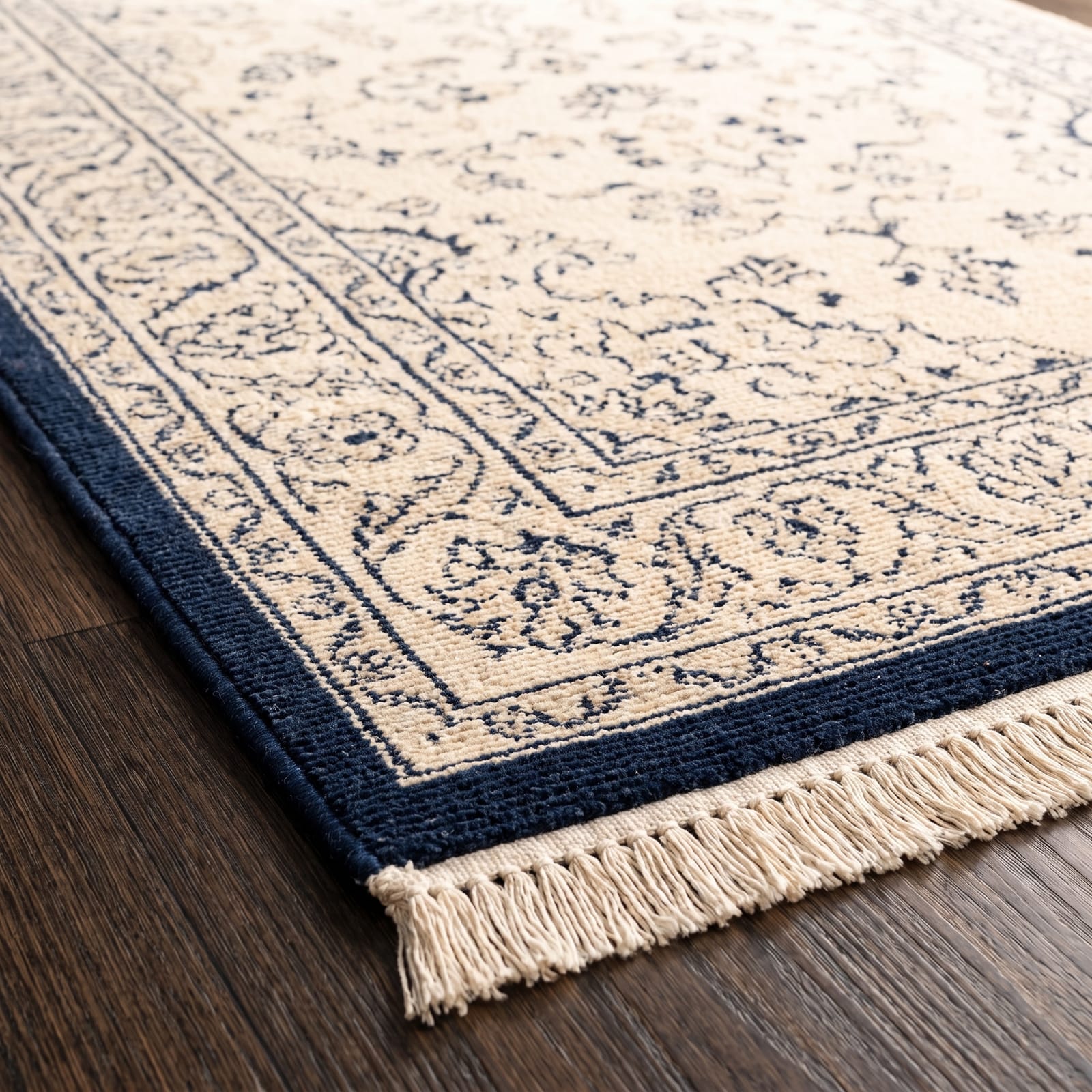
The Hokku Designs Cream and Navy Traditional Patterned Woven Base Washable Rug accomplishes all three jobs. The ground color is a warm cream—not stark white, which would create too harsh a contrast against the navy walls, but a slightly amber-tinted ivory that reads as soft and aged. Against this cream field, a traditional medallion pattern is rendered in navy blue, pulling the wall color down to the floor plane and creating a tonal dialogue between vertical and horizontal surfaces. The navy of the rug does not match the navy of the walls exactly—the rug’s pattern has a slightly warmer, more ink-like quality—but the relationship is close enough to register as intentional. The eye reads the hallway as a single coordinated environment rather than a dark room with a white rug dropped into it.
The construction is a flatwoven polyester and cotton blend, which addresses the practical demands of an entryway rug that most traditional rugs cannot meet. Flatweave construction means there is no raised pile to trap dirt, sand, or moisture tracked in from outside. The polyester component resists staining and fading. The integrated woven base eliminates the need for a separate rug pad on hard floors. Most critically, the rug is machine washable—a necessity for an entryway runner that absorbs the full daily impact of shoes, weather, and foot traffic.
The short hand-finished fringe at each end adds a classical detail that softens the rug’s edges against the hardwood floor. Fringe on a hallway runner is a small thing, but it signals a deliberate choice—this is not a rubber-backed utility mat placed at the door for function alone. It is a textile selected for its contribution to the room’s visual language, grounded in the same tradition as the gallery wall and the brass sconces above.
Runner placement in a narrow hallway follows a simple geometry: center the rug between the walls, leave four to six inches of exposed floor on each side, and position the runner so it begins at or near the console table and extends toward the hallway’s opposite end. The exposed floor margins prevent the rug from touching the baseboards, which would make the hallway feel narrower. The centered placement creates symmetrical negative space on both sides, reinforcing the corridor’s axis and guiding foot traffic along the runner’s length.
Keeping a Narrow Entryway Functional and Uncluttered
A narrow hallway’s greatest enemy is accumulation. Every object left on the console, every coat hung on a visible hook, every shoe kicked beneath the table adds visual noise to a space that has almost no room to absorb it. The moody navy gallery hallway works because every element earns its place through material contribution, and nothing remains that does not.
The tray contains. The vase provides height. The stems introduce organic movement. The sconces illuminate. The gallery wall occupies the vertical surface that would otherwise be blank. The runner defines the floor. Each element performs a job, and the spaces between them—the empty tabletop, the clear navy wall, the exposed floor beneath the splayed console legs—are as deliberate as the objects themselves.
Functional entryway storage, in a hallway this narrow, should be invisible. A slim drawer beneath the console tabletop, if the table includes one, can hold keys and a phone charger without adding visible bulk. Coat hooks, if needed, belong behind the entry door or inside a nearby closet—not mounted on the gallery wall, where they would interrupt the art arrangement and introduce the visual clutter of hanging fabric into a carefully controlled composition. Shoe storage should be addressed outside the hallway entirely: a closed cabinet in an adjacent room, a bench with enclosed storage by the back door, or a simple tray inside a closet.
The discipline of subtraction is what separates a styled entryway from a decorated one. A styled entryway looks the same on Tuesday as it does on Saturday—the same three objects on the console, the same clear walkway, the same quiet composition of dark walls, warm light, and restrained material warmth. A decorated entryway looks good in the photograph and chaotic by the end of the first week. In a narrow hallway, there is no room for the difference.
Dusk in the Navy Corridor
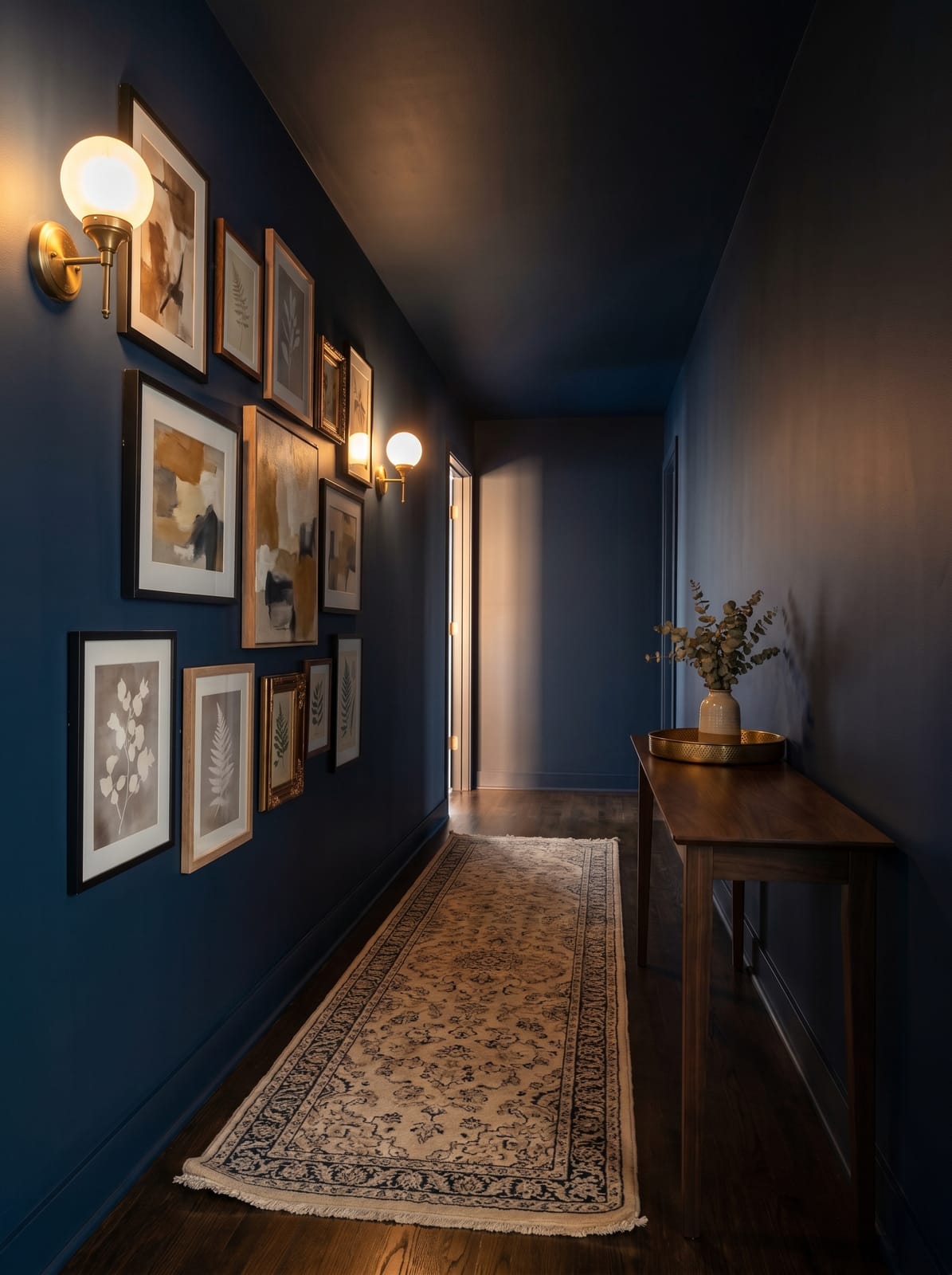
As the afternoon light drops and the window at the hallway’s end dims from warm white to a slate blue-grey, the corridor undergoes its daily transformation. The sconces come on—two warm opal globes glowing symmetrically against the deep navy walls, their aged brass mounts catching a thin line of amber reflection along each curved arm.
The navy paint, which reads at midday as a confident dark blue with cool undertones, deepens now into something closer to indigo—a color that seems to gain saturation as the ambient light drops. The gallery frames, evenly lit by the flanking sconces, cast soft rectangular shadows on the wall behind them, the frames’ edges defined more sharply in the low, directional light than they were in the flat illumination of noon. Each piece in the gallery becomes more present, more individual, as the overhead glare that flattened them during the day gives way to focused side-lighting.
The walnut console shifts from its daytime honey-amber to a darker, more figured warmth—the grain lines standing out in sharper relief as the sconce light rakes across the surface at a low angle. The brass-tone tray, which read during the day as a simple gold circle against the wood, now catches the full force of the nearest sconce and throws a diffused warm reflection upward toward the gallery wall. The ceramic vase beside it glows—its reactive crackle glaze catching the amber light in a hundred tiny fractures, each one refracting at a slightly different angle, the surface alive with a quiet, geological shimmer.
The runner rug, its cream field muted in the low light, grounds the corridor with a soft horizontal presence. The navy medallion pattern, barely visible during the bright hours when the cream field dominated, now reads more clearly against the deeper tonal range—the rug and the walls finding their closest color harmony in the transitional half-light of dusk.
The hallway is at its best in this hour. The darkness is no longer architectural—it is atmospheric, warm, held in place by the two brass globes and the slim walnut table and the cream textile underfoot. The front door opens. The corridor takes you in. You have arrived somewhere.
Sources & Details
Explore the complete source list for this room, from the anchor pieces to the smaller finishing details.
Source note: Some links in this source list may be affiliate links, which means we may earn a commission at no extra cost to you. As an Amazon Associate I earn from qualifying purchases.
Gold Stainless Steel Decorative Tray
Plated stainless steel with a polished deep gold or brass-tone finish and a raised rim.
A shallow round tray with a warm brass-tone finish that visually matches the console styling crop and corrals small entryway objects.
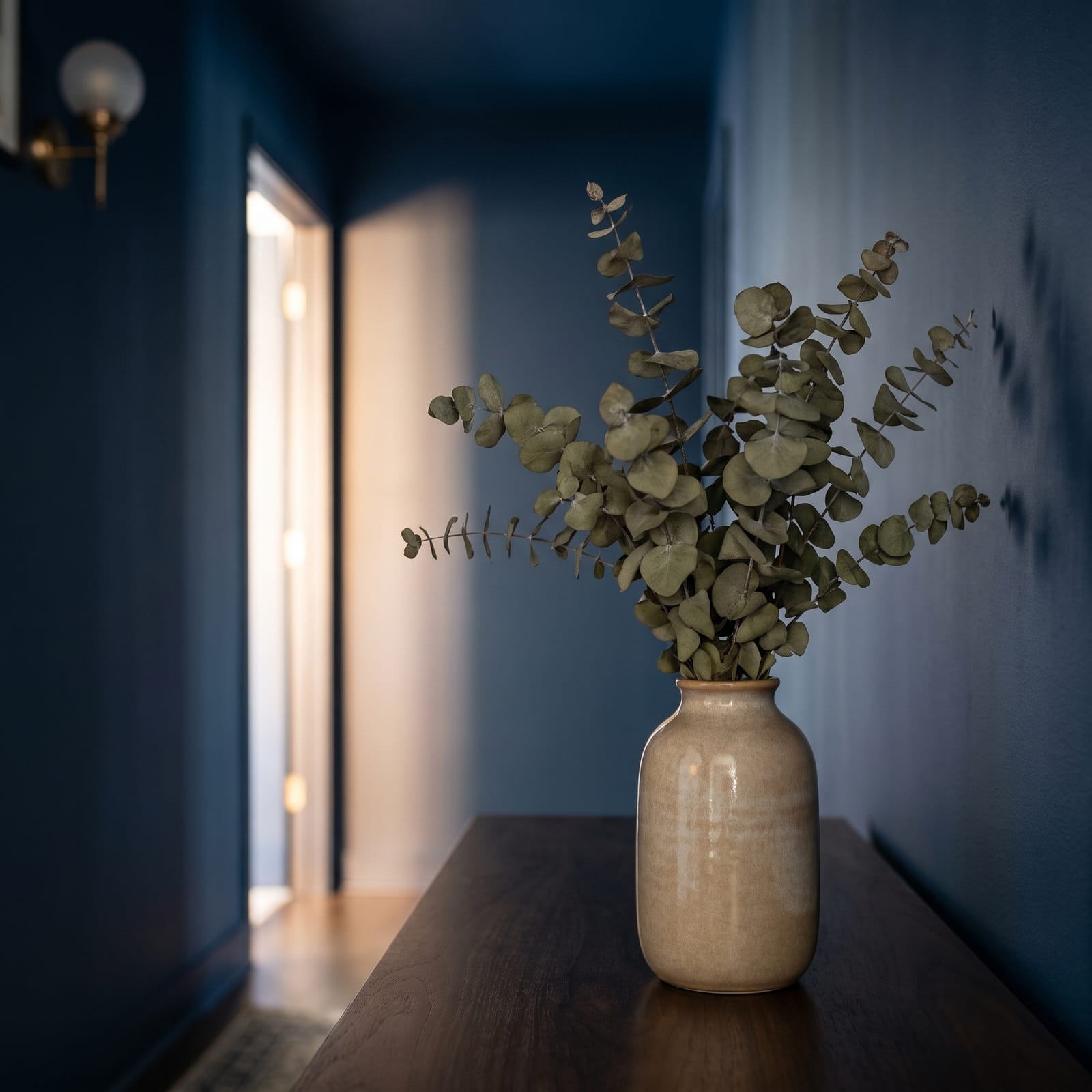
White Reactive Glaze Bud Vase
Ceramic bud vase with a white reactive crackle glaze and natural variation.
The reactive glaze, warm off-white tone, and bottleneck form closely match the vase crop; preserved eucalyptus or similar greenery can be styled separately for height and movement.
Frequently Asked Questions
Is navy blue too dark for a narrow hallway?
Navy blue is one of the most effective colors for a narrow hallway precisely because of its depth. Light wall colors in tight corridors tend to expose every dimensional shortcoming—the eye reads the walls as flat, close, and clinical. A saturated navy absorbs light rather than bouncing it between parallel surfaces, which softens the perception of the walls' proximity and reduces the visual flicker of reflections in a confined space. The key is to pair the dark paint with controlled warm lighting, such as aged brass globe sconces positioned at eye level, which create focused pools of amber glow against the dark surface. The navy then reads as atmospheric and intentional rather than claustrophobic. This is the same strategy used in fine dining restaurants and boutique hotel corridors, where low light levels and dark walls create an intimate passage that draws you forward.
What size console table works best in a narrow entryway?
For a hallway narrower than forty-eight inches, the console table's depth is the critical measurement—not its length. A depth between ten and fourteen inches keeps the table flush against the wall while preserving a walkway of at least thirty inches, which is the minimum comfortable passage width for a single person. Length depends on the available wall span, but a table between thirty-six and forty-four inches provides enough surface for a tray, a vase, and a small stack of mail without overwhelming the corridor. Splayed or tapered legs are preferable to straight legs in narrow spaces because they angle inward beneath the tabletop, reducing the footprint at floor level where ankle clearance matters most. Avoid console tables with lower shelves in very tight hallways—they add visual bulk and collect clutter that makes the passage feel obstructed.
How do you style a console table without creating clutter?
The rule for entryway console styling is restraint governed by odd numbers and varied heights. Start with a single round tray placed slightly off-center on the tabletop—this contains everyday objects like keys and wallets without letting them scatter across the surface. Add a ceramic bud vase at the opposite end, choosing a form with enough height to break the horizontal plane of the table and introduce a vertical element. A few stems of preserved eucalyptus or dried botanicals in the vase provide organic movement without requiring maintenance. The total object count on the console surface should stay between three and five items. Anything above five begins to read as accumulation rather than curation. Leave at least thirty percent of the tabletop surface visibly empty—negative space is what makes the remaining objects look placed rather than dumped.
What color rug pairs well with navy blue hallway walls?
A cream or ivory ground with navy patterning creates the strongest visual relationship because it pulls color from the walls into the floor plane without doubling the darkness of the space. Traditional medallion or geometric motifs in navy on a light field read as grounded and classical, which complements the moody wall color without competing for attention. Avoid solid navy rugs in a navy hallway—they merge with the walls at floor level and erase the spatial boundary between vertical and horizontal surfaces. Similarly, avoid bright white runners, which create too harsh a contrast in a dark corridor and show every mark. A cream-based washable flatweave with navy pattern elements, fringe detailing, and a low pile profile offers the ideal balance: enough visual interest to anchor the hallway, enough practicality to withstand daily foot traffic, and enough warmth to soften the transition between the dark walls and the hardwood floor.
How far apart should gallery wall frames be spaced?
The standard gallery spacing for residential hallways is two to three inches between frames measured edge to edge. This creates enough breathing room for each piece to register as individual while maintaining the visual cohesion of a grouped collection. In a narrow hallway, resist the temptation to fill every inch of wall—leave at least six to eight inches of clear wall space between the outer edges of the gallery arrangement and any architectural elements like sconces, door frames, or crown molding. The center of the gallery grouping should sit at fifty-seven to sixty inches from the floor, which places the visual midpoint at average standing eye height. For a two-column vertical arrangement flanking a centered element, measure from the center outward to ensure symmetry. Use kraft paper templates taped to the wall before driving any nails—the cost of patience is zero, and the cost of unnecessary holes in a freshly painted navy wall is a full afternoon of touch-up.
Do brass sconces work well against navy blue walls?
Brass and navy is one of the most reliable material pairings in interior design because the warm gold of brass occupies the opposite end of the color temperature spectrum from the cool blue of navy. This complementary relationship means the metal appears to glow against the dark background—the navy absorbs the ambient light that would normally flatten the brass finish, leaving only the warm, focused reflections from the fixture itself. Aged brass finishes are particularly effective because their slightly muted, antique surface does not produce the sharp mirror-like reflections of polished brass, which can read as harsh in a dark corridor. A frosted opal glass shade further softens the light output, replacing the direct glare of an exposed bulb with a diffused, milky glow that washes the surrounding navy wall in a warm amber halo. The result is a controlled interplay of warm light against cool depth.
How do you make a moody entryway feel welcoming instead of oppressive?
The difference between a moody entryway and a gloomy one comes down to warmth, not brightness. Moody spaces use darkness as a deliberate design element, but they counterbalance it with warm material tones—walnut wood, brass metalwork, cream textiles, and natural greenery. The critical technique is layered lighting: wall-mounted sconces at sixty to sixty-six inches from the floor provide mid-level ambient warmth, while a light-colored runner rug on the floor reflects available light upward and defines the walkway. Organic elements like a ceramic vase with preserved greenery introduce life and vertical interest. The walls should feel like a backdrop for curated objects, not a void. If the hallway has no natural light source, consider a warm-toned LED bulb rated between twenty-seven hundred and three thousand Kelvin in the sconces—this produces the amber glow of late-afternoon sunlight rather than the blue-white cast of overhead fluorescent lighting.
What materials pair well with navy blue walls in an entryway?
Navy blue walls function as a deep, neutral canvas that reveals the character of the materials placed against them. Walnut wood is the natural starting point—its warm chocolate-to-amber grain provides organic warmth against the cool blue. Brass in aged or brushed finishes introduces metallic warmth without the formality of polished chrome or the coolness of brushed nickel. Ceramic in off-white or cream reactive glazes adds a handmade, artisanal quality whose surface irregularities catch light in unpredictable ways against the flat matte wall. Woven textiles in cream and navy flatweave patterns bring texture to the floor plane and create a dialogue between the wall color and the ground. Preserved eucalyptus or dried botanical stems provide the final layer—organic forms in muted greens and silvers that soften the geometric arrangement of frames, furniture, and fixtures. The common thread is a warm, slightly imperfect, natural material palette that makes the dark walls feel inhabited rather than industrial.