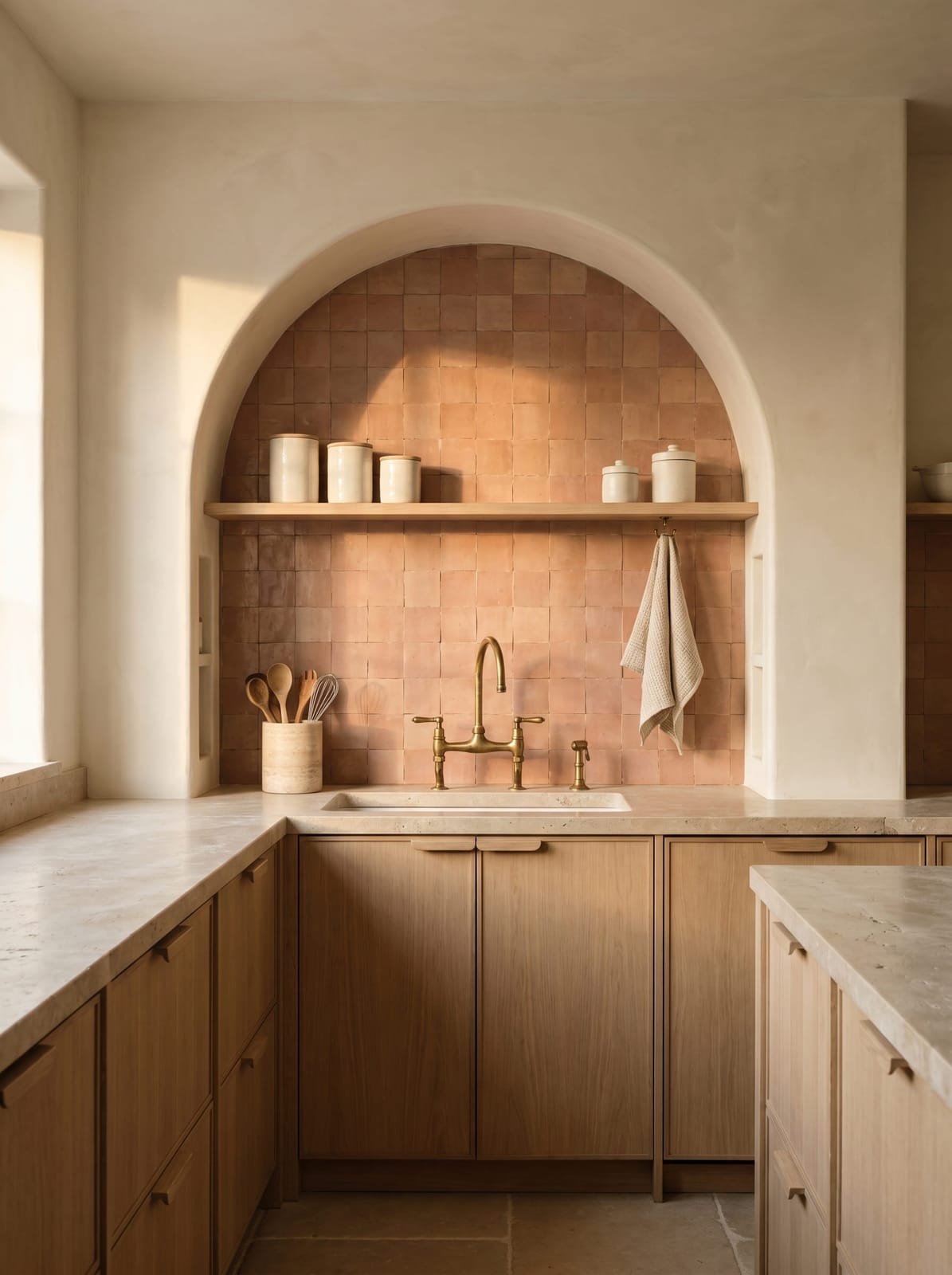
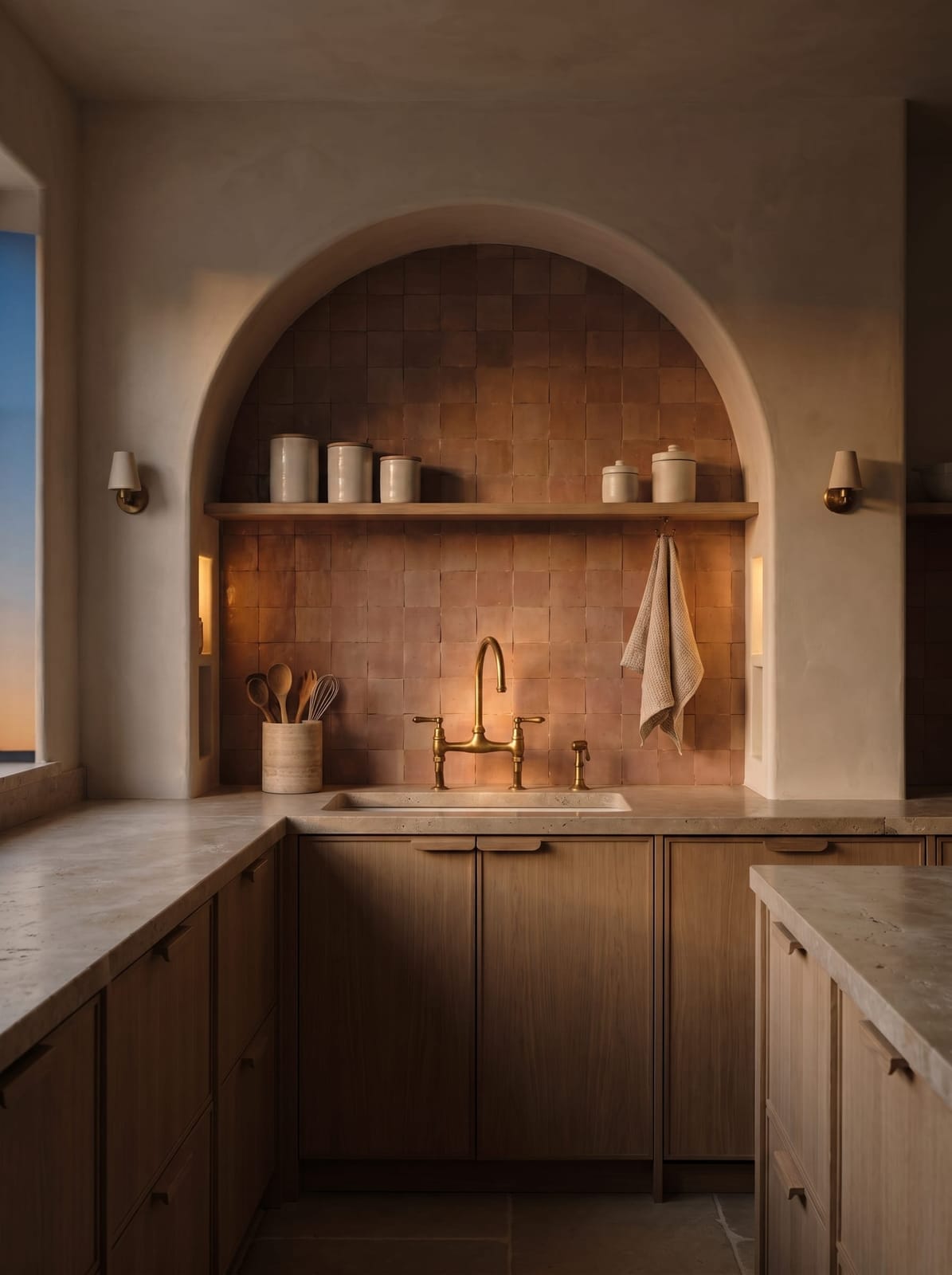
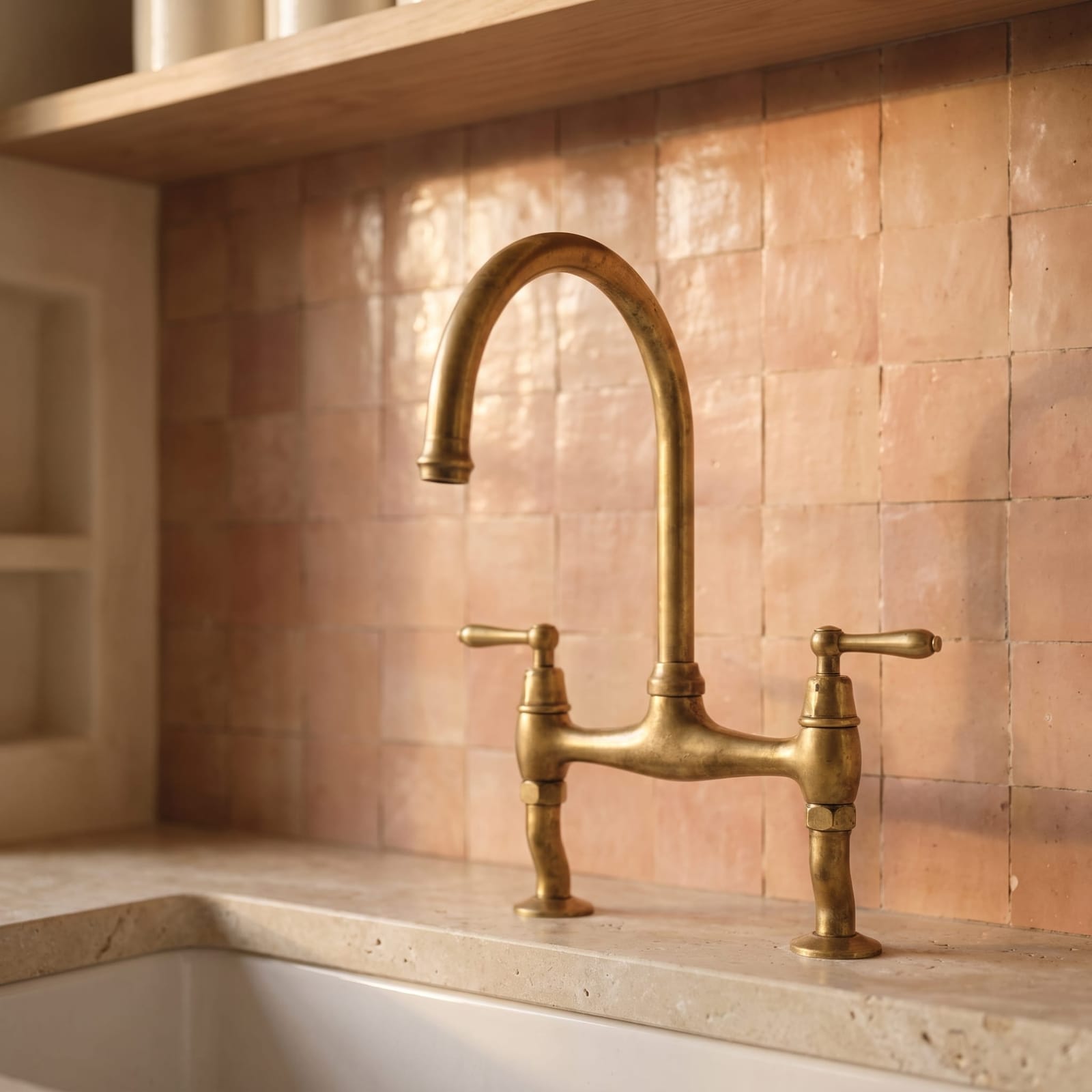
The best kitchen sinks are not designed to disappear. They are designed to be arrived at. In this kitchen, the sink sits inside a recessed arch lined with handmade terracotta zellige tiles, and the effect is closer to approaching a hearth than a basin. The glazed clay catches light from the window and redistributes it in soft, liquid flashes across the curved interior of the niche. The brass bridge faucet rises from the countertop in a clean vertical arc, its gooseneck spout bending over the basin like a question mark. Everything about the composition says: stand here. This is where the room begins.
The materials in this kitchen were chosen for their refusal to look manufactured. Zellige tiles are hand-molded and hand-cut in Morocco, each piece carrying the slight wobble and glaze pooling of individual craft. The oak cabinetry is finished in a clear matte that lets the grain speak without varnish or stain. The travertine utensil crock on the counter was carved from stone deposited by mineral springs. Even the waffle-weave towel hanging from the brass hook beside the sink has the dimensional texture of hand-loomed cloth. Nothing here came off a production line looking identical to the piece beside it. That irregularity is not a flaw. It is the entire design strategy.
The Alcove and Its Glaze
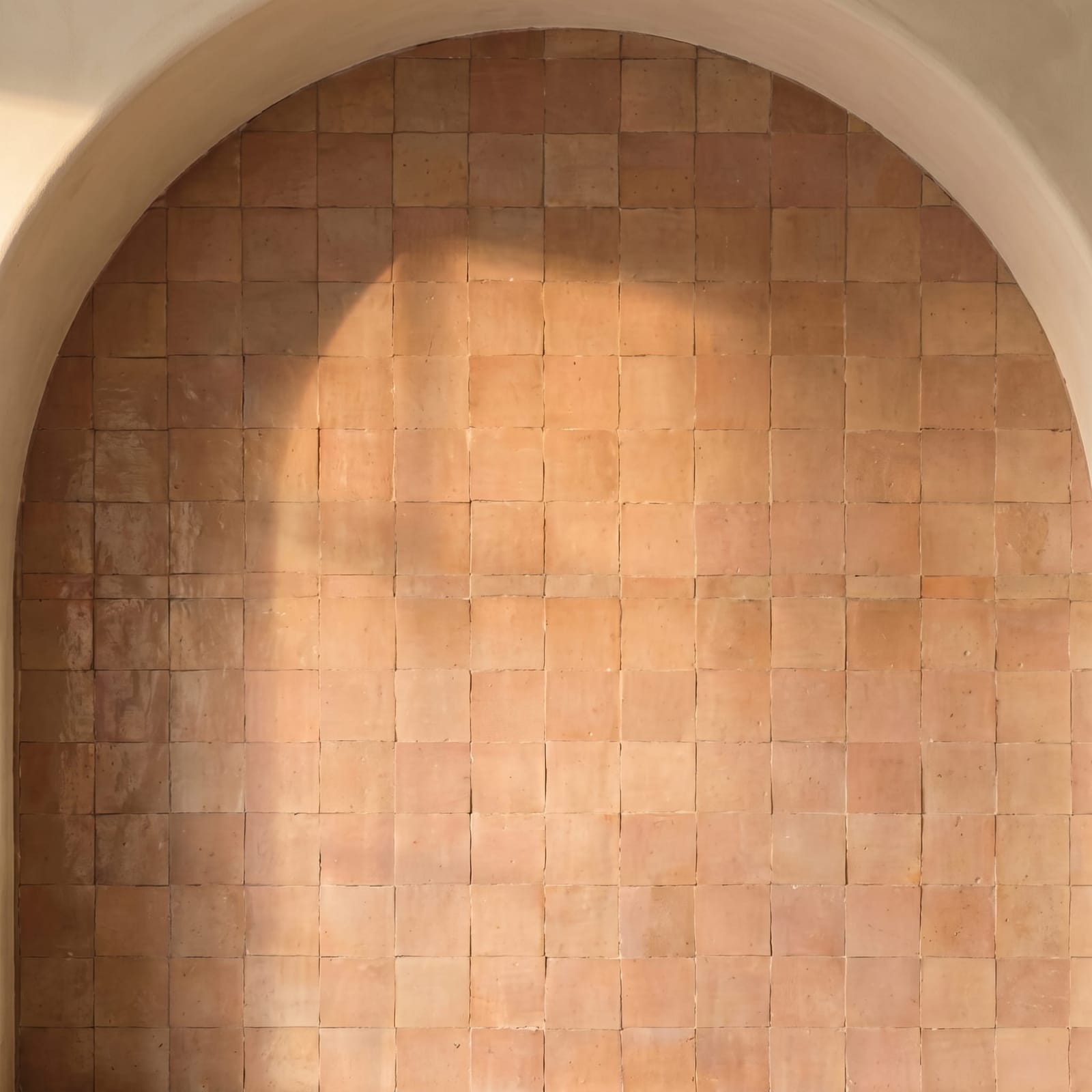
The arched niche is the organizational center of the kitchen, and the zellige tiles that line it are the most visually active surface in the room. Each tile is a 4×4-inch square of fired Moroccan clay, glazed by hand in a pink-terracotta tone that shifts from soft blush to warm amber depending on how much glaze pooled on the surface during firing. Set edge to edge with thin grout lines in a matching sand tone, the tiles read not as a grid of individual squares but as a continuous, shimmering skin draped over the curve of the arch.
The glaze is what makes zellige different from every other tile on the market. It is applied unevenly — thicker in the centers, thinner at the edges, occasionally crackled where the glass cooled too quickly. This irregularity means the surface catches light at unpredictable angles. Under the direct window light of midday, the tiles flash with bright, wet highlights. At dusk, when the under-shelf lighting takes over, the same surface deepens to a warm, smoky amber, and the glaze cracks become visible as fine, dark lines across the clay body. The arch does not look the same at any two hours of the day, and that constant, slow transformation is what gives the niche its life.
The shape of the arch itself matters. A squared recess would create four hard corners where the tile work terminates abruptly. The arch eliminates those interruptions, allowing the zellige to flow in a continuous curve from countertop to soffit. The tiles do not stop. They turn. And that turning motion gives the niche a sense of enclosure — a protected interior space within the larger room — that a flat backsplash cannot create.
The Bridge and the Basin
The faucet at the center of the arch is a brushed brass bridge model with a high gooseneck spout and lever handles. The bridge — a horizontal pipe connecting the hot and cold supply lines above the counter deck — is the defining structural feature. It elevates the faucet from a mechanical fitting into an architectural element, a small brass framework standing at the center of the tiled niche like a piece of scaffold in front of a mosaic.
The brushed brass finish is important here. Polished brass would compete with the glaze of the zellige tiles, creating two sources of high reflectivity in the same visual field. Brushed brass absorbs light rather than bouncing it. It reads as warm and matte, coordinating with the soft sheen of the zellige without mirroring it. Over time, the brass will develop a gentle patina — a darkening at the base of the handles, a slight clouding where water sits on the spout — that makes it look more like the tiles and the stone around it. This is a faucet that ages into its kitchen rather than aging out of it.
The side sprayer, mounted to the right of the bridge on its own deck hole, extends the functionality of the faucet without cluttering the niche. The sprayer head matches the brushed brass of the main fixture, and its hose retracts below the counter when not in use. The result is a working sink with full prep capability that still reads, at rest, as a composed still life of brass and clay.
Oak Without Interruption
Below the countertop, the kitchen cabinets are built from light white oak finished with a clear matte sealant that protects the wood without adding sheen or color. The grain is visible — quiet, straight lines with occasional cathedrals — and the wood reads as pale, warm, and clean.
The cabinet hardware is the most restrained detail in the room. Instead of metal knobs or bar pulls, the drawers and doors are fitted with solid oak pulls designed with a soft, rounded profile. The pulls mount flush against the face of the cabinet, sitting in the narrow shadow line between the door edge and the frame. From across the room, the hardware is nearly invisible. The cabinetry reads as a series of smooth, unbroken timber planes, and the visual rhythm of the kitchen stays horizontal and calm.
This decision — wood handles on wood cabinets — is a deliberate rejection of the typical contrast strategy in kitchen design, where metal hardware is used to punctuate and define individual cabinet doors. Here, the pulls disappear into the surface they serve. The oak speaks as one continuous material, from the cabinet faces to the drawer fronts to the handles themselves, and the only metal in the room is concentrated at the faucet and the towel hook, where it belongs.
Stone Weight on the Counter
The countertop between the sink and the stove holds a single heavy object: a cylindrical travertine utensil crock standing roughly six and a half inches tall. The stone is natural beige travertine — honed but unfilled, so the characteristic pitting of the limestone surface is visible as small, irregular voids scattered across the cylinder. Wooden cooking spoons and spatulas stand upright inside the crock, their handles fanning slightly above the stone rim.
The weight of the piece matters. A ceramic or wooden utensil holder of the same size would weigh a fraction of what this stone cylinder weighs, and it would shift every time a spoon was pulled from the group. The travertine does not move. It sits on the counter with the permanence of a bollard, and its mineral surface — cool, dense, faintly gritty to the touch — introduces a geological presence into the kitchen that the smooth oak and glazed clay do not provide.
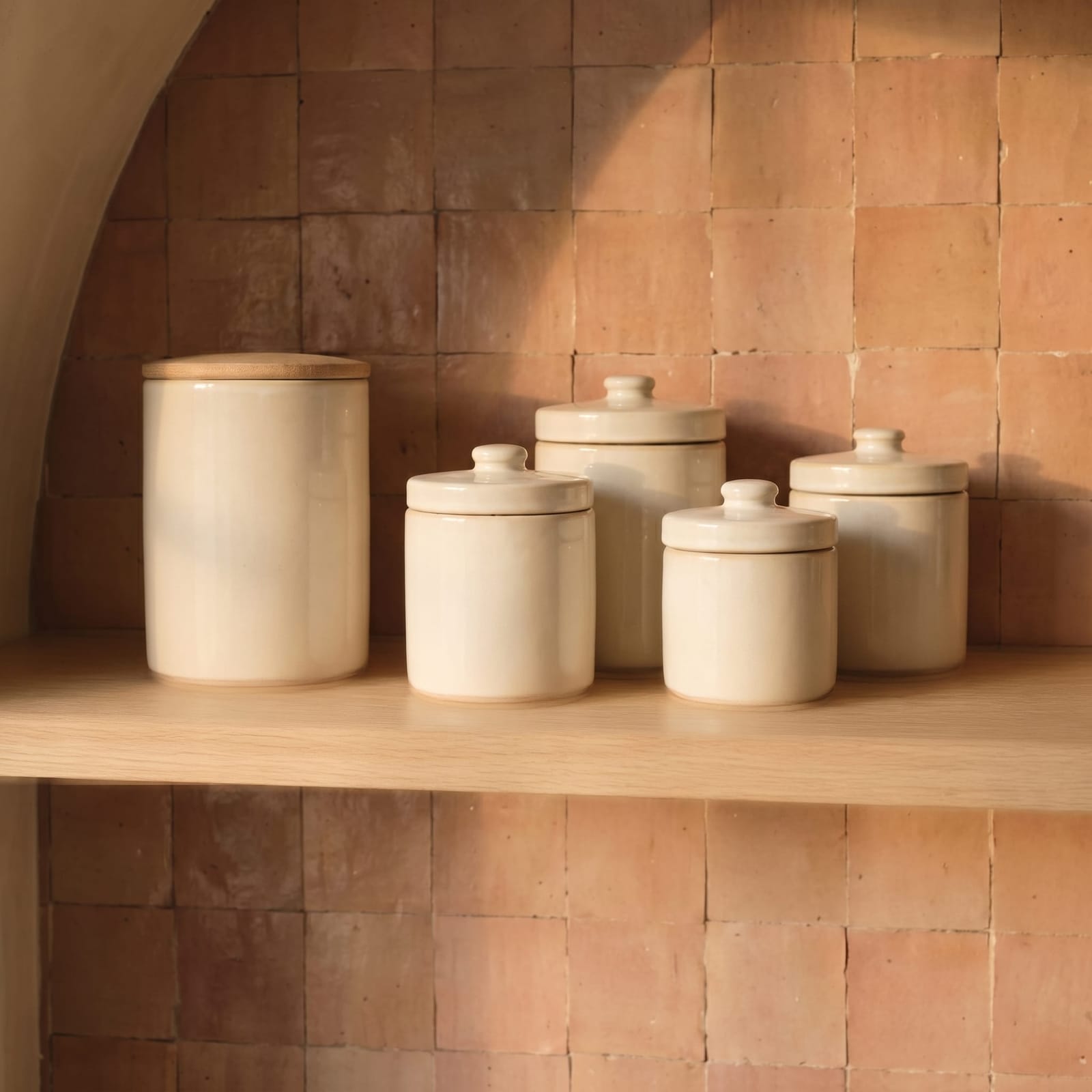
On the floating shelf above the countertop, a set of three speckled cream stoneware canisters with flat wooden lids provides storage for dry goods. The canisters are graduated in size, the tallest at the back, and their semimatte sesame-cream glaze carries a fine speckle that reads as handmade without looking rustic. The wooden lids echo the oak of the cabinets below. The canisters replace branded packaging — coffee bags, tea boxes, flour sacks — with objects that are visually quiet and worth displaying.
The Towel as Texture
Beside the sink, hanging from a small brass wall hook, a waffle-weave kitchen towel in warm terracotta serves as the room’s softest surface. The honeycomb texture of the weave creates a fine, dimensional grid that absorbs light differently from every other material in the kitchen. The zellige is glossy. The oak is matte. The travertine is mineral. The towel is fibrous, pliable, and warm, and its terracotta tone bridges the pink-clay of the backsplash tiles and the beige of the stone crock.
It is a small detail, but it solves a real design problem. Kitchens dominated by hard surfaces — stone, tile, wood, metal — can feel acoustically and visually rigid. A single piece of woven cloth introduces the softness that the room needs without requiring curtains, upholstery, or any other fabric commitment. The towel hangs. The towel drapes. And in a room where every other surface is fixed and permanent, that quiet flexibility is enough.
Time Moves Differently Here
There is a reason why handmade materials make a kitchen feel slower than engineered ones. A zellige tile is the record of a single person pressing clay into a mold, glazing the surface, and cutting the edges with a chisel. A travertine crock is the product of mineral deposition that occurred over thousands of years. An oak pull was shaped from a tree that grew for decades. These materials carry time inside them, and a room built from these materials inherits that quality.
A kitchen lined with engineered quartz, porcelain-look tiles, and chrome fixtures can be beautiful, but it is a beauty that arrives fully finished. It will not change. A kitchen lined with zellige, travertine, oak, and brass is a beauty that unfolds. The glaze will develop a network of fine cracks over the years. The brass will darken. The oak will mellow from pale honey to warm amber. The stone will absorb the oils of daily use and deepen in tone. Every material in this kitchen is moving, slowly, toward a version of itself that does not exist yet. And that slow becoming is the most luxurious quality a room can have.
Sources & Details
Explore the complete source list for this room, from the anchor pieces to the smaller finishing details.
Source note: Some links in this source list may be affiliate links, which means we may earn a commission at no extra cost to you. As an Amazon Associate I earn from qualifying purchases.
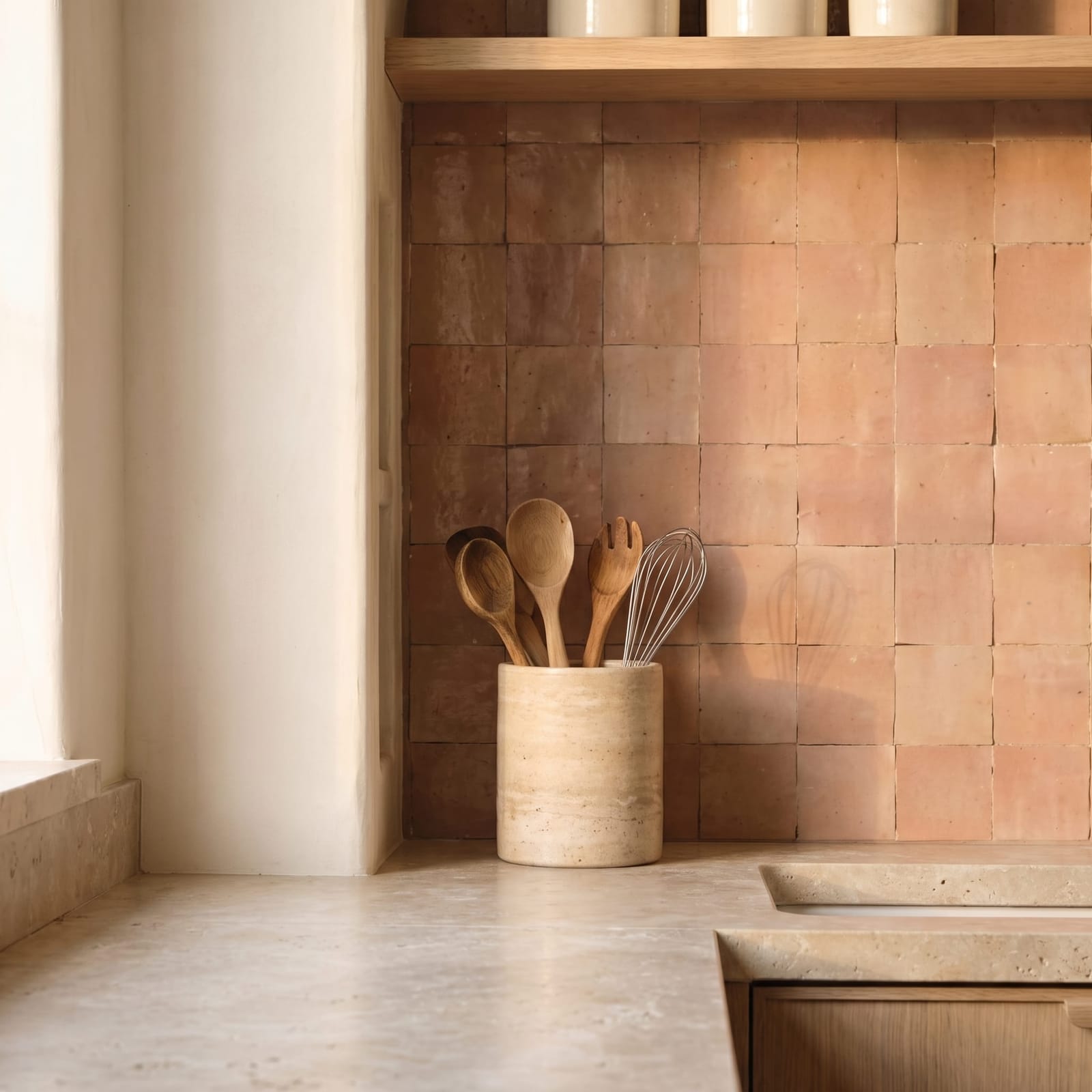
Beige Travertine Stone Utensil Holder
6.5-inch tall cylinder utensil holder handcrafted from natural honed beige travertine stone.
A solid beige travertine crock brings mineral weight and clean structure to organize wooden utensils.
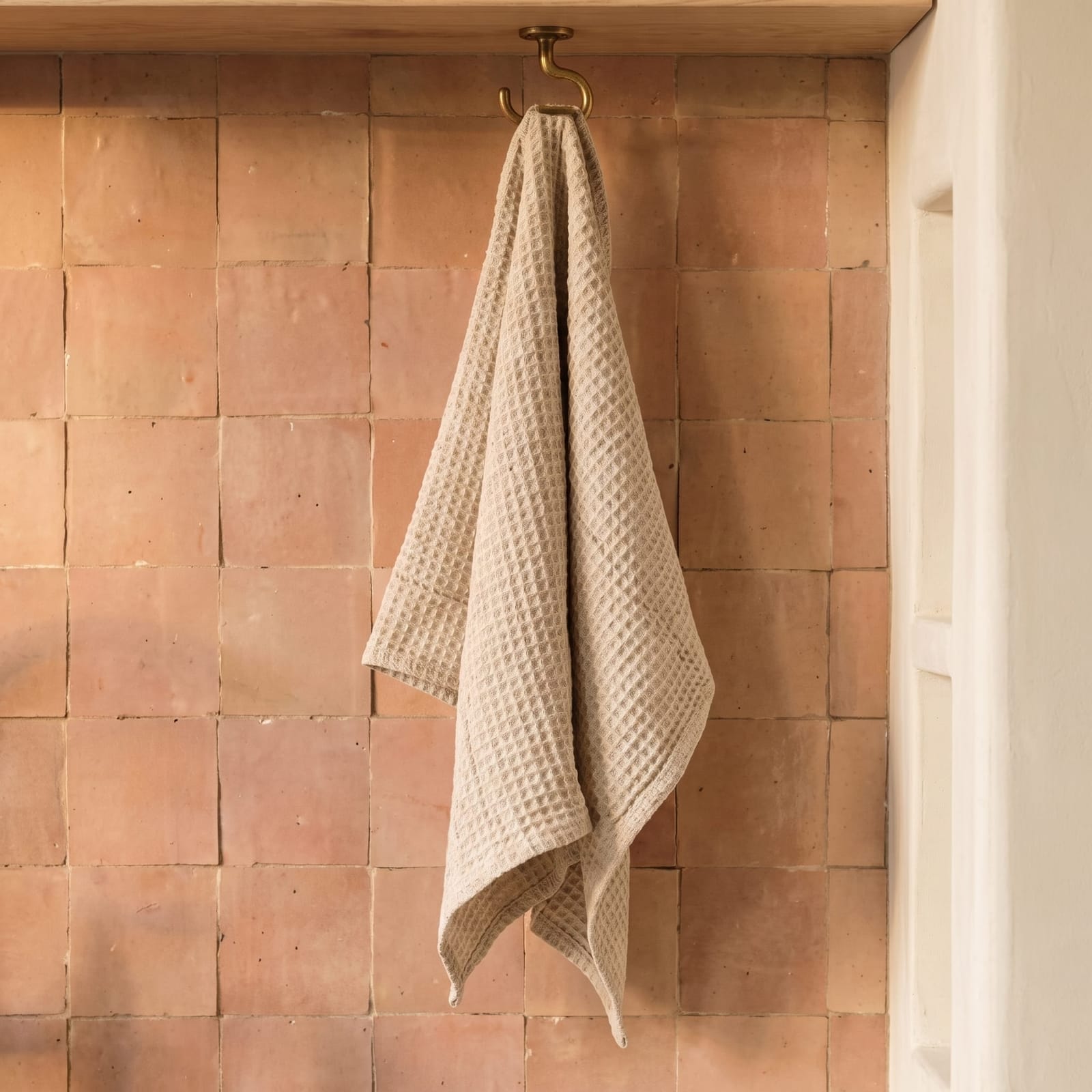
Sandy Tan Waffle Kitchen Towel
Cotton waffle-weave kitchen towel in a warm tan/oatmeal shade.
A solid waffle kitchen towel in sandy tan coordinates with the warm wood and plaster tones of the sink alcove.
Frequently Asked Questions
Why recess a kitchen sink inside a tiled arch?
A recessed arch transforms the sink from a flat, utilitarian zone into a defined architectural volume. The depth of the niche creates natural shadow lines that frame the faucet and basin, giving the eye a clear focal point in the kitchen. Lining the alcove with glossy zellige tiles amplifies this effect because the curved surface catches and scatters light from multiple angles, creating a shimmering interior that a flat backsplash cannot achieve. The arch also physically separates the wet prep zone from the surrounding countertop, making the kitchen feel organized into distinct activity areas without the need for walls or partitions.
Are zellige tiles practical for a kitchen backsplash?
Glazed zellige tiles are exceptionally practical for kitchen backsplashes. The glaze is a glass-based coating fired at high temperature, creating a surface that is impervious to grease, water, and most food stains. Because each tile is hand-cut with slightly irregular edges, the tiles are set close together with very thin grout lines, reducing the maintenance burden associated with wide grout joints. The textured, undulating surface is also visually forgiving — minor splatters, water spots, and cooking residue blend into the natural variation of the glaze rather than standing out against a uniform surface. Cleaning requires only a wipe with warm water and a soft cloth.
What is a bridge faucet and why choose one for a kitchen?
A bridge faucet connects the hot and cold water supply lines above the countertop in a visible horizontal pipe called the bridge. Unlike standard single-hole or widespread faucets where the plumbing connections are hidden below the deck, a bridge faucet exposes its structure as a deliberate design feature. The raised bridge creates a small architectural moment at the sink, adding visual weight and classic character. In a kitchen designed around handmade materials like zellige and oak, a brushed brass bridge faucet with a gooseneck spout introduces a sense of craft and permanence that mass-produced pull-down sprayers cannot replicate.
How do solid wood cabinet pulls affect kitchen design?
Replacing metal hardware with solid wood pulls fundamentally changes the tactile and visual character of a kitchen. Metal handles create small points of contrast — reflective highlights against a matte cabinet surface. Wood pulls, by contrast, blend into the cabinet face, creating a continuous material read from door to handle. When the pulls are designed with soft, rounded profiles that mount flush against the drawer lip, they eliminate the protruding hardware silhouette entirely. The result is a kitchen where the cabinetry reads as clean, uninterrupted planes of timber rather than a grid of doors punctuated by metal accents.
Is travertine durable enough for kitchen countertop accessories?
Natural travertine is a sedimentary limestone that is significantly harder and denser than it appears. A honed travertine utensil holder will not crack, chip, or degrade from daily kitchen use. Its weight — considerably heavier than ceramic or wood alternatives — prevents tipping when loaded with tall cooking utensils. The characteristic surface pitting of travertine is cosmetic, not structural, and can be left unfilled for a more organic texture or filled with resin for a smoother finish. The soft beige tones of natural travertine coordinate with warm kitchen palettes without introducing the visual coldness of marble or the uniformity of engineered stone.
How do you keep a minimalist kitchen counter from looking empty?
The distinction between minimalist and empty is material quality. An empty counter is a bare surface with nothing on it. A minimalist counter is a curated surface where every visible object earns its place through beauty, function, or both. In this kitchen, the counter holds a travertine utensil crock — a heavy, sculptural stone cylinder that organizes wooden spoons while serving as a textural counterpoint to the smooth countertop. On the floating shelf above, a set of three cream ceramic canisters with wooden lids provides daily storage in a form that is worth looking at. A single waffle-weave towel on a brass hook adds soft texture. Nothing is decorative in the conventional sense. Everything is functional. But every object was chosen because its material, color, and form contribute to the room.
What grout color works best with terracotta zellige tiles?
For terracotta-toned zellige, a grout color within the same warm family produces the most cohesive result. A warm sand or pale terracotta grout blends into the tile edges, allowing the natural glaze variation to dominate the visual field rather than a grid of contrasting grout lines. Avoid bright white grout, which creates a high-contrast grid that competes with the organic irregularity of handmade tiles. If you want a slightly more defined look, a soft cream grout provides subtle definition without the harshness of a full contrast. The goal is to let the tiles read as a continuous textured surface rather than a mosaic of individual squares.