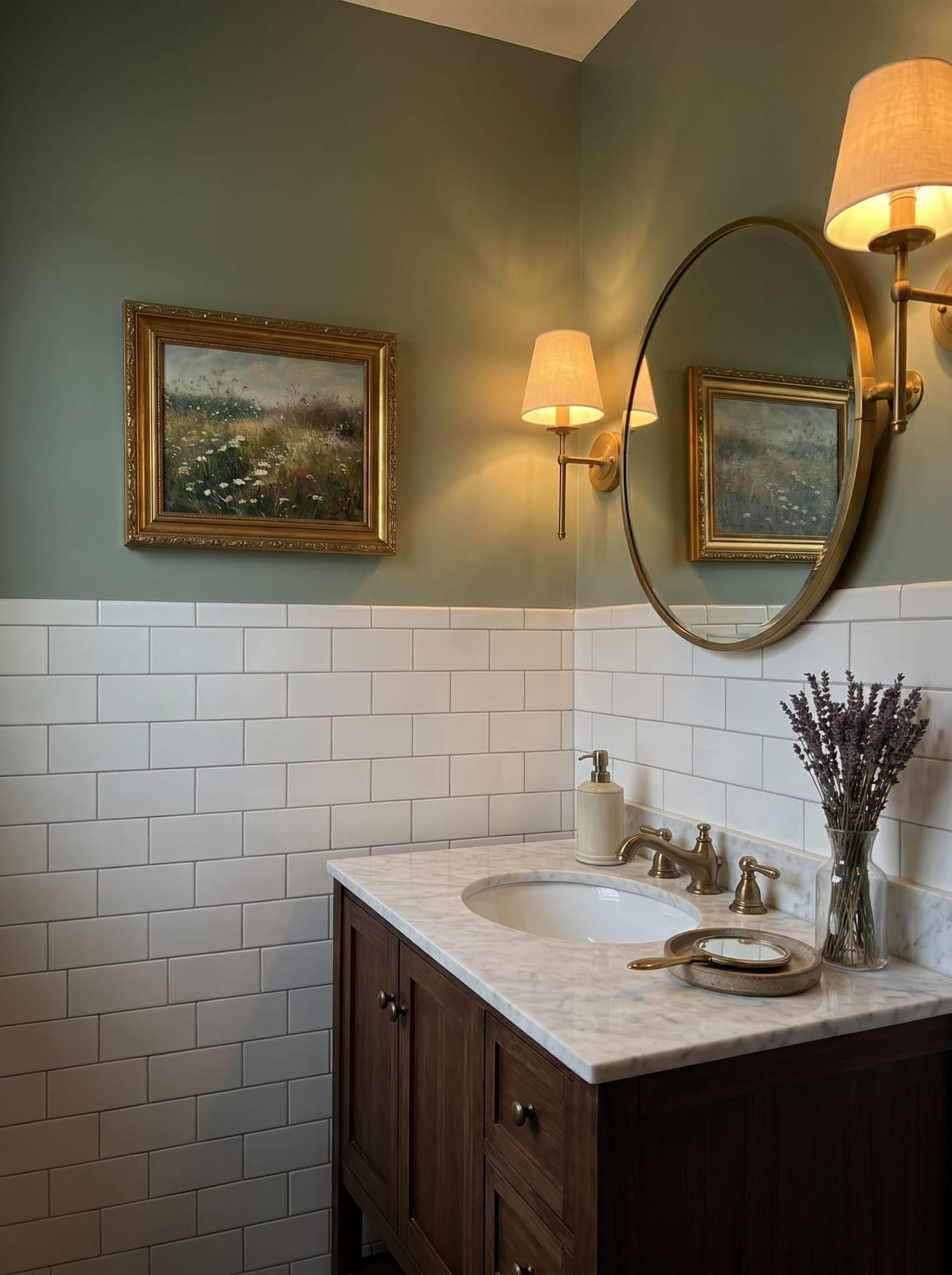
There is a particular kind of bathroom that does not try to be a spa, a gallery, or a minimalist statement. It tries to be a room in a house—a warm, considered space where every surface has been chosen for how it feels under the hand and how it ages over years of daily use. The sage green brass vanity bathroom belongs to that tradition.
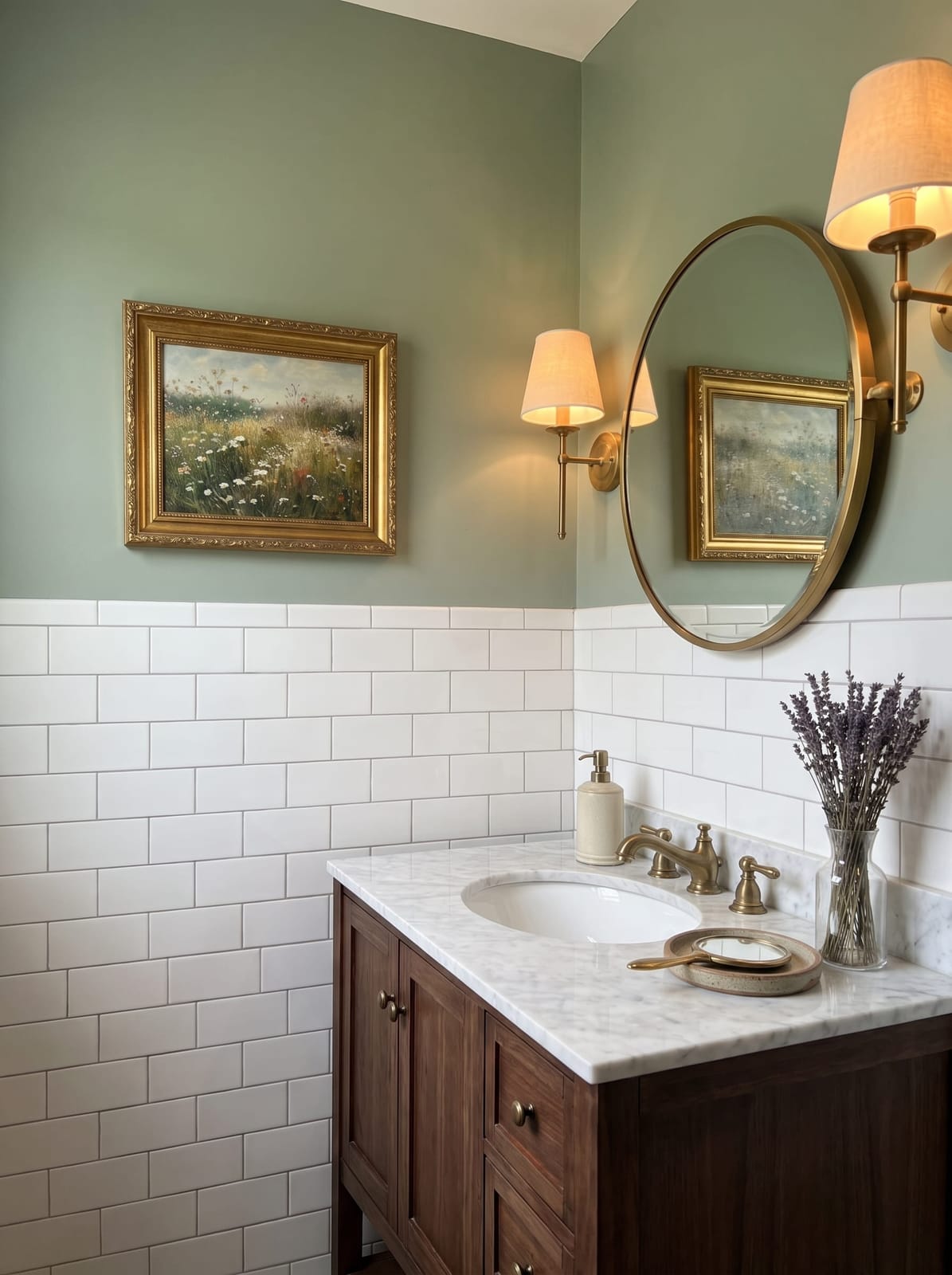
The walls above the wainscot are painted in sage green, a color that shifts between soft olive and warm grey depending on the hour. Below, bright white subway tiles catch and scatter whatever light enters the room. At the center of the wall, a walnut vanity stands on quiet brass hardware, its dark grain interrupted only by a slab of Carrara-veined marble and the curve of an antique gooseneck faucet. A circular mirror floats above the sink, flanked by two fabric-shaded sconces whose cream linen cones glow amber at dusk. It is a room built from five materials—wood, stone, brass, ceramic, linen—and it needs nothing else.
The Quiet Authority of Sage Green
Color choices in small rooms carry disproportionate weight. A bedroom can absorb a bold wall because the eye has distance to adjust. In a bathroom, you stand eighteen inches from the paint. The color fills your peripheral vision. It becomes atmospheric.
Sage green succeeds in this proximity because it is not truly green. It is a composite hue: a base of muted olive tempered by a substantial grey undertone and warmed by a trace of raw umber. These layered undertones suppress the chroma—the color’s intensity—so the wall never vibrates or competes with reflective surfaces. It reads instead as a tinted neutral, closer in behavioral terms to a warm grey or a putty than to a true botanical green.
What this means in practice is that sage adapts to its context. Against the bright white gloss of subway tile, it appears distinctly colored—present, identifiable, deliberate. Against the dark chocolate grain of walnut wood, it recedes, letting the timber’s natural figure dominate. Against brass, something more interesting happens: the yellow undertone in the sage and the yellow in the metal vibrate at a similar frequency, creating a harmonic relationship that feels effortless rather than coordinated. No single pairing needs to be forced because the color was chosen to participate, not to perform.
The room’s upper walls also host a Framed Country Meadow Landscape Painting in a heavy ornate gold frame sourced from Etsy’s nishartgallery. The print depicts a wildflower field rendered in muted golds, russets, and sage-adjacent greens—a palette drawn directly from the room’s own materials. Hung on the painted drywall above the wainscot line, the artwork breaks the flat monochrome expanse and introduces depth. The ornate gold frame connects visually to the brass faucet and mirror bezel below, drawing a vertical thread of warm metal from countertop to eye level. It is the kind of detail that transforms a bathroom from a tiled box into a curated interior.
White Subway Wainscoting: Structure Below, Color Above
The lower third of every wall is clad in Daltile Restore Bright White Subway Tile, a three-by-six-inch glossy ceramic tile laid in a staggered running bond pattern. This is not a decorative flourish. The tile wainscot performs three distinct jobs simultaneously: it waterproofs the splash zone around the sink and tub, it establishes a hard architectural datum line that structures the room’s proportions, and it provides a luminous white base that amplifies whatever natural light reaches the interior.
The glossy glaze is critical. A matte or honed tile would absorb light and blend quietly into the drywall above, losing the visual tension between the two surfaces. Glossy ceramic, by contrast, catches the sun at oblique angles and throws shimmering reflections across the adjacent walls and ceiling. These reflections are not sharp or distracting—they are the soft, rippling artifacts of a slightly uneven hand-glazed surface, and they give the lower wall a liquid quality that makes the room feel brighter than its actual light sources would suggest.
The wainscot terminates at thirty-six inches, capped with a simple ceramic bullnose trim that creates a clean horizontal ledge. This height is not arbitrary. It aligns precisely with the top of the vanity backsplash, forming a single unbroken line that wraps the room and reads as a continuous architectural datum. Below the line: hard, reflective, waterproof, white. Above: soft, absorbent, colored, matte. The division makes the ceiling appear higher by compressing visual weight toward the floor and giving the eye a clear resting point at counter height.
At the point where tile meets marble meets walnut—the vanity zone—the materials overlap and interact most densely. It is here that a small object like the Labrazel Frattura Crackle Ceramic Dispenser earns its place. The dispenser’s cream body, covered in a controlled network of kiln-fired crackle glaze, rhymes with the veining of the marble slab beneath it. Its solid brass pump head picks up the antique brass of the faucet three inches away. A lesser accessory—a plastic pump from a drugstore—would interrupt this material conversation. The Frattura participates in it.
A Walnut Vanity Built for Water
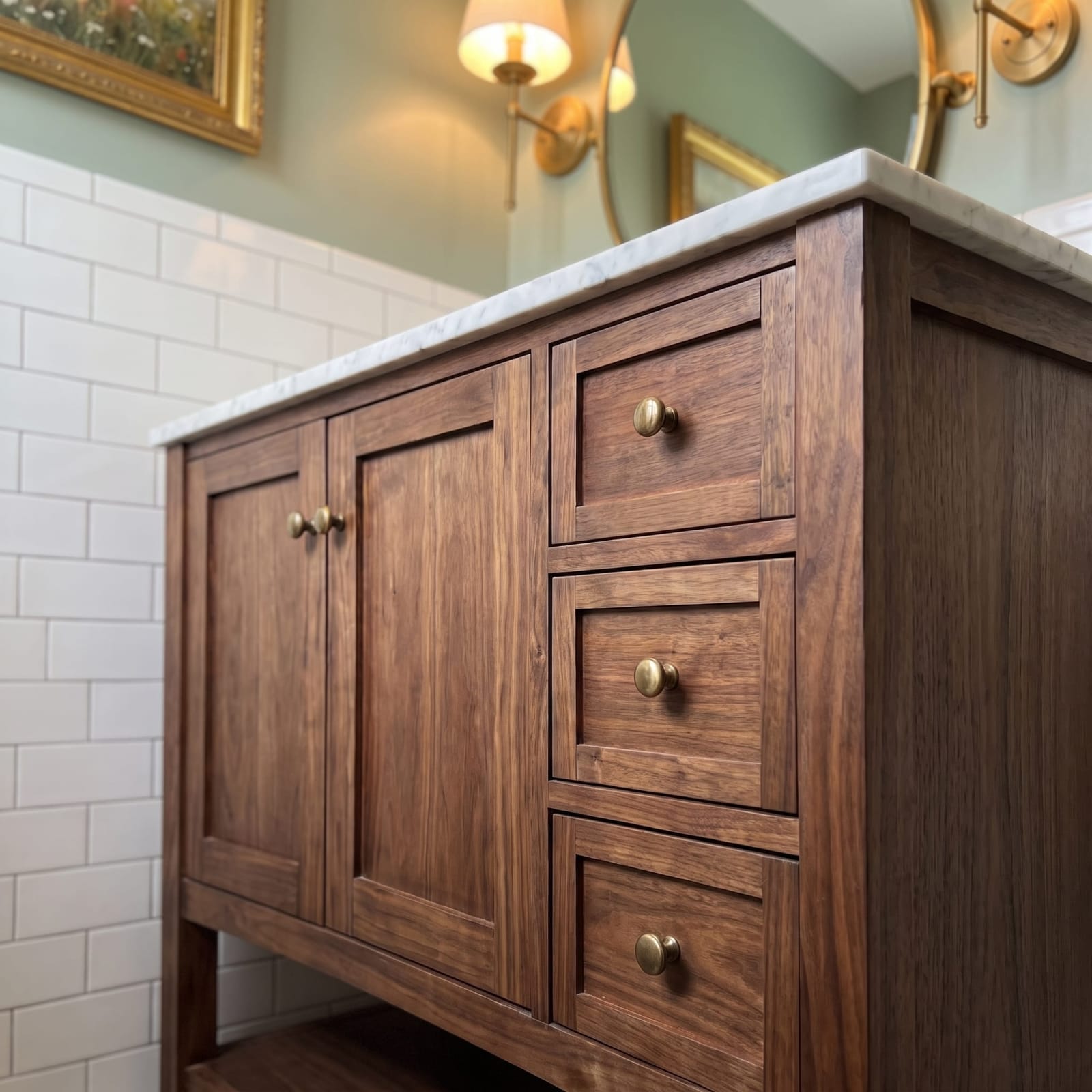
Walnut is not the obvious choice for a bathroom cabinet. Oak is harder. Maple is more common. Thermofoil is cheaper and immune to moisture. But walnut offers something none of those alternatives can: a grain pattern of extraordinary depth, with heartwood that ranges from pale honey to near-black chocolate, often within the same board. When you stand in front of a walnut vanity, the surface is never flat. The grain pulls the eye along its interlocking figure, revealing new details under different angles of light.
The Vanity Art 36-Inch Single Bathroom Vanity in walnut uses shaker-style construction—recessed panels framed by clean stiles and rails—which keeps the visual profile quiet and lets the wood speak. Three drawers stack vertically on one side, their faces cut from sequential boards so the grain flows continuously from top to bottom. A single cabinet door occupies the opposite bay. Small antique brass knobs, no larger than a thumbnail, punctuate each drawer face without interrupting the wood’s rhythm.
The vanity is topped with an engineered Carrara marble slab. Engineered marble uses real marble particles bound in resin, producing a surface that captures the veined, luminous character of quarried Carrara while resisting the etching and staining that plague natural stone in wet environments. The white background with soft grey veining acts as a visual bridge: it is bright enough to connect with the subway tile wainscot and warm enough to sit comfortably against the walnut below. A white ceramic undermount sink is mounted flush beneath the slab, preserving the unbroken marble plane and keeping the countertop easy to wipe clean.
The intersection of walnut, marble, and white tile is what gives this vanity its quiet authority. No single material is loud. Each one defers to its neighbor, creating a layered composition that rewards close looking without demanding it.
Antique Brass: The Faucet as Sculptural Object
The plumbing in a bathroom is often treated as a utilitarian necessity—chosen for function, installed without ceremony. In this room, the Kingston Brass Heritage Widespread Faucet in Antique Brass is something closer to a small sculpture mounted on the countertop.
The widespread format places the spout and two lever handles on three separate deck mounts spaced eight inches apart. This is a format borrowed from pre-war American plumbing, and it carries visual weight that a single-hole faucet cannot replicate. The spout rises in a high-arc gooseneck curve, reaching its apex roughly ten inches above the sink rim before bending downward in a smooth, continuous radius. The lever handles sit on bell-shaped escutcheons—flared metal collars that transition the cylindrical handle shaft into the flat marble deck—and curve outward with a restrained, classical flourish.
The finish is antique brass: a pre-patinated surface that has been chemically darkened to a low-luster, tawny gold and sealed with a protective lacquer. Unlike polished brass, which demands constant buffing to maintain its mirror sheen, antique brass is designed to look as though it has already weathered years of use. Water spots and fingerprints disappear into the matte-satin surface. The color sits halfway between the bright gold of the mirror bezel and the deep brown of the walnut—a midtone metal that anchors the room’s warm palette without pulling it toward either extreme.
Every brass element in this room—the faucet, the mirror frame, the sconce stems, the vanity knobs, the dispenser pump—speaks the same tonal language, yet no two pieces are identical in finish or profile. This variation is intentional. A bathroom where every metal element matches perfectly reads as a showroom display. A bathroom where the metals are related but distinct reads as a room that was assembled over time, with care.
Mirror, Sconces, and the Vertical Axis
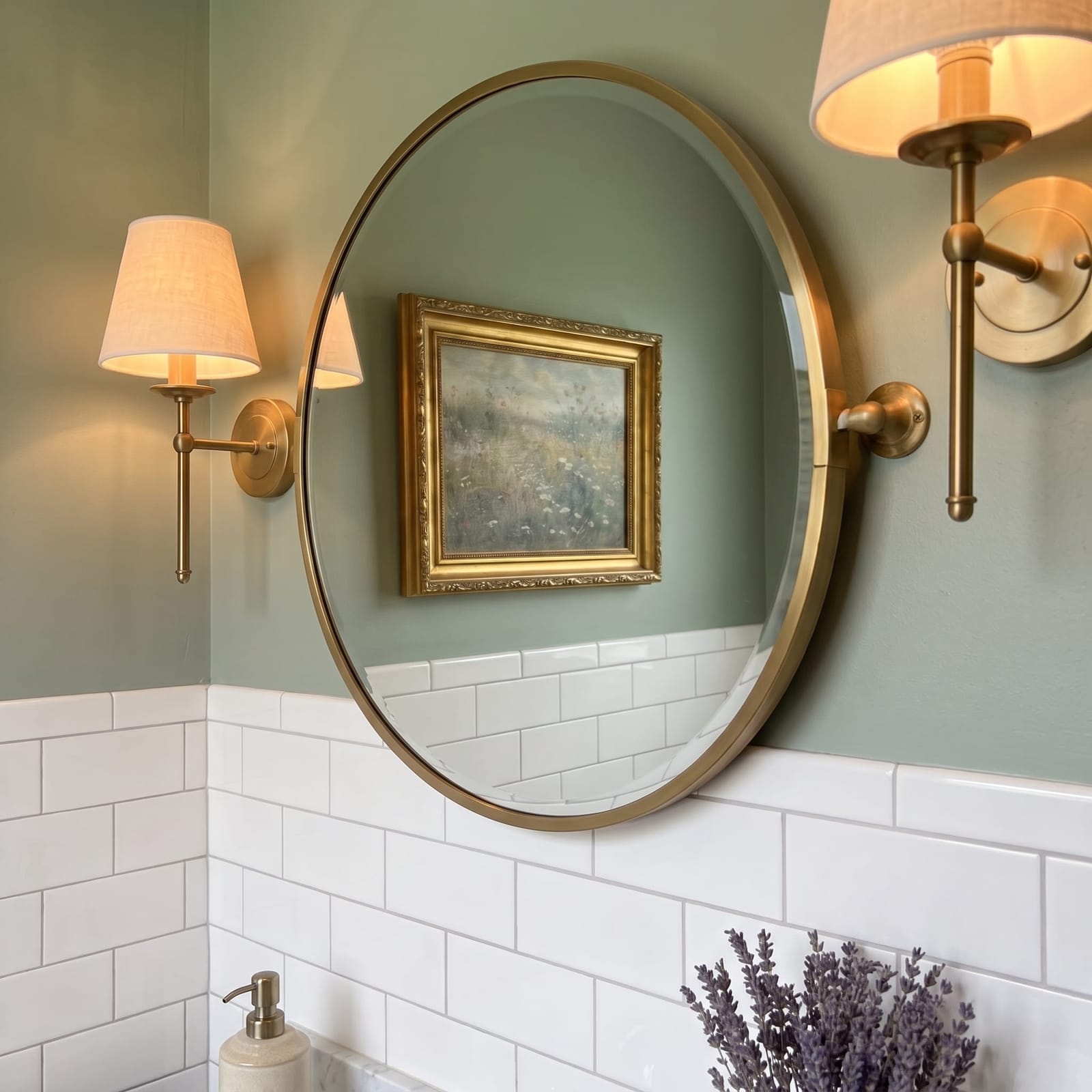
The composition above the vanity is orchestrated around a single vertical axis. At the center sits the Kohler Essential Round Mirror in Moderne Brushed Gold—a circle of reflective glass bordered by a thin metal bezel so slim it reads almost as a drawn line. The brushed gold finish diffuses reflections along the frame rather than throwing sharp highlights, which keeps the mirror integrated with the wall rather than floating off it.
The circle is the only curved form in the room. Every other element—tiles, shaker panels, cabinet pulls, bullnose trim, the rectangular landscape painting—is built from straight lines and right angles. The mirror breaks that grid, and the break is what makes it a focal point. The eye is drawn to geometric exceptions. A round mirror in a rectangular room has the same arresting effect as a single curved wall in a linear corridor: it holds attention because it departs from the established pattern.
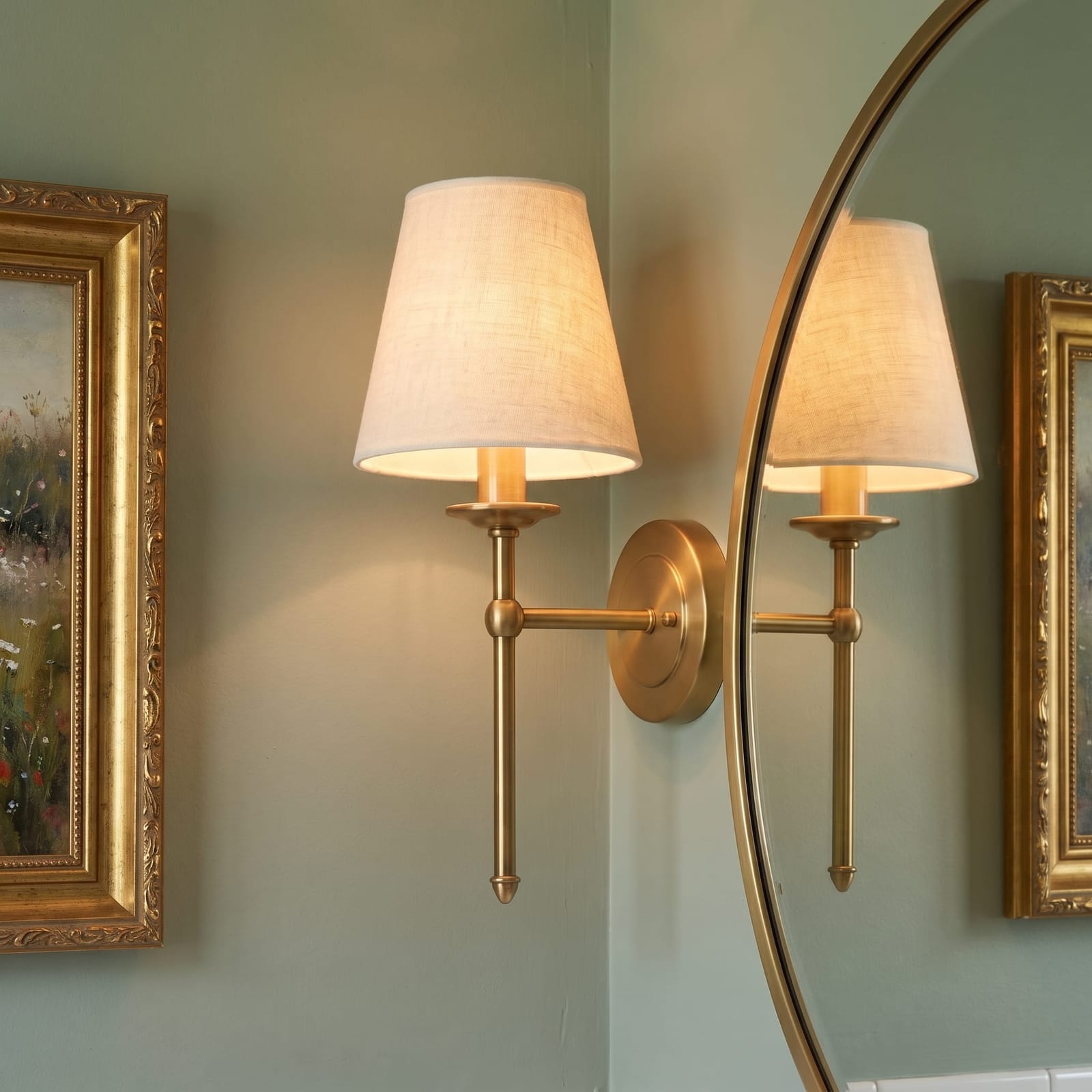
Flanking the mirror, mounted symmetrically on the sage green wall, are two Ophelia & Co. Wallchiere Sconces in Warm Brass. Each sconce extends a long, slender metal arm downward from a circular backplate, supporting a tapered cream linen shade at its terminus. The vertical drop of the sconce arm is substantial—roughly fourteen inches from plate to shade—which gives the fixture a tall, columnar presence that elongates the wall and frames the circular mirror between two upright sentinels.
The fabric shades transform the quality of the light. Where a bare bulb or clear glass globe would cast harsh, directional beams that create unflattering shadows under the brow and chin, the linen diffuses the output into an even, wraparound wash. This is task lighting disguised as atmosphere. The cream color of the shade, when backlit by a warm-white LED, takes on a soft amber glow that tints the surrounding sage green walls with a honeyed warmth. At full daylight, the shades read as sculptural textile objects. At dusk, they become the room’s primary light source—two amber cones that hover on either side of your reflection.
Countertop Styling: Where Function Meets Intention
The details that sit on top of the vanity—the objects you touch every morning—are where a bathroom either sustains its design argument or abandons it. A curated countertop extends the room’s material vocabulary to the smallest scale. A careless one undercuts everything the tile, wood, and brass have established.
The Labrazel Frattura Crackle Dispenser is a hand-thrown ceramic cylinder finished in a crackle glaze technique that dates to Song Dynasty celadon ware. The process involves formulating the outer glaze to contract at a slightly different rate than the underlying clay body during kiln cooling, which produces a web of fine, decorative crazing across the surface. No two pieces crack identically. The result is an object that carries visible evidence of its own making—a counterpoint to the machine-precision of the subway tiles and the factory-milled shaker panels.
The dispenser’s cream tone falls between the white of the marble and the ivory of the sconce shades, bridging the room’s two lightest values. Its solid brass pump mechanism—substantial, weighted, finished to coordinate with the Kingston Heritage faucet—clicks with a satisfying mechanical action that reinforces the sense of material integrity. This is the difference between a bathroom accessory and a bathroom object: one is purchased out of necessity and replaced without thought; the other is chosen for its participation in a material system and maintained as part of the room’s identity.
The Framed Country Meadow Landscape on the wall above performs a similar role at a larger scale. Its ornate gold frame ties directly to the mirror bezel and faucet escutcheons, creating a triangular metal constellation—frame, mirror, faucet—that structures the vanity wall into a deliberate composition. The painting’s pastoral subject matter, rendered in muted earth tones, reinforces the room’s connection to the natural world without being literal about it. It is not a botanical print or a seashell photograph. It is a quiet landscape that suggests the view you might see from a country house window, and it belongs on this wall because its palette was born from the same clay, brass, and leaf that built the room around it.
From Morning Light to Evening Glow
The sage green bathroom is two rooms. In the morning, when east-facing light floods through the window, the subway tiles blaze white and the sage walls lift toward olive-gold. The marble veining sharpens. The walnut grain separates into distinct bands of honey, caramel, and espresso. The brass fixtures flash—brief, bright catches of reflected sun that move across the faucet’s gooseneck curve as the light angle shifts. It is a crisp, energetic room: a room for waking up.
By evening, the character inverts entirely. The overhead fixture dims. The two fabric sconces become the dominant light source, casting their diffused amber glow in overlapping cones that meet at the mirror’s center. The sage green deepens, its grey undertone absorbing the warm light and pushing the walls into shadow. The walnut darkens to near-black at its deepest grain lines while the lighter sapwood bands warm to copper. The antique brass faucet, no longer catching directional sunlight, settles into its resting tone—a low, steady gold that matches the ornate frame of the meadow painting above.
The marble countertop, lit from the sides by the sconces rather than from above by the sun, takes on a softer luminosity. Its veining, which read as crisp grey lines in daylight, blurs into gentle washes of lavender and warm taupe. The crackle glaze on the Frattura dispenser, backlit by ambient sconce light, throws its web of fine cracks into subtle relief—visible only at close range, like the texture of handmade paper. Even the grout lines between the subway tiles shift character, their recessed shadows deepening from hairline seams into a gentle grid that gives the wainscot a quilted, dimensional quality it did not possess at noon.
This transformation is not accidental. It is the direct consequence of choosing materials with complex, layered surfaces—wood with interlocking grain, marble with translucent veining, ceramic with crackle glazing, brass with pre-patinated depth—rather than flat, uniform finishes that look identical regardless of the light source. A room built from laminate, chrome, and painted MDF reads the same at every hour. A room built from walnut, Carrara, and antique brass reads differently every time you enter it, revealing new details as the light changes and rewarding the attention you gave to its construction.
Sources & Details
Explore the complete source list for this room, from the anchor pieces to the smaller finishing details.
Source note: Some links in this source list may be affiliate links, which means we may earn a commission at no extra cost to you. As an Amazon Associate I earn from qualifying purchases.
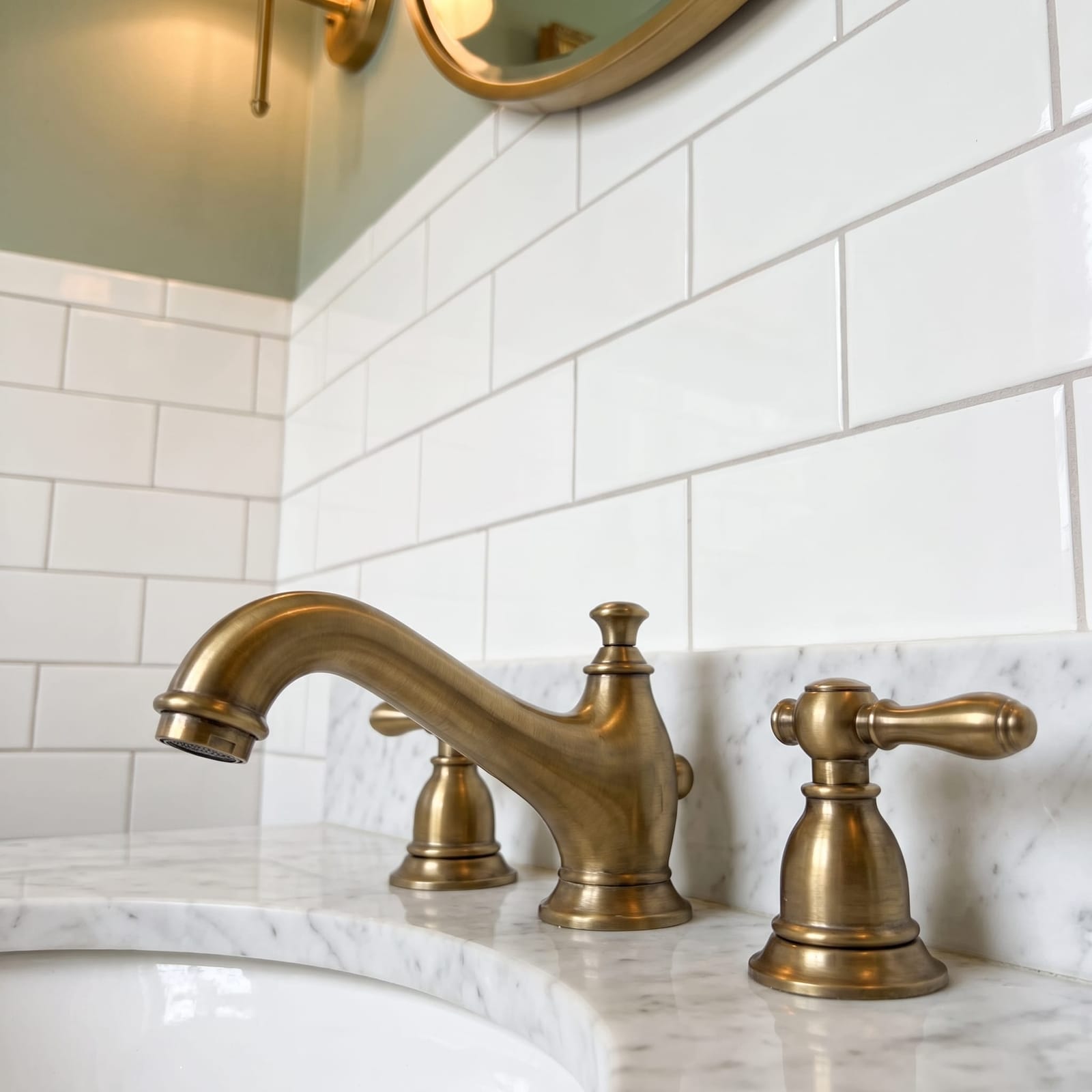
Antique Brass Widespread Bathroom Faucet
Classic antique/brushed brass widespread bathroom faucet with dual metal lever handles and gooseneck spout.
Exact gooseneck profile, bell-shaped collar escutcheons, and curved metal lever handles in antique brass.
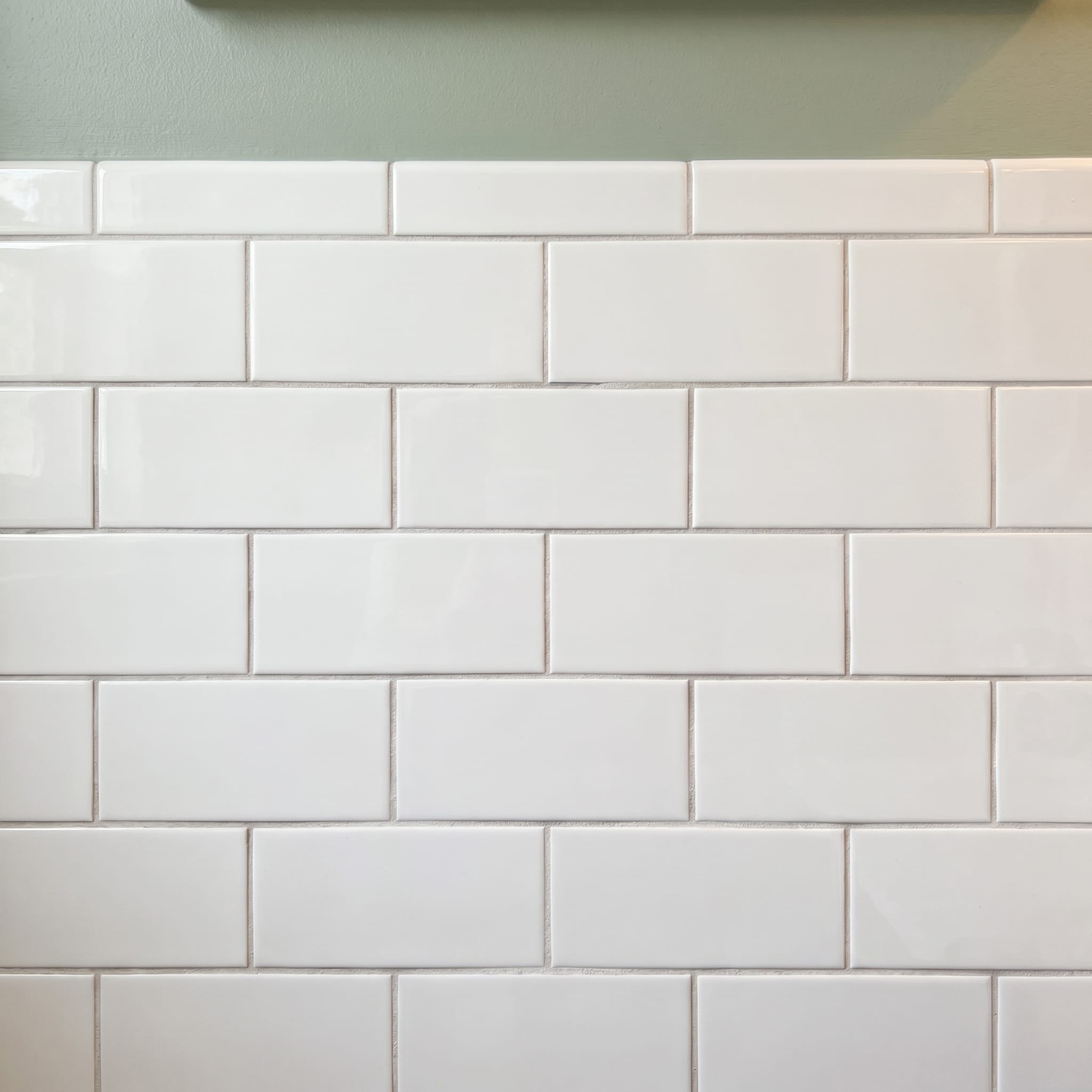
Glossy White Subway Tile
Glossy white ceramic 3x6 inch subway wall tile.
Industry standard bright white glossy subway tile that replicates the wainscot tile wall in the room.
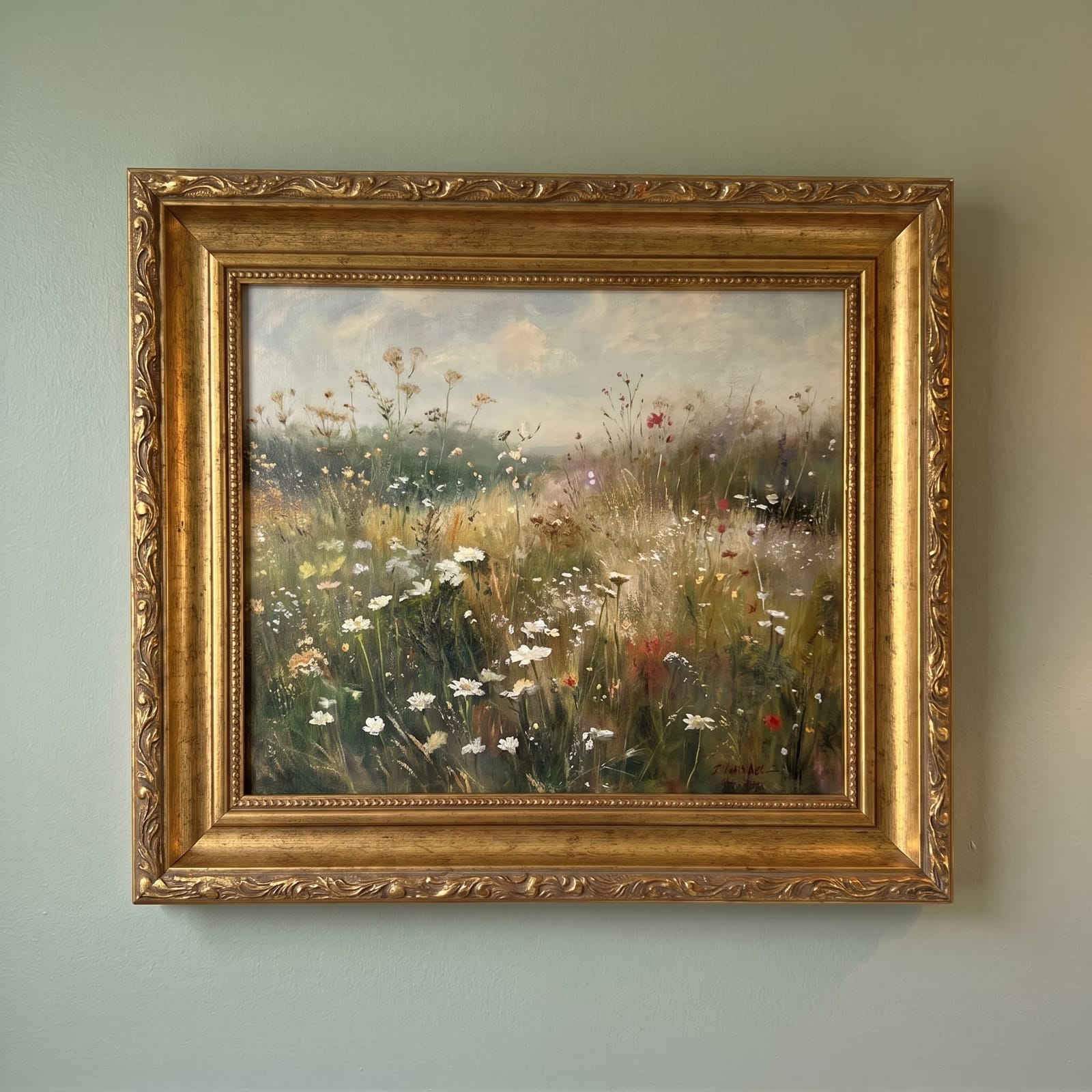
Ornate Gold Framed Landscape Painting
Vintage gold framed oil painting print depicting a country meadow/wildflowers in a heavy ornate gold frame.
Outstanding visual replica of the wildflower meadow landscape art and heavy antique gold frame hanging on the bathroom wall.
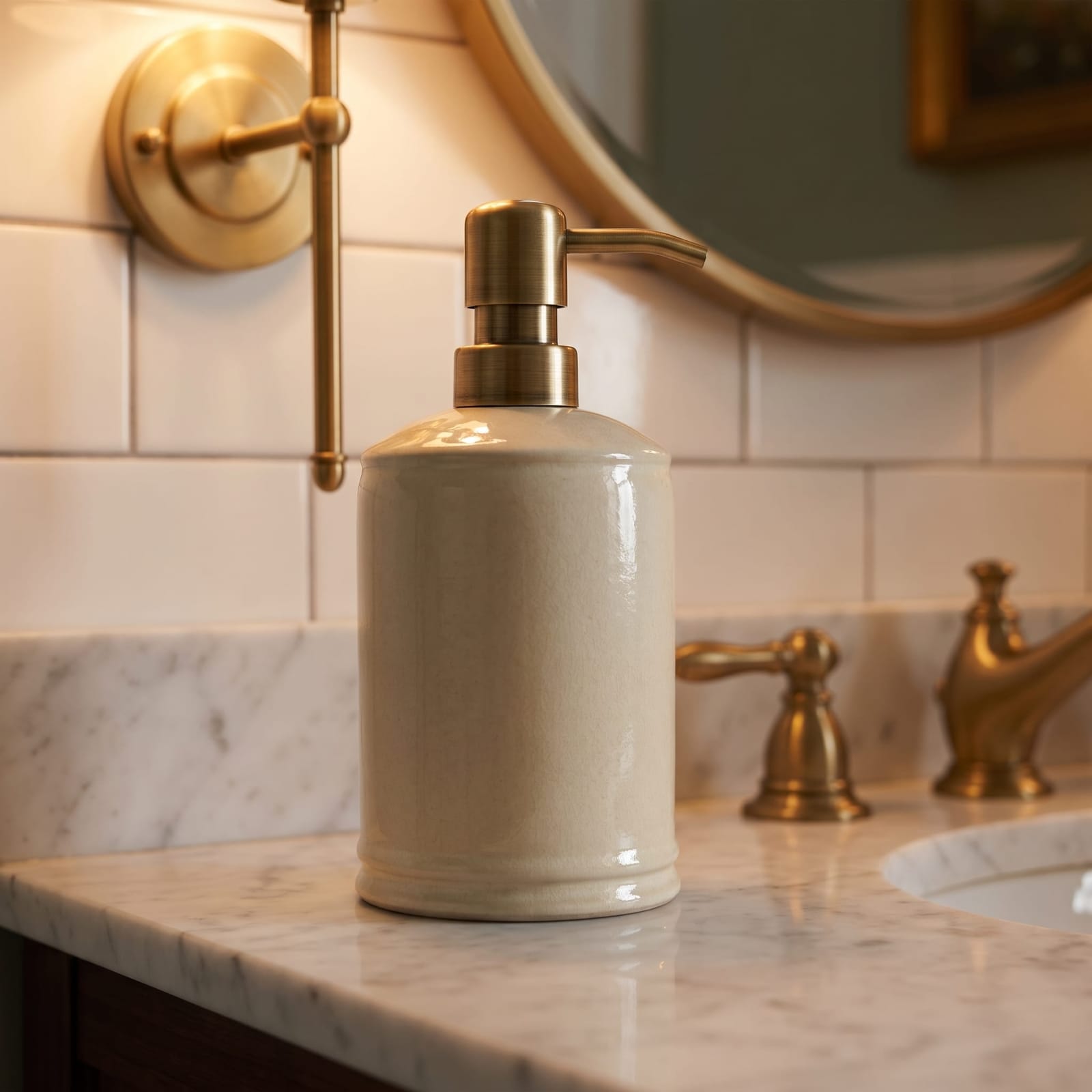
Crackle Glaze Ceramic Soap Dispenser
Cream or beige crackle glaze ceramic soap dispenser with brushed brass pump.
Exquisite match for the cream cylindrical body, kiln-fired crackle glaze, and brushed brass pump sitting on the vanity deck.
Frequently Asked Questions
What makes sage green an ideal paint color for a bathroom with warm wood tones?
Sage green sits at the intersection of green, grey, and yellow on the color wheel, which gives it an unusual ability to harmonize with organic materials rather than compete against them. Against the chocolate-brown grain of a walnut vanity, the green reads as a forest-floor complement—warm, grounded, and quiet. Against bright white subway tile, it provides enough contrast to feel intentional without overwhelming a small footprint. Because its grey undertone suppresses the chroma, sage never reads as loud or juvenile the way mint or kelly green can. It functions as a colored neutral: a wall color that carries real personality while still letting brass fixtures, marble veining, and wood grain take center stage.
How do you protect a walnut bathroom vanity from moisture and humidity damage?
The critical factor is the finish, not the species. A quality walnut vanity like the Vanity Art 36-inch arrives with a factory-applied conversion varnish or catalyzed lacquer that seals the wood pores against vapor penetration. Your maintenance job is to preserve that seal. Wipe standing water from the cabinet face immediately—pooled water along the toe kick is the most common source of finish failure. Run a bathroom exhaust fan rated at 80 CFM or higher during every shower and for at least twenty minutes after. Clean surfaces with a barely damp microfiber cloth and never spray chemical cleaners directly onto the wood. If the finish dulls over years of use, apply a thin coat of water-based polyacrylic to restore the moisture barrier without yellowing the walnut's natural warmth.
Why choose a widespread faucet over a single-hole faucet for a traditional vanity?
A widespread faucet places its spout and two handles on three separate deck mounts spaced eight inches apart, which creates a more substantial visual footprint on the countertop than a compact single-hole unit. For traditional and transitional bathrooms, this matters. The separated handles recall the engineering of pre-war plumbing, lending historical weight to the vanity. The Kingston Brass Heritage model in this room uses bell-shaped escutcheons and a high-arc gooseneck spout that would look cramped and distorted if compressed into a single-hole body. Widespread faucets also offer ergonomic advantages: the handles sit closer to the user's natural hand position at the counter edge, making temperature adjustment intuitive rather than requiring a reach toward the backsplash.
What is the correct wainscoting height for a bathroom, and how does it affect the room's proportions?
Standard wainscoting height falls between 36 and 42 inches from the finished floor, which typically aligns with the top of the vanity backsplash. This placement is not arbitrary—it divides the wall at roughly the one-third mark, establishing a visual base that reads as architecturally deliberate. In a bathroom with a colored upper wall like sage green, the white tile wainscot acts as a reflective plinth: it bounces natural light upward into the painted zone, preventing the color from feeling cave-like. Setting the wainscot too low (below 30 inches) makes it read as a baseboard afterthought. Setting it too high (above 48 inches) can shrink the colored portion into a crown stripe. The 36-inch line in this room aligns precisely with the vanity countertop, creating a continuous horizontal datum that unifies the space.
Can you safely hang framed artwork in a bathroom without moisture damage?
You can, provided you choose the right materials and take basic precautions. Avoid hanging original oil paintings or unprotected works on paper. Instead, opt for giclée prints on archival canvas or paper prints sealed behind glass in a tight frame. The gold-framed meadow landscape in this room uses exactly this approach—a reproduction print behind glazing in an ornate polyurethane frame that resists warping. Mount the frame using two-point hardware so it sits flat and stable. Place silicone bumpers on the bottom corners to hold the frame a few millimeters off the wall, allowing air to circulate behind it and preventing moisture from being trapped against the drywall. With an exhaust fan running properly, bathroom humidity drops to ambient levels within thirty minutes of a shower, which is well within the tolerance of a sealed frame.
What are the advantages of fabric-shaded sconces over glass sconces for vanity lighting?
Fabric shades transform the quality of light from a point source into a field. A bare bulb or clear glass globe throws directional light that creates hard shadows under the brow, nose, and chin—unflattering for grooming and makeup application. The Ophelia & Co. wallchiere sconces in this bathroom wrap the bulb in a tapered cream linen shade that scatters photons in every direction, producing an even, shadowless wash across the face. This is the same principle behind professional portrait lighting softboxes. Beyond function, the fabric introduces a tactile layer that no glass fixture can replicate. In a room made entirely of hard, reflective surfaces—glazed tile, polished brass, plate glass—the woven texture of linen reads as warm, residential, and deliberate. It signals that the bathroom was designed as a room in the home, not merely a wet utility.
How does a round mirror change the visual composition above a bathroom vanity?
A round mirror introduces the only curved geometry in a room otherwise built from rectangles: rectangular tiles, rectangular shaker panels, rectangular cabinet pulls. That single curve becomes a natural focal point—the eye gravitates toward it because it breaks the pattern. Practically, the circular shape leaves triangular pockets of open wall on either side of the glass, which is the ideal location for vertical sconce mounts. A rectangular mirror of equivalent width would crowd the sconces or force them onto the side walls. The Kohler Essential round mirror in this room is framed by a thin brushed gold bezel that catches just enough light to define the circle without overpowering it. The mirror also reflects the sage green wall opposite, pulling color into the vanity zone and making the room feel wider than its footprint.
Why does the Labrazel Frattura crackle glaze soap dispenser cost significantly more than standard bathroom accessories?
The Labrazel Frattura is a kiln-fired ceramic piece finished with a crackle glaze—a technique where the outer glaze layer is formulated to shrink slightly faster than the clay body as it cools, producing a controlled network of fine hairline fractures beneath a smooth, sealed surface. This process is unpredictable by nature; each piece emerges from the kiln with a unique crack pattern, making every dispenser a one-off. The brass pump mechanism is machined from solid metal rather than injection-molded plastic, and the finish is matched to coordinate with widespread faucets in the antique or brushed brass family. You are paying for handcraft variance, material integrity, and a countertop object that participates in the room's design language rather than sitting outside it as a disposable afterthought.