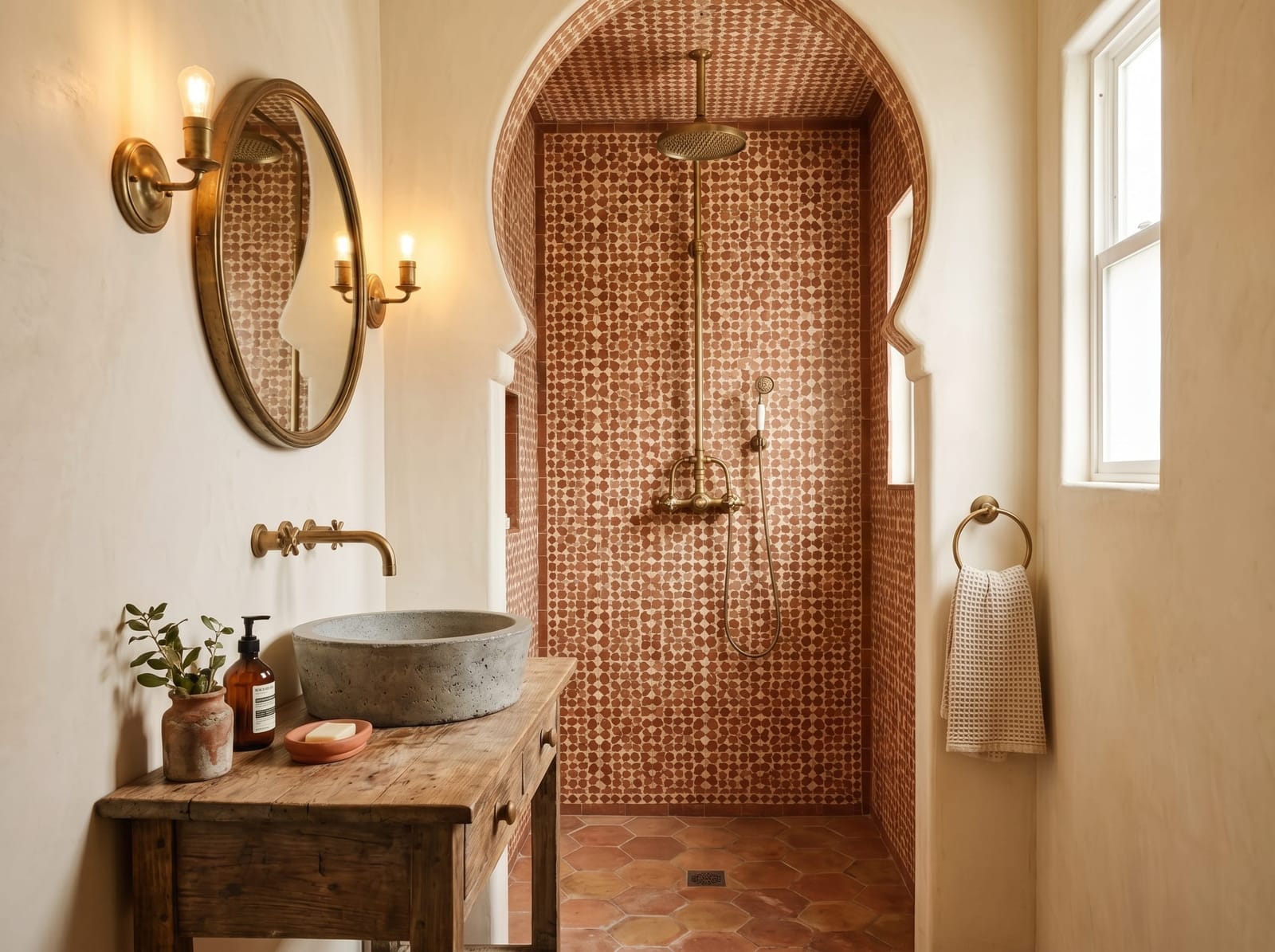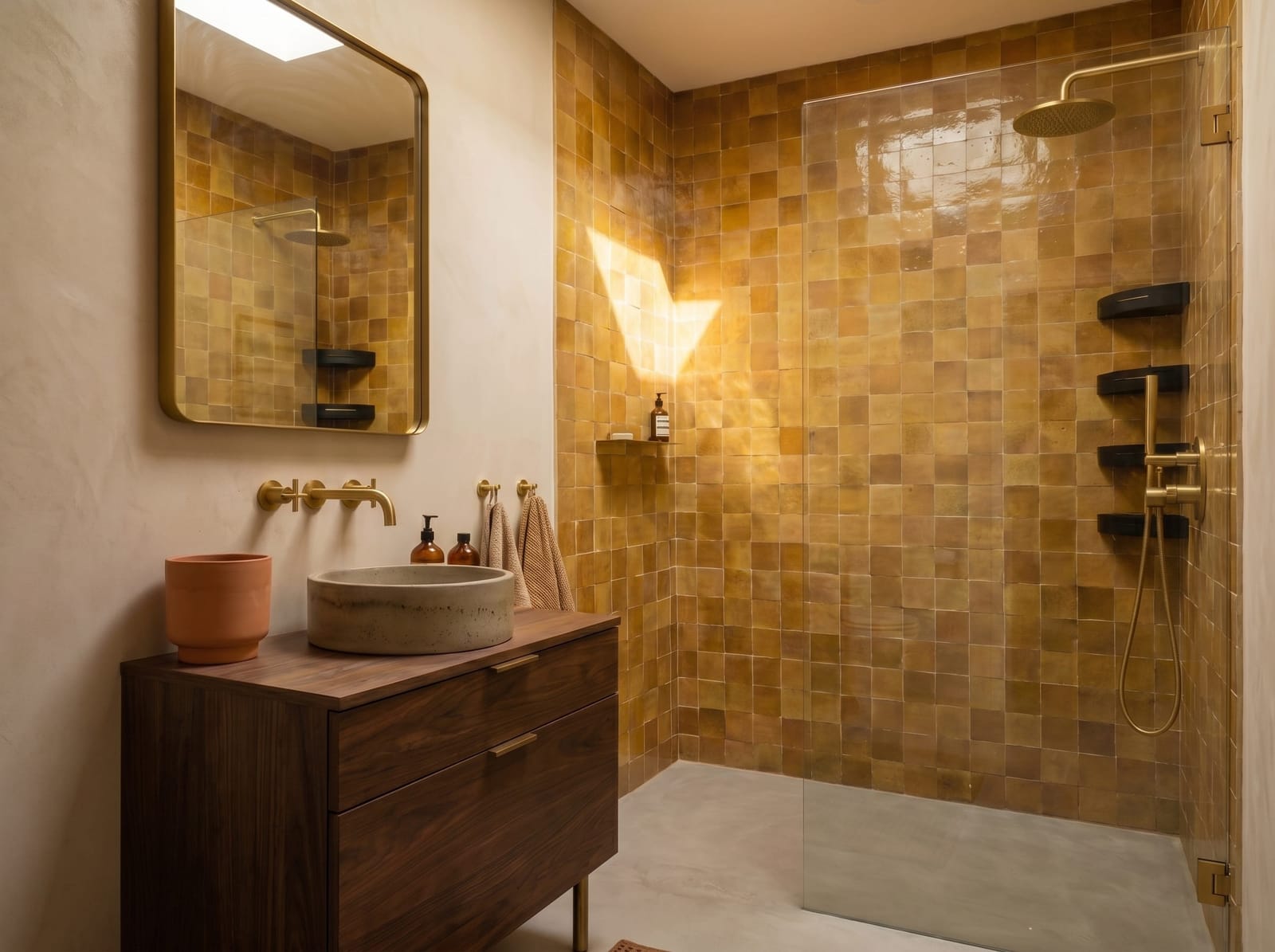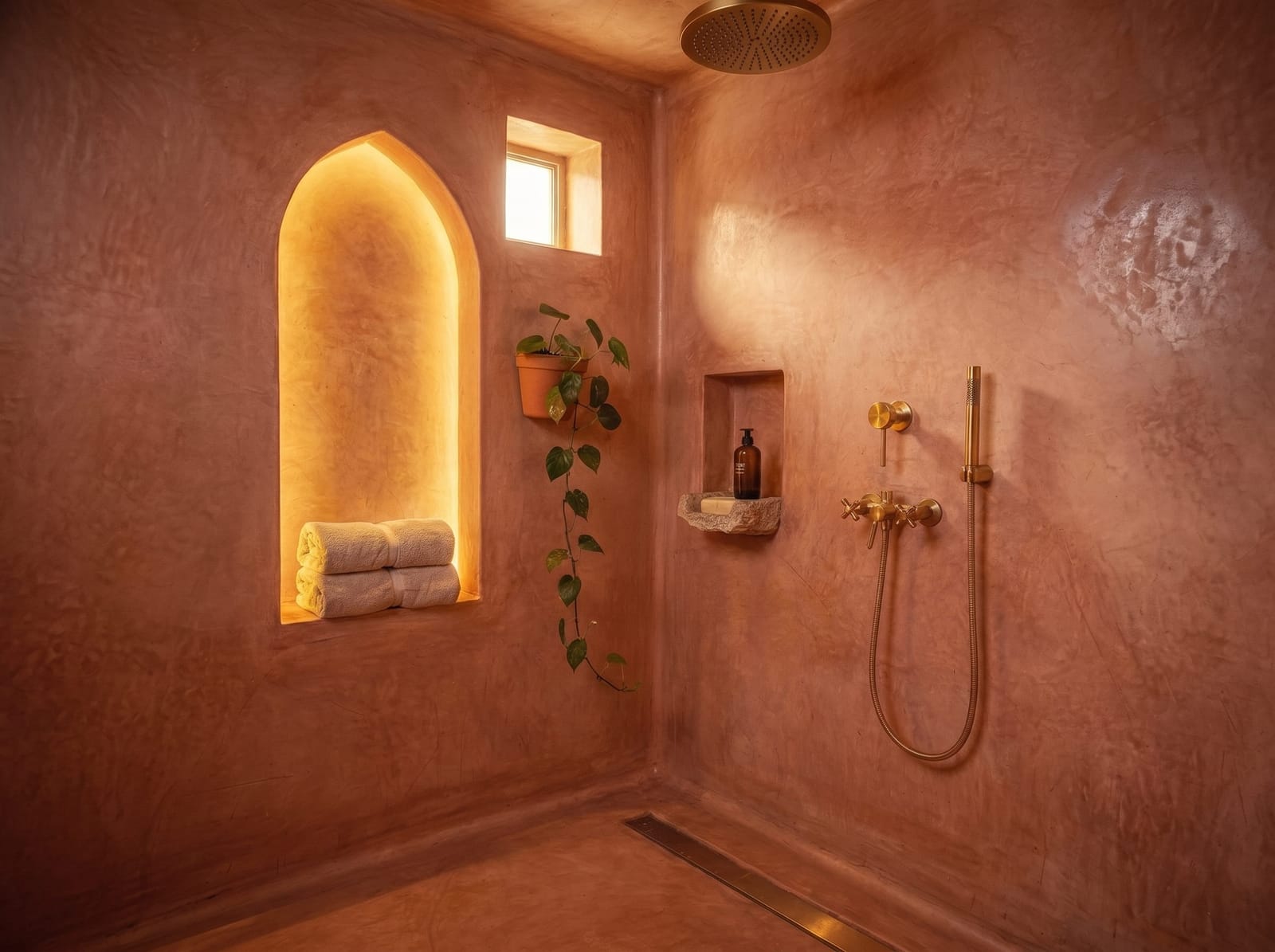
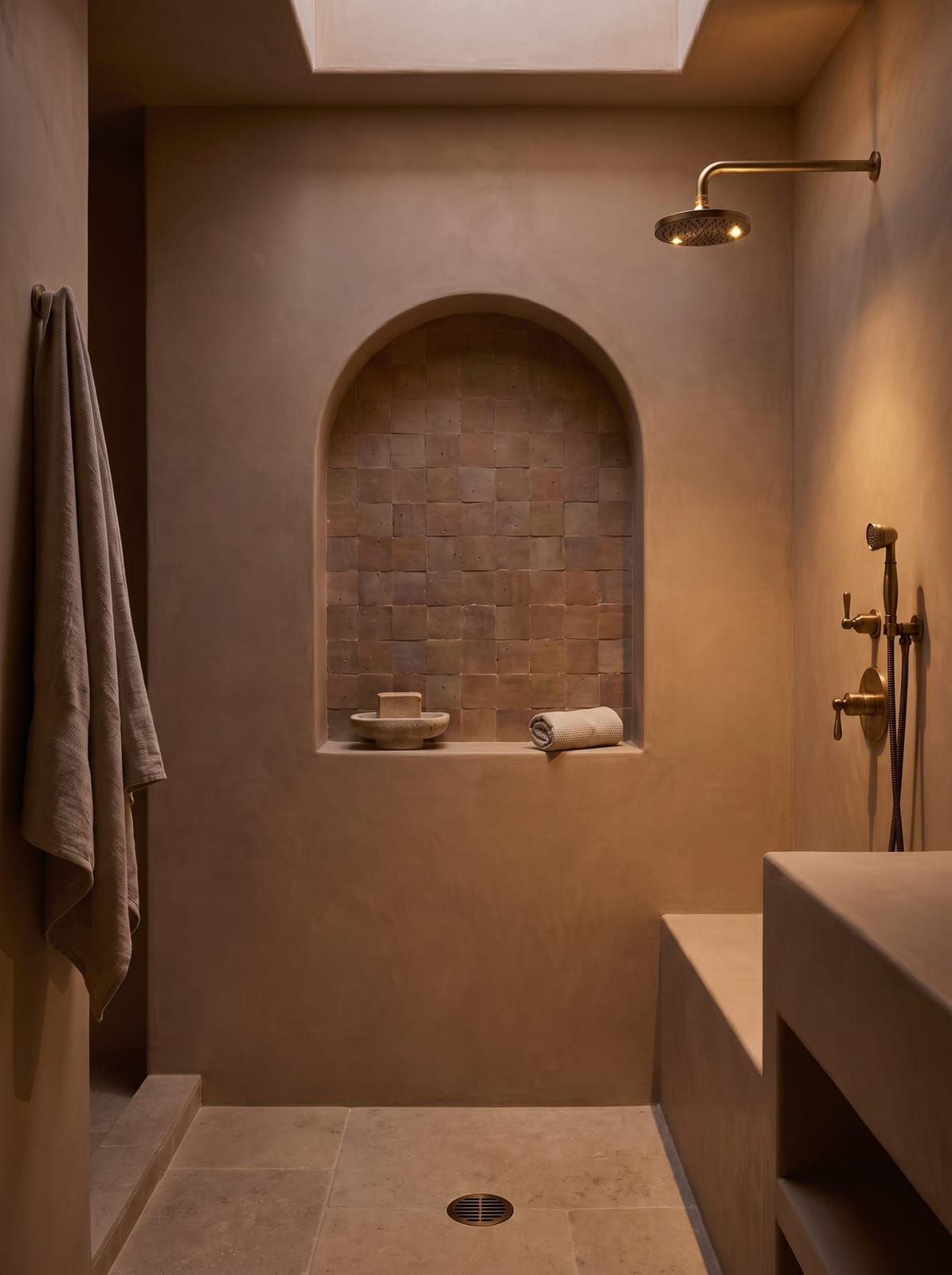
There is a particular quality to sunlight that has traveled straight down. It arrives without angle, without opinion, without the golden bias of a window facing west or the cool blue cast of a north-facing clerestory. Vertical light is neutral until it meets a surface — and then the surface decides everything. In this bathroom, the surface it meets is handmade Moroccan zellige tile glazed in a color that sits somewhere between dusty rose and fired copper, and what happens when that straight-down skylight hits those irregular, hand-chiseled faces is not reflection in any simple sense. It is diffusion. Dispersion. The light scatters across hundreds of slightly different planes, each tile angled a fraction of a degree differently from its neighbors, each glaze pocket a slightly different thickness, and the wall begins to shimmer — not with the flat, predictable gleam of a polished surface, but with the slow, breathing luminosity of something alive.
That is the organizing principle of this shower. Not a fixture, not a layout, not a color scheme — but the relationship between one overhead opening and one wall of imperfect clay. Everything else in the room exists to support that relationship, to amplify it, or to stay out of its way.
The Zellige Niche and Vertical Light
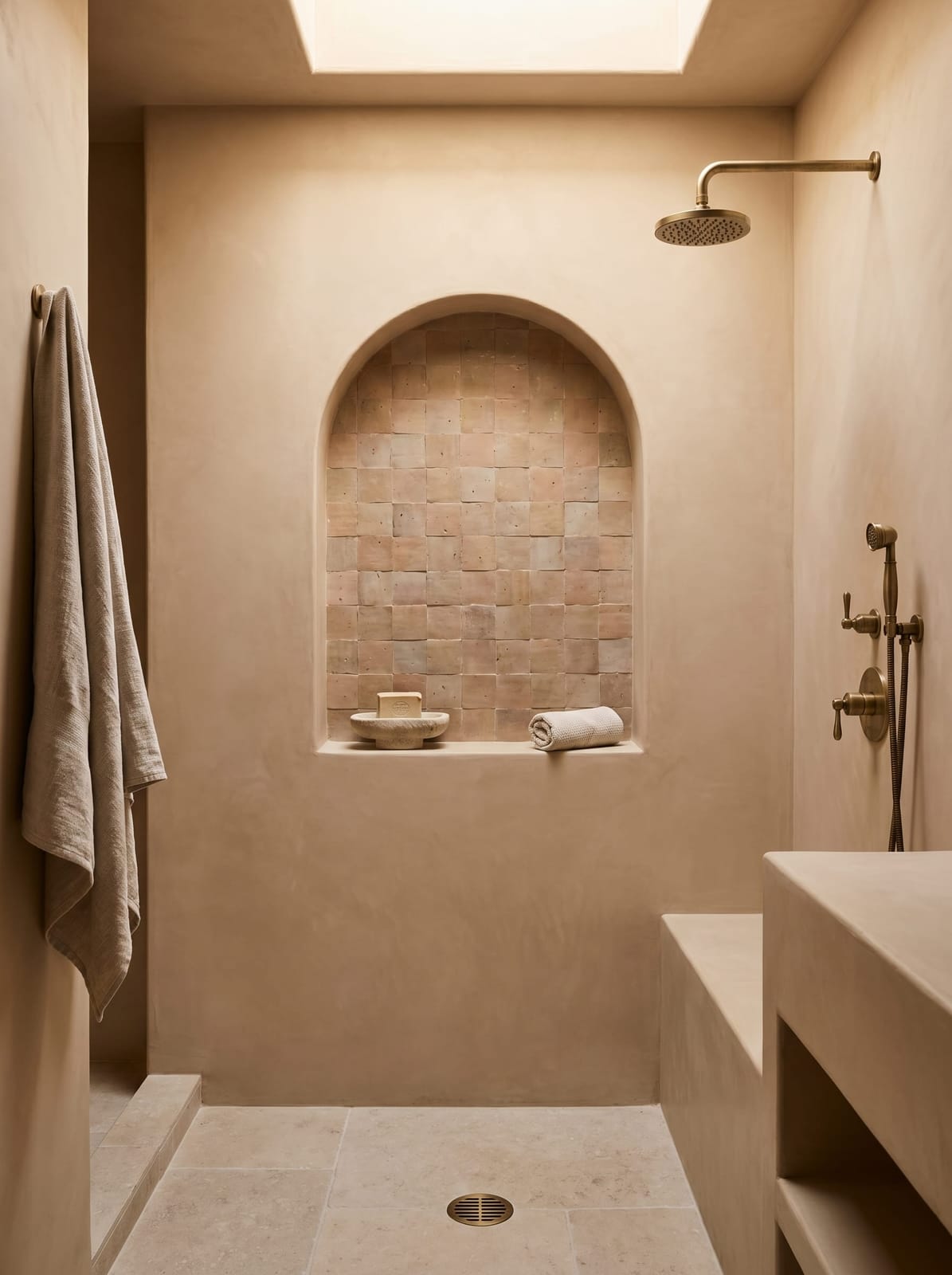
The shower alcove is recessed into the bathroom wall and lined entirely — floor, walls, and the shallow built-in ledge — in 4×4-inch Villa Lagoon Moroccan zellige tiles in the Copper Rose colorway. The name is accurate but insufficient. Copper Rose suggests a single hue, and what these tiles actually deliver is a range: pale blush where the glaze pulled thin during firing, deep terracotta where it pooled thick, and everything between — dusty peach, raw sienna, a faint suggestion of saffron where the mineral content of the clay body bleeds through the translucent glaze. No two tiles are the same color. No two tiles are exactly the same size. Each one was hand-molded from Atlas Mountain clay, dipped once in a wood-ash glaze, fired in a traditional kiln, and chiseled to its final dimensions by hand. The result is a surface that behaves less like tile and more like textile — a woven, undulating skin with depth, movement, and an irreducible human irregularity that no factory process can replicate.
The skylight changes everything. In a bathroom lit only by wall sconces or recessed ceiling cans, zellige reads as beautiful but relatively static — a richly colored wall with appealing texture. Under a skylight, the same wall becomes kinetic. The sun crosses the opening throughout the day, and as its angle shifts, different tile faces catch the light and release it. At nine in the morning, the upper courses glow with a pale, almost milky blush while the lower rows remain in soft shadow. By noon, the light falls straight down and the entire wall ignites — every glaze irregularity, every chiseled edge, every hairline craze line in the surface suddenly visible, and the alcove fills with a warm, ambient radiance that has no single source point. By late afternoon, the light rakes low and the shadows between tiles deepen, turning the tight grout joints into a fine dark grid that gives the wall a new geometry it did not have at midday.
The grout itself is a warm sand tone, nearly invisible against the clay body of the tiles. This is essential. Zellige demands visual continuity. A high-contrast grout — bright white, dark charcoal — would impose a rigid lattice over the organic surface, converting a shimmering skin into a grid of framed squares. The sand-toned joints allow the eye to read the wall as a single, breathing surface rather than a collection of individual pieces, and they permit the color variations between tiles to flow into each other without interruption.
Set into the tiled ledge at the back of the niche, a natural travertine pedestal soap dish holds a bar of soap at a slight elevation above the tile surface. The pedestal base — a short, turned foot carved from the same block of stone — lifts the soap clear of standing water, allowing it to dry between uses and preventing the chalky soap residue that accumulates when a bar sits directly on a flat surface. But the dish is not here only for drainage. Travertine is a sedimentary limestone, formed in mineral-rich hot springs, and its surface carries the pitted, fossil-textured patina of deep geological time. Against the glazed, fire-born surface of the zellige, the raw, water-born texture of the travertine creates a material conversation — two stones, two origins, two textures, united by their warmth and their handmade irregularity.
Brass as Geometry
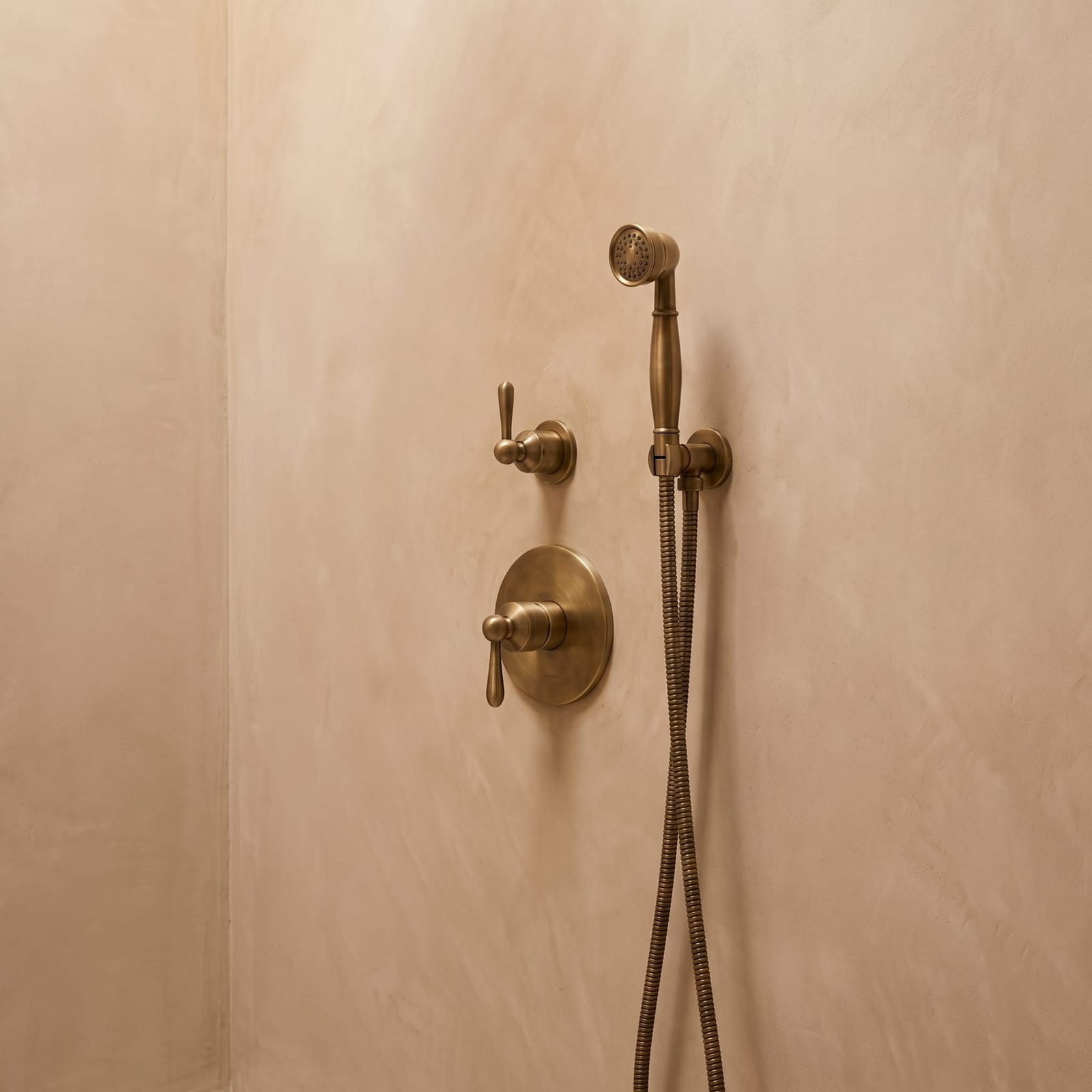
Against this warm, undulating clay backdrop, the shower hardware operates as a system of clean, minimal lines. The contrast is deliberate and necessary. If the tiles are the room’s texture, the brass is its geometry. If the zellige is organic, handmade, and irregular, the metalwork is precise, machined, and perfectly cylindrical.
The primary fixture is a Kohler Purist wall-mount handshower kit in Vibrant Moderne Brushed Gold. The system is minimal by design: a cylindrical wand connected by a flexible hose to a wall elbow, held by a slim adjustable bracket. There is no exposed riser pipe, no diverter column, no thermostatic bar cluttering the tile wall. The wand sits flush against the zellige when not in use, its brushed gold finish absorbing the ambient warmth of the surrounding glaze rather than competing with it. The Purist line’s geometry — pure cylinders, no decorative flourishes, no visible fasteners — reads as modern without reading as cold, and the brushed surface texture softens what could otherwise feel clinical.
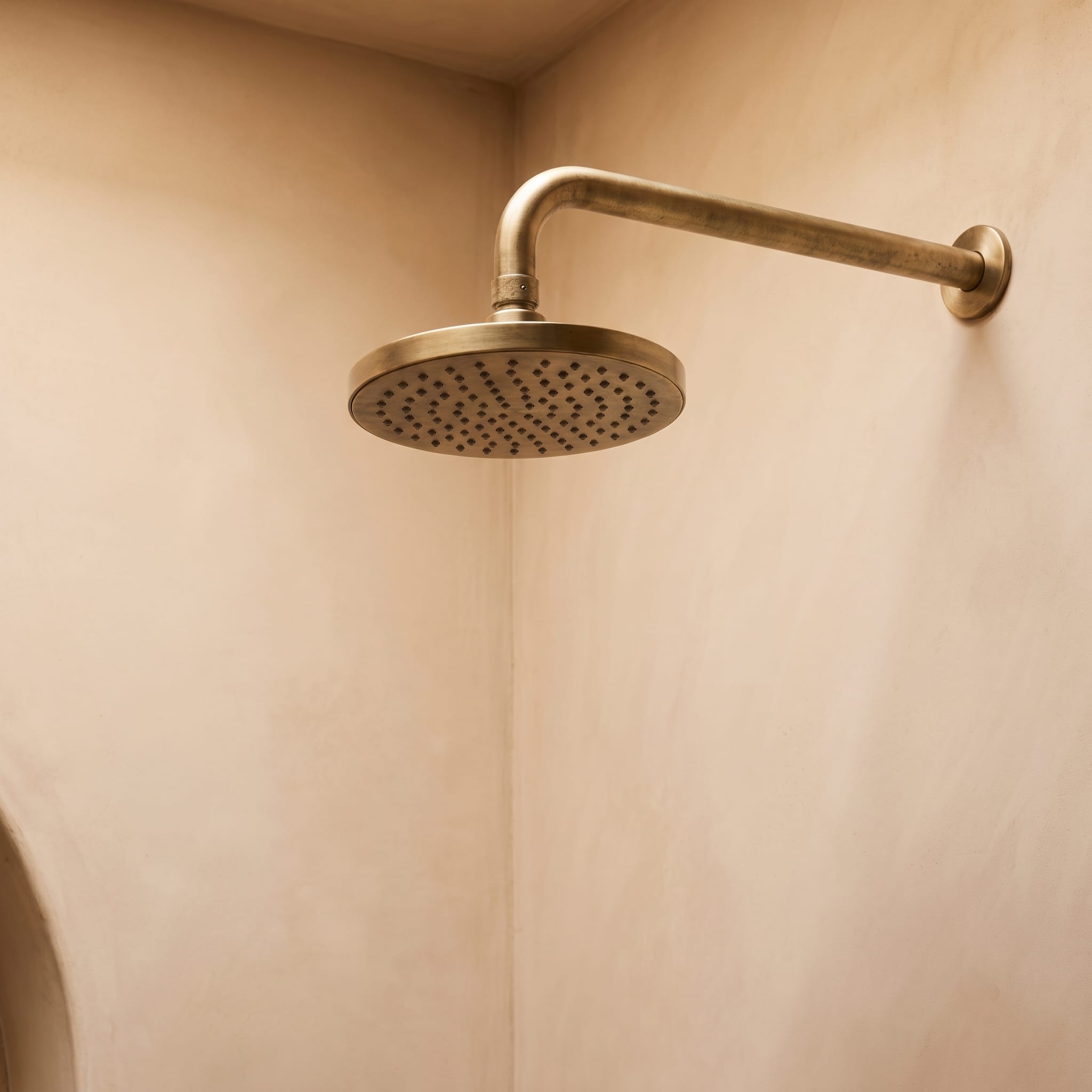
Overhead, a matching Kohler Purist 8-inch rain shower head extends from the tiled wall on a horizontal arm. The head is a flat, circular disc — a simple geometric form that works against the irregular tile surface behind it the way a full moon works against a textured sky. The rain delivery pattern is wide and gentle, a low-pressure curtain of water that drops vertically rather than spraying at an angle, and that verticality echoes the direction of the skylight above. Light falls straight down. Water falls straight down. The two vertical flows occupy the same column of space, and the effect, standing beneath both simultaneously, is immersive in a way that angled shower heads cannot achieve.
At the floor, the metallic language completes itself with an Oatey round brushed gold drain strainer. It is a small detail — a 4¼-inch circle of slotted brass set flush into the tile floor — but it matters. In a shower where every surface has been considered, a standard chrome drain cover would register as an afterthought, a default specification that broke the material logic of the room. The gold strainer coordinates the plumbing infrastructure with the fixtures above, closing the loop from rain head to wand to floor. The PVD finish — a physical vapor deposition process that bonds the gold tone at the atomic level — ensures the surface will not flake, tarnish, or discolor under daily water contact, which is the practical reason for specifying it. The visual reason is simpler: it completes the circle.
Cotton and the Threshold of Softness
A bathroom built entirely from hard mineral surfaces — tile, stone, metal — would be beautiful but uninhabitable in the sensory sense. It would echo. It would feel rigid under every touch. The eye would have nowhere soft to land, and the body would register the room as a chamber rather than a refuge. This is where textile enters the composition, and in this bathroom, the textile is deliberate and specific.
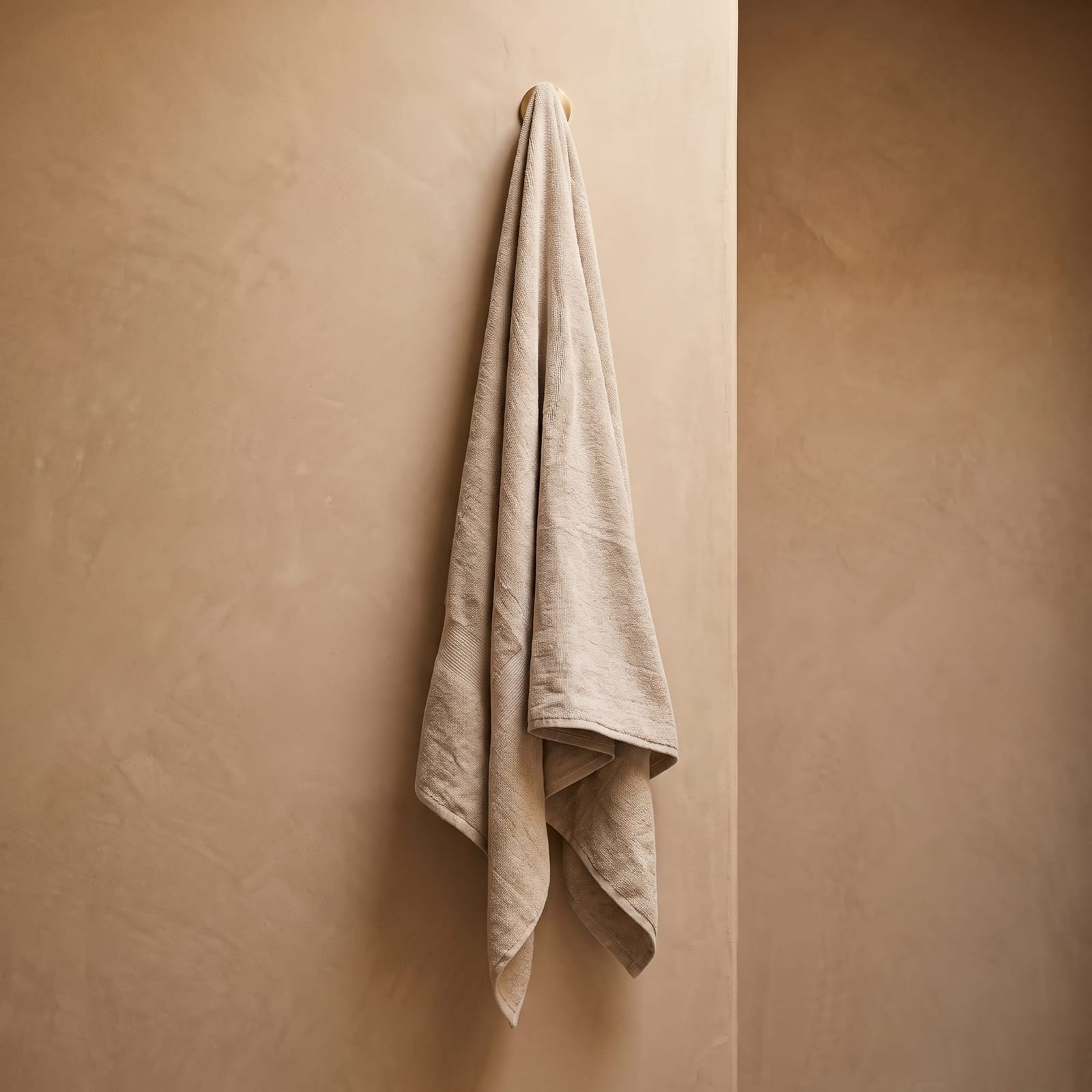
Hanging from a simple brass hook beside the shower opening, a Casaluna waffle bath towel in Natural introduces the first soft surface in the room’s material hierarchy. The waffle weave is not a decorative choice — it is a structural one. The honeycomb grid creates hundreds of small pockets in the fabric surface, and each pocket traps a thin layer of air that insulates while absorbing water rapidly. The result is a towel that dries the body efficiently while drying itself quickly afterward, which matters in a skylit shower room where humidity cycles between wet use and ambient drying throughout the day. The natural oatmeal color — unbleached, undyed cotton in its raw state — places the towel squarely within the warm tonal range of the surrounding materials. It is not white, which would have created a cold, clinical contrast against the terracotta tiles. It is not brown, which would have disappeared into the walnut and stone. It is the color of raw cotton, which is the color of warmth without commitment to any particular hue, and it works.
Beside it, or tucked into the built-in niche as a decorative roll, a matching Casaluna waffle hand towel in the same Natural shade provides a smaller-scale echo of the same texture. The rolled presentation — a hand towel furled tightly and placed horizontally on the zellige ledge — adds a spa-like intentionality to the niche, turning a functional textile into a compositional element. The two towels, bath and hand, share the same weave, the same fiber, the same colorway, and that repetition matters. In a room where the hard surfaces already carry significant visual complexity — the shifting glaze of the zellige, the veined warmth of the travertine, the reflective geometry of the brass — the textiles need to be simple, unified, and quiet. They need to absorb visual energy rather than generating it.
How the Room Shifts
The most honest test of a material-driven bathroom is the twelve-hour test. Not how it photographs at its best hour, but how it behaves across the full arc of a day.
At eight in the morning, when the skylight admits the first direct sunlight, this room is pale and fresh. The zellige tiles read as a soft blush pink — closer to rose quartz than to fired clay — and the brass hardware catches sharp, clean highlights. The travertine soap dish is almost invisible against the tile, its warm stone tone blending into the surrounding glaze. The room feels mineral, bright, and awake.
By noon, when the sun stands directly overhead, the light intensifies and the room transforms. The zellige wall becomes a single field of warm, diffused radiance — every tile face contributing to an ambient glow that fills the alcove without casting visible shadows. The brass rain head, lit from directly above, appears to float in a haze of golden light. The towels, backlit by the reflected warmth of the tile wall, take on a faint honey tone they do not possess in isolation.
At dusk, the skylight dims and the balance inverts. The tiles deepen from dusty rose to fired copper, their surface shadows suddenly pronounced, the tight grout joints emerging as a visible grid of dark lines. The brass fixtures, now catching the last oblique rays, glow with an amber intensity that makes them the brightest objects in the room. The travertine soap dish, previously subdued, stands out against the darkened tile behind it — its pale mineral surface holding the last of the light. The waffle towels, no longer warmed by reflected radiance, return to their true oatmeal color, and the room settles into a quiet, warm, ember-like stillness.
This is not two rooms. It is one room that refuses to hold a single mood. And that refusal — that continuous, unforced transformation from rose to copper, from bright to deep, from mineral to amber — is the quality that separates a bathroom built from living materials from one built from finished ones. No dimmer switch, no color-changing LED, no programmatic intervention. Just clay, stone, brass, cotton, and the sun, doing what they have always done.
Sources & Details
Explore the complete source list for this room, from the anchor pieces to the smaller finishing details.
Source note: Some links in this source list may be affiliate links, which means we may earn a commission at no extra cost to you. As an Amazon Associate I earn from qualifying purchases.
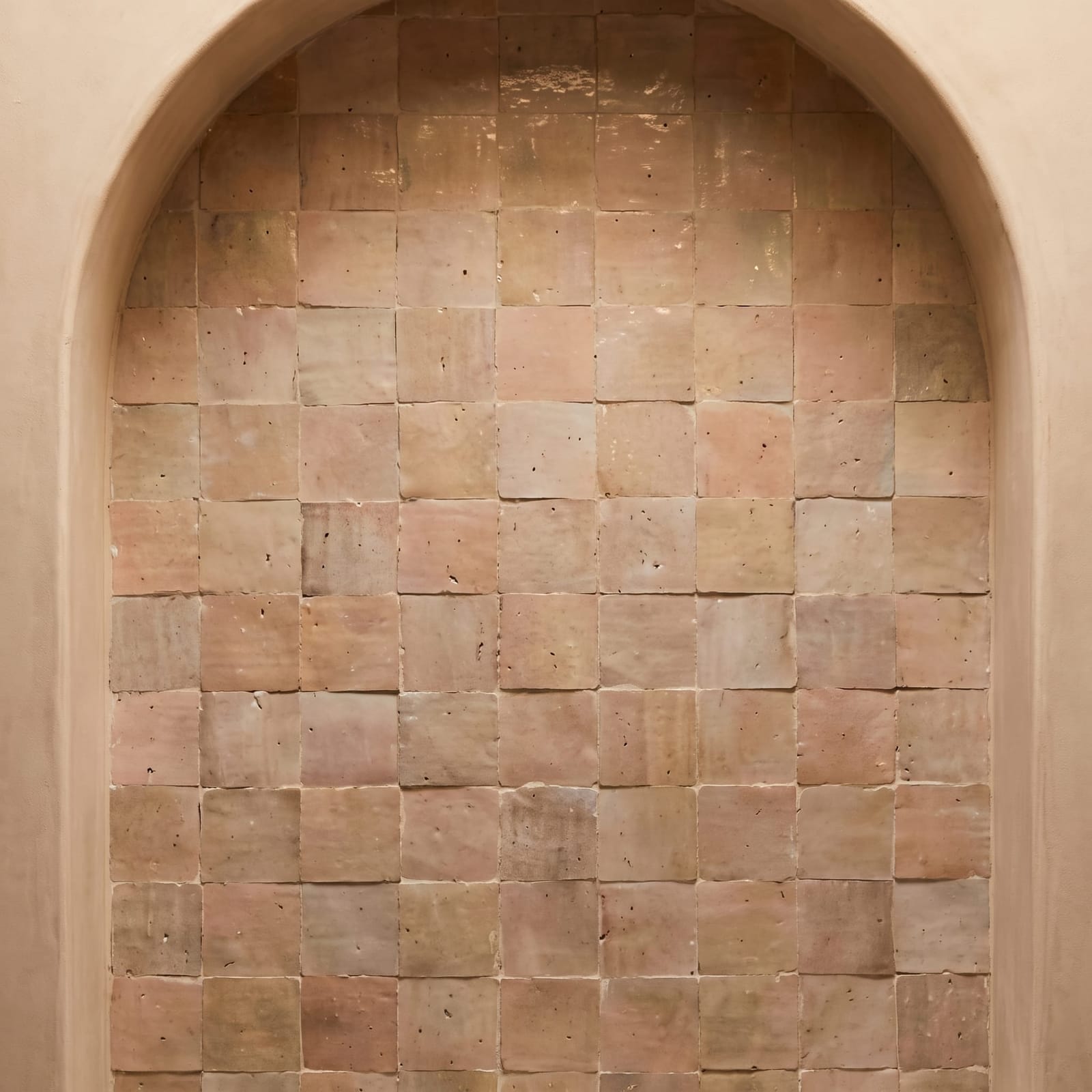
Copper Rose Glazed Zellige Tile
4x4-inch authentic glazed clay zellige tiles in a soft Copper Rose blush pink shade.
Handmade Moroccan glazed clay tiles in dusty rose bring shimmery color variation and organic texture.
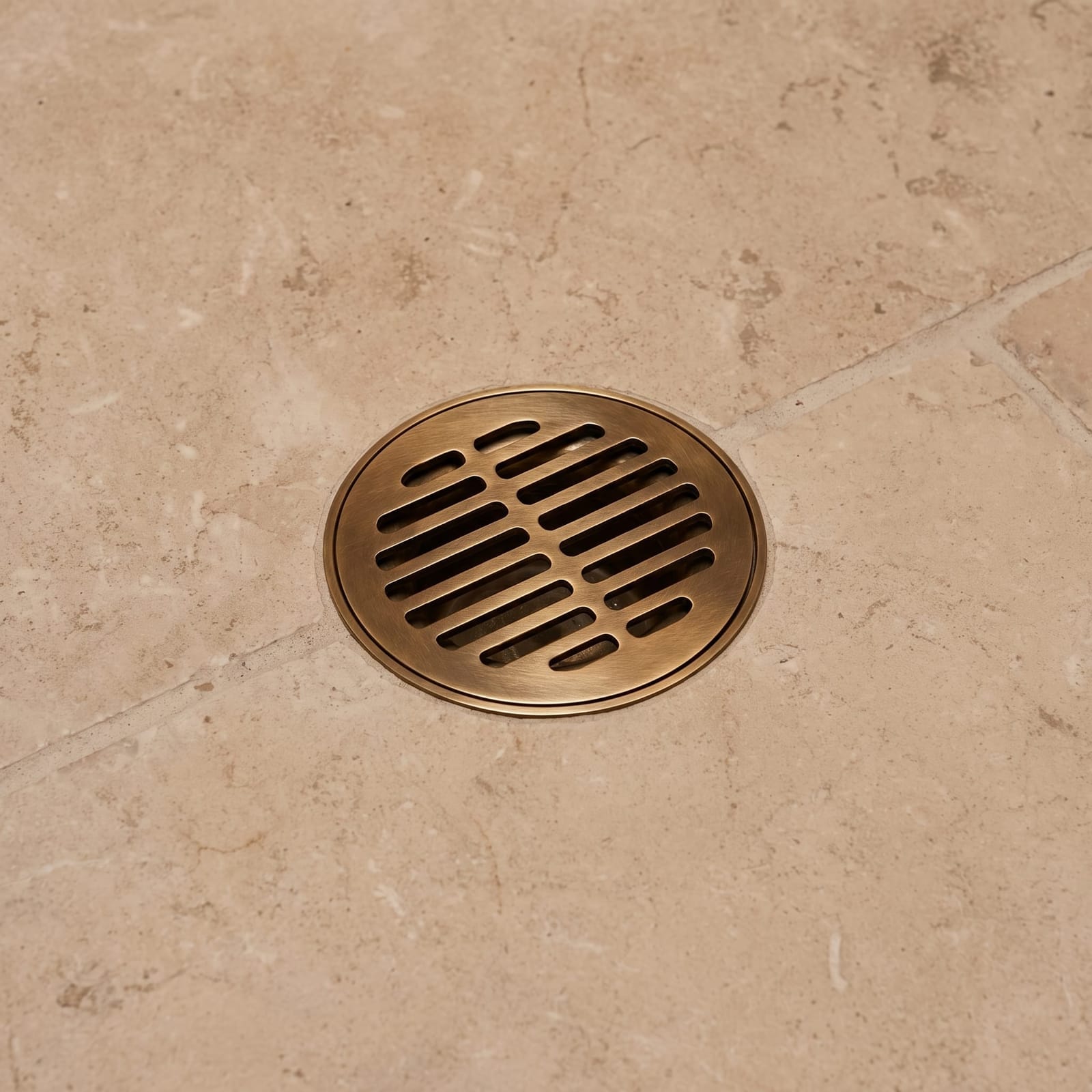
Brushed Gold Round Floor Drain
4-1/4 inch round snap-in brass grid shower strainer in a warm brushed gold finish.
A matching brushed gold slotted floor drain coordinates the metal elements down to the shower floor.
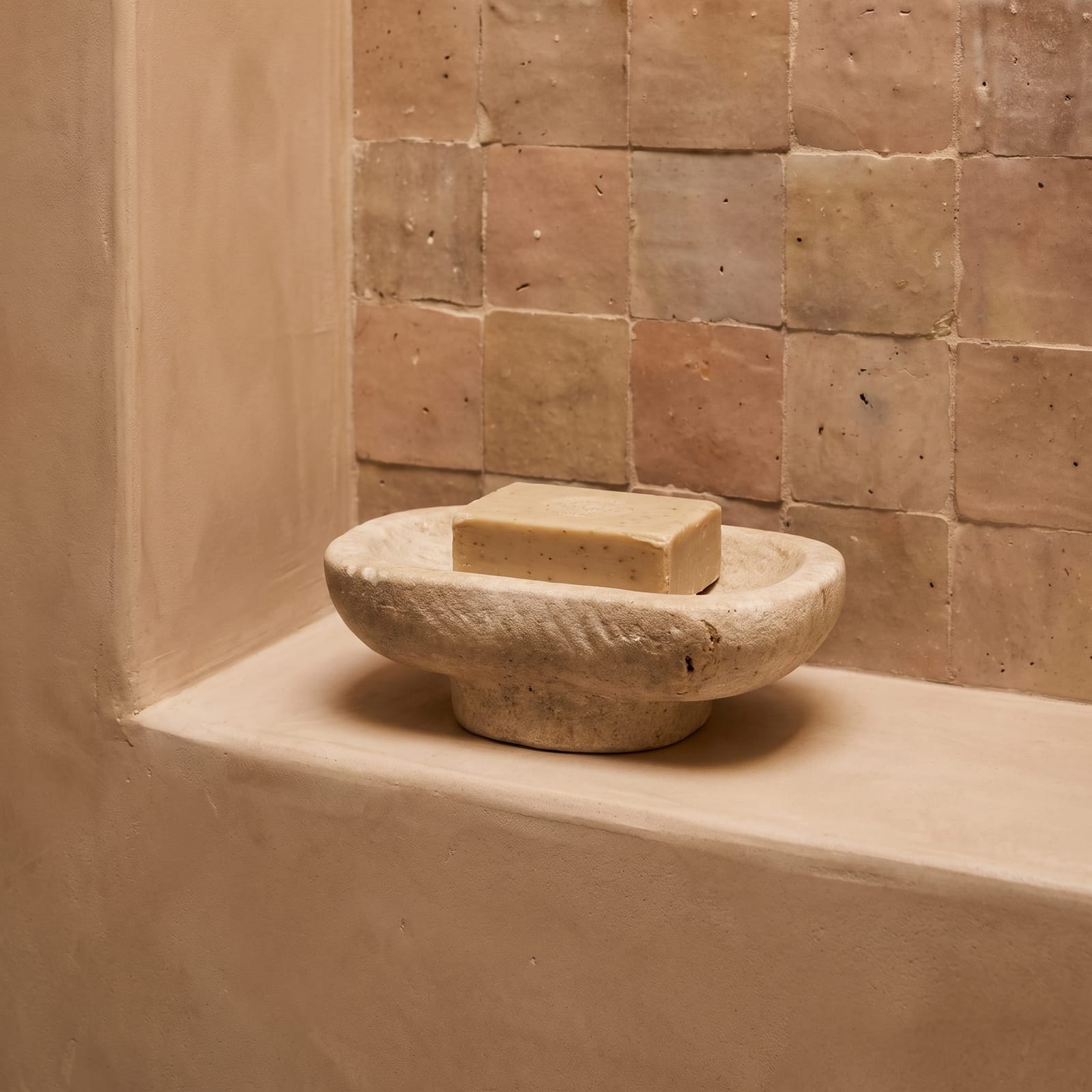
Footed Travertine Stone Soap Dish
Pedestal-footed round soap holder carved from natural textured travertine stone.
A footed pedestal travertine dish holds soap bar inside the tiled niche, adding natural stone texture.
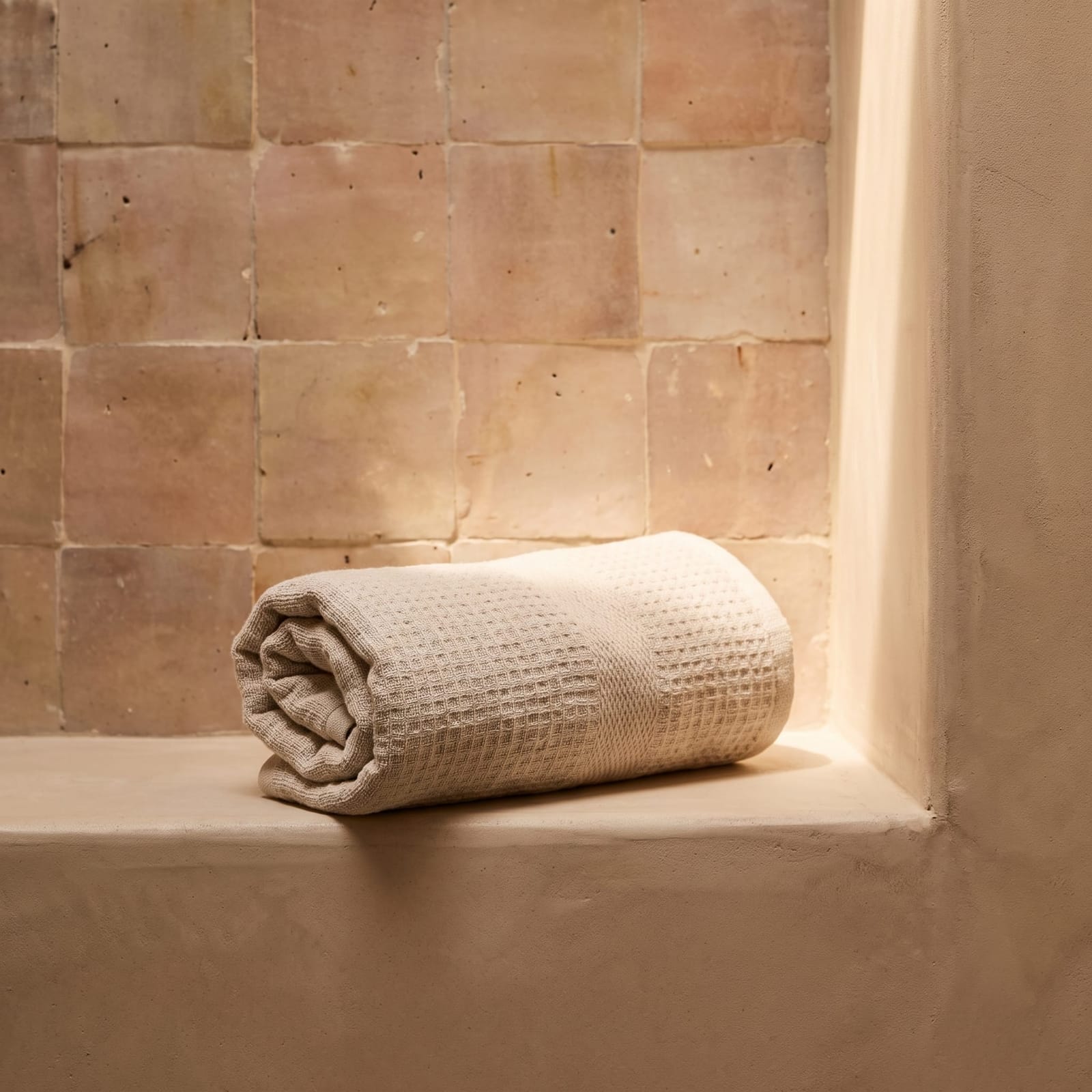
Natural Waffle-Weave Hand Towel
Waffle-woven premium cotton hand towel in a soft natural oatmeal beige shade.
A rolled natural waffle hand towel adds a decorative tactile element to the shower niche area.
Frequently Asked Questions
How does a skylight change the appearance of zellige tiles?
A skylight brings direct vertical sunlight into the shower alcove, highlighting the glossy, undulating surface of handmade zellige tiles. Since each clay tile is hand-chiseled at a slightly different angle, the vertical sunbeams hit the irregular glaze faces individually. This creates a moving, high-contrast display of shimmer and texture throughout the day, shifting from bright morning highlights to a deep, warm sunset glow.
Why pair a hand shower kit with a separate rain shower head?
Combining a fixed rain shower head with a wall-mounted hand shower kit offers the perfect balance of luxury and functionality. The overhead rain head provides an immersive, gentle flow of water that mimics rainfall. The hand shower wand, connected by a flexible hose, provides targeted pressure for rinsing and simplifies cleaning the shower enclosure, keeping the layout minimal and clean.
What is the best way to clean a brushed gold shower system?
Brushed gold finishes (like Kohler's Vibrant Moderne Gold) are highly durable but should be treated gently to preserve their warm luster. Avoid harsh acids, abrasive scrubbers, or bleach. Clean with mild soap, warm water, and a soft microfiber cloth. To prevent hard-water spots, wipe the fixtures dry after each use. A thin layer of carnauba wax can be applied occasionally to help water bead off.
Why use a travertine pedestal soap dish in the shower niche?
A footed pedestal soap holder made of natural travertine stone adds an elegant mineral element to the built-in shower ledge. Travertine is a porous stone that coordinates beautifully with the clay tile and gold hardware. The pedestal design elevates the soap bar, allowing it to dry quickly and preventing soap scum from pooling directly on the tiled ledge.
Does a brushed gold floor drain strainer rust over time?
Quality strainers (like Oatey's stainless steel grid strainers) feature a durable PVD (Physical Vapor Deposition) finish that makes them highly resistant to corrosion, scratches, and tarnishing. Unlike cheaper plated metals, PVD brushed gold bonds at the atomic level, meaning it won't flake or rust under daily water contact. Regular cleaning keeps it bright and free of mineral scale.
What grout should be used for dusty rose zellige tiles?
For dusty rose or copper-colored zellige, use a grout in a warm sand, pale peach, or beige tone. The grout should blend with the clay body of the tile rather than creating a harsh grid. A high-contrast grout (like bright white or dark grey) will distract from the handmade variations in the glaze. Use a polymer-modified grout and seal it after curing to protect the joints from moisture.
How does a waffle bath towel contribute to the spa atmosphere?
A waffle-weave cotton bath towel in a natural beige color brings textural depth to the bathroom. The honeycomb grid pattern creates pockets that absorb water rapidly while allowing the fabric to dry quickly. Its unbleached, raw texture coordinates with natural stone and plaster, adding a tactile element that makes the room feel soft, warm, and inviting.