A black tile bathroom is one of those ideas that looks extraordinary in magazine spreads but can make homeowners hesitate. The concern is always the same: that it will feel cold, sterile, or like standing inside a cave. And the concern is reasonable — when dark walls are paired with cool-toned lighting, chrome hardware, and nothing to break the visual weight, a black bathroom can feel genuinely oppressive.
But the coldness is rarely about the color itself. More often, it comes from what surrounds it.
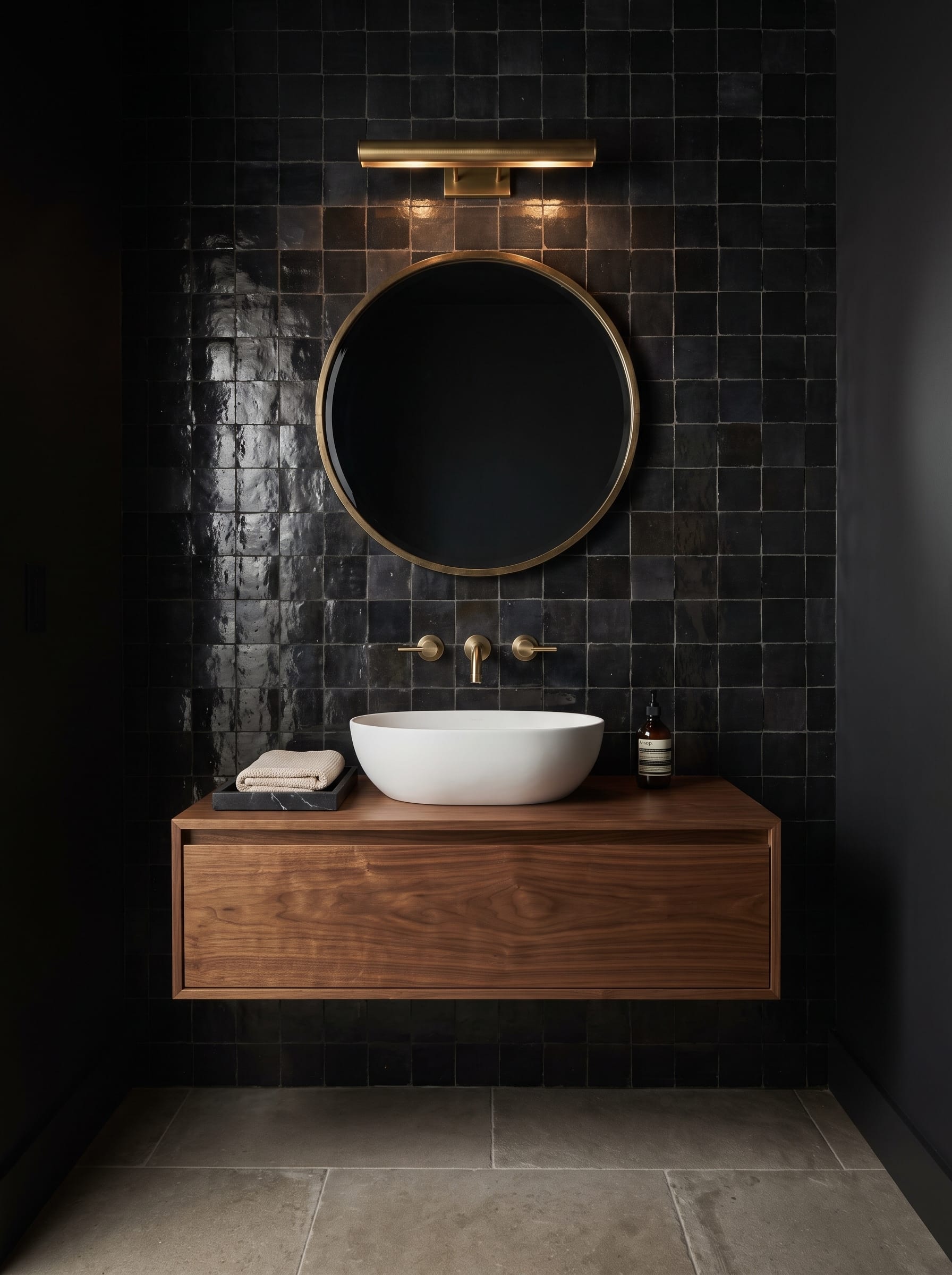
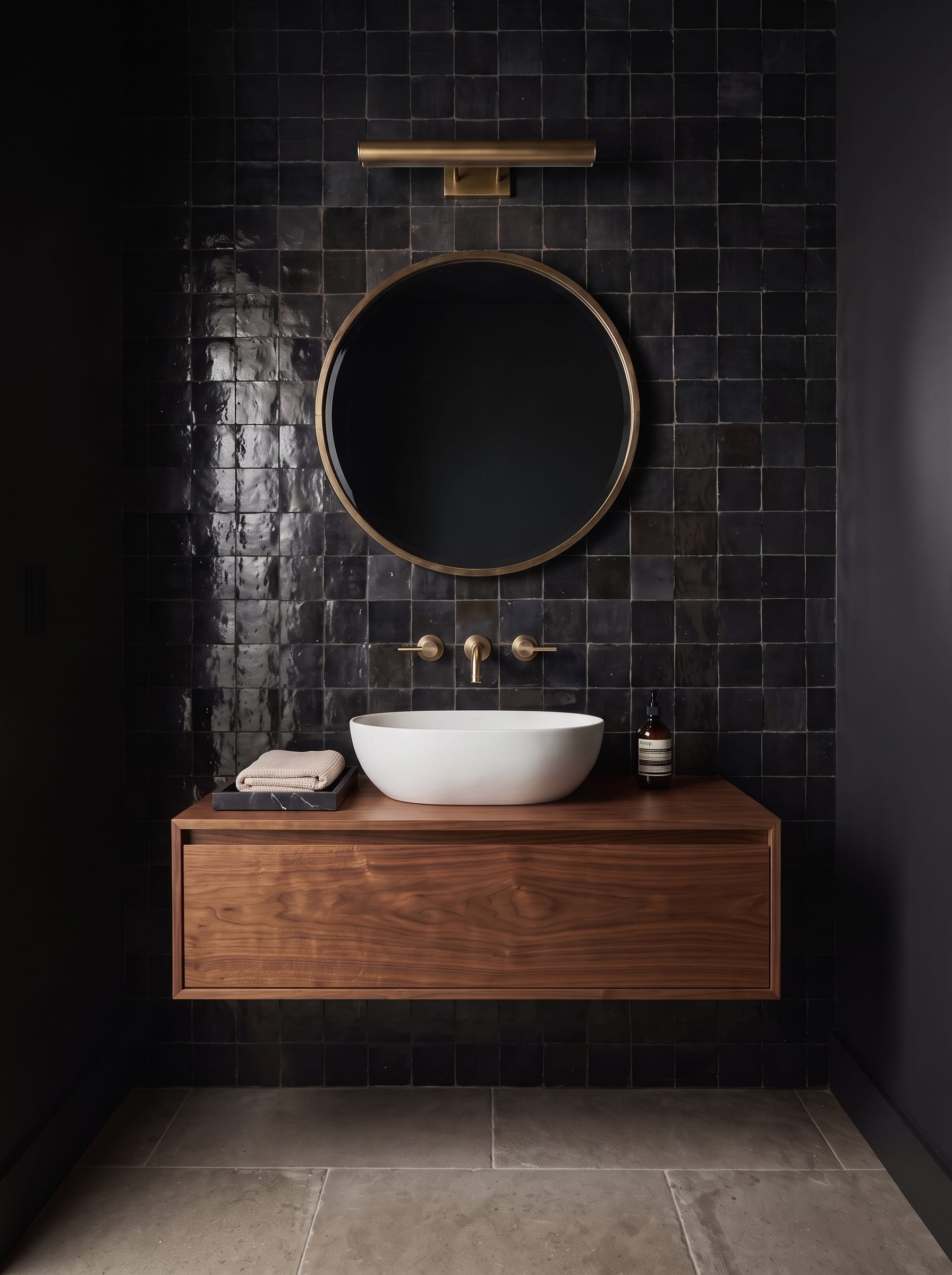
This bathroom gets the balance right. Glossy black Zellige-style tile covers the wall from floor to ceiling, and the space feels warm, atmospheric, and grounded rather than heavy. The difference lies in five deliberate material choices: the horizontal sweep of a warm walnut vanity, the reflective texture of the glazed tile surface, a pale ceramic basin that interrupts the dark field, brushed brass hardware that threads everything together, and warm layered lighting that reveals the tile’s depth instead of flattening it. None of these decisions are decorative afterthoughts. Each one counteracts a specific problem that black surfaces can create.
Here’s how to make the same balance work in your own bathroom — and what to avoid.
Anchor the Room with Warm Walnut
A floating walnut vanity does more work in this room than any single finish could. Its effect is both visual and textural — the warm amber-brown grain reads immediately against the dark tile, creating a clear horizontal line that separates the upper vanity zone from the tiled wall and pale floor below. Without it, the entire wall would be an unbroken dark surface with nothing for the eye to rest on.
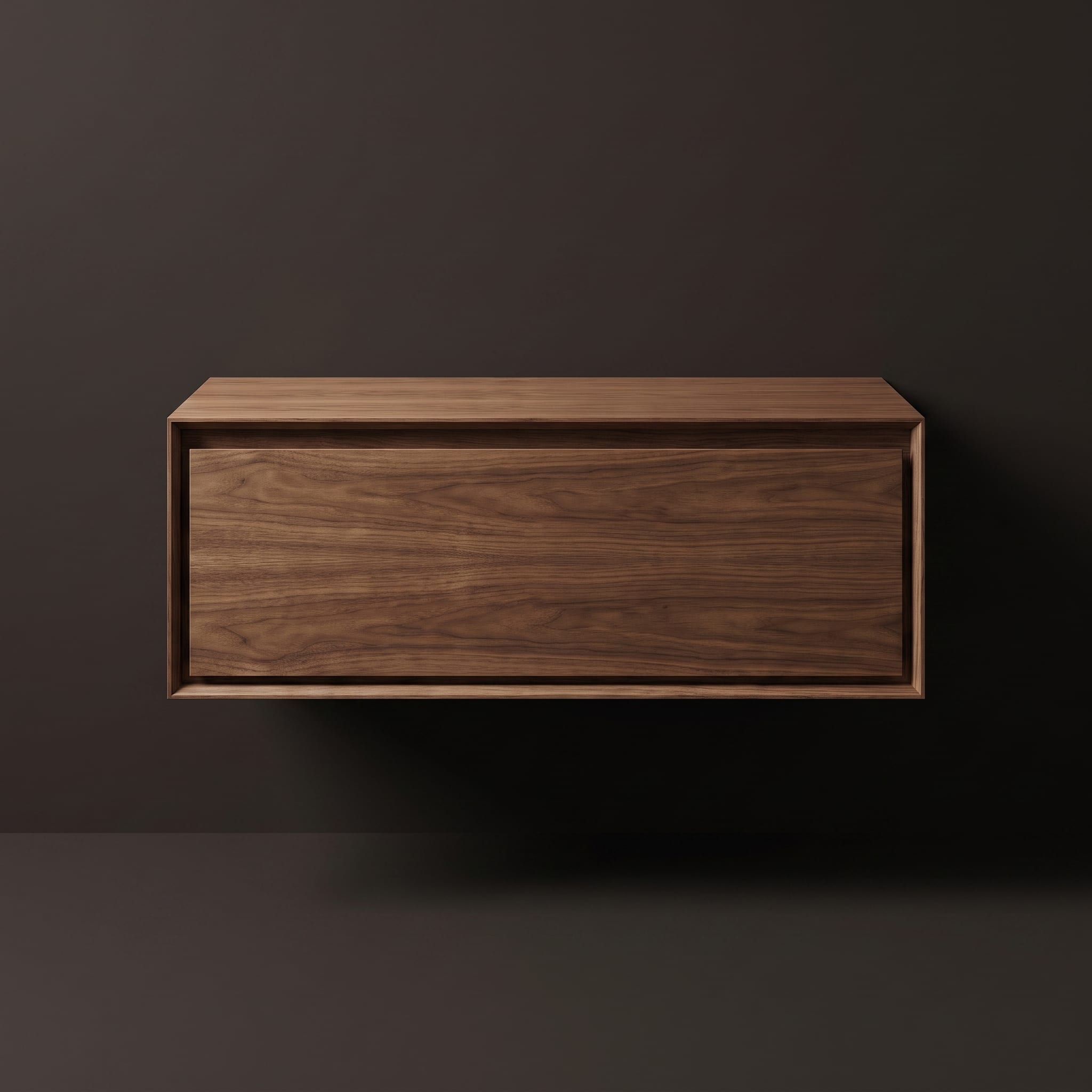
Amber walnut introduces warmth without weakening the room’s dark character. Its horizontal grain also gives the eye a calm place to rest across the tiled wall.
What matters here is the warmth of the wood itself. Walnut sits in the red-amber range of the brown spectrum, which means it naturally complements the warm undertones that good lighting draws out of the black glazed tile. A cool-toned gray oak or a pale bleached finish can work against the tile’s warmth rather than with it — still functional, but less likely to create the same inviting effect.
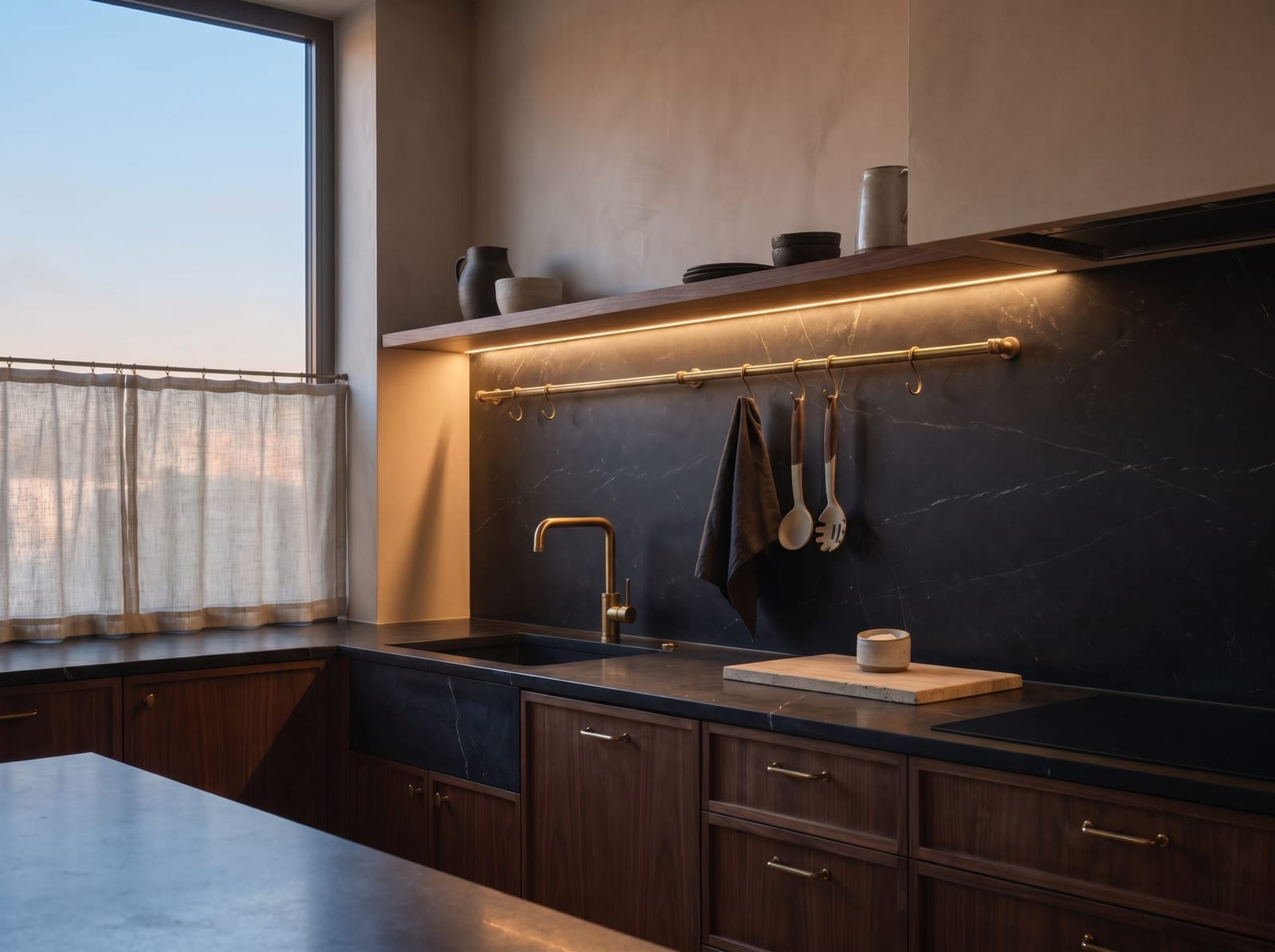
The floating mount is important for a different reason. By lifting the vanity off the floor and leaving a gap of open space beneath it, the room feels less enclosed. The floor reads as a continuous plane rather than a corridor blocked by furniture, and in smaller bathrooms this visual separation between cabinet and floor makes the space feel noticeably less heavy. A similar walnut-against-dark-tile balance shows up in a moody walnut soapstone kitchen, where walnut cabinetry provides the same horizontal warmth against dark soapstone surfaces.
The grain direction is a quiet but real contributor. Horizontal grain emphasizes width, which gives the vanity a calm, grounded presence. Vertical grain or a flat laminate surface wouldn’t create the same sense of movement across the cabinet face.
Walnut can be suitable in a bathroom when the vanity is specifically made for that environment. Choose a bathroom-rated product, follow its care instructions, wipe up standing water and maintain adequate ventilation.
Why Glossy Zellige Glaze Changes Everything
The tile in this room is not flat matte black. It’s a glossy glazed square tile with the kind of surface irregularity that handmade or Zellige-style production creates — subtle undulations across each face that catch ambient light at different angles, producing soft specular highlights that shift as you move.
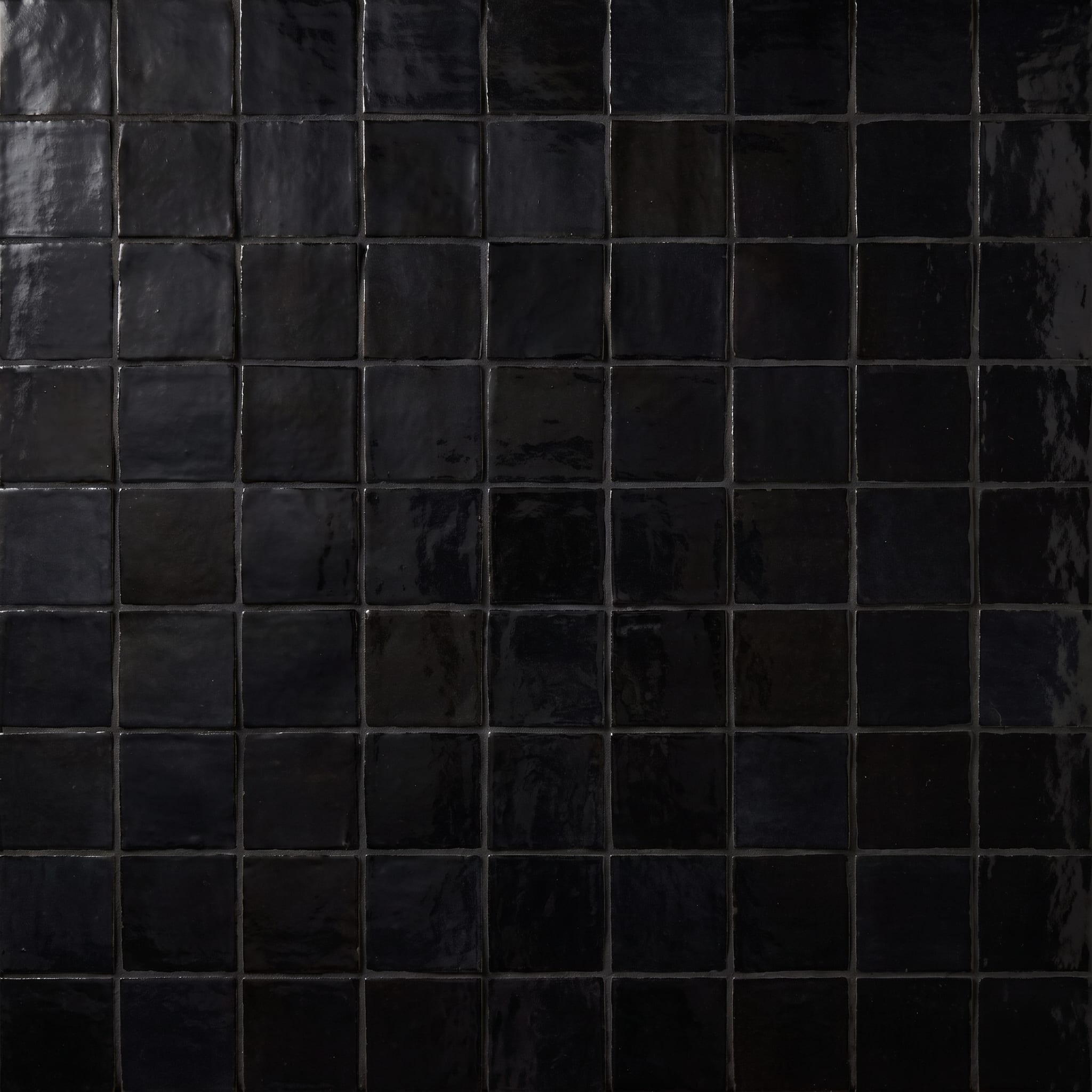
This matters enormously in a dark bathroom. A matte black surface produces fewer visible highlights and can read flatter than glossy glazed tile. A glossy glazed surface does the opposite: it bounces light back in scattered, diffuse highlights that make the wall feel alive with depth. Under the picture light’s warm downward wash, individual tile faces shimmer slightly, and the surface reads more like dark water than flat paint. As clé tile describes it, glazed Zellige surfaces reflect light with a candlelit quality that flat tiles cannot reproduce.
The small square format amplifies this effect. Each tile’s glaze catches light independently, producing dozens of tiny reflections across the wall rather than one uniform sheen. The visible grout lines add a fine grid rhythm that breaks the dark expanse into readable segments — a structure the eye can follow instead of a monolithic void.
A useful editorial distinction: authentic Zellige tiles are hand-cut and kiln-fired in Morocco using traditional methods. Many widely available ceramic tiles described as “Zellige-look” or “Zellige-style” — such as Bedrosians’ Cloé line — are machine-produced glazed ceramic tiles that replicate the surface variation of handmade Zellige at a different price point. Both can produce the irregular highlight effect that makes this room work, but their composition, installation, and sealing requirements differ. When sourcing tile, confirm whether you’re buying handmade Zellige or glazed ceramic, and follow the specific manufacturer’s installation guidance for whichever product you select.
A Pale Basin for Visual Relief
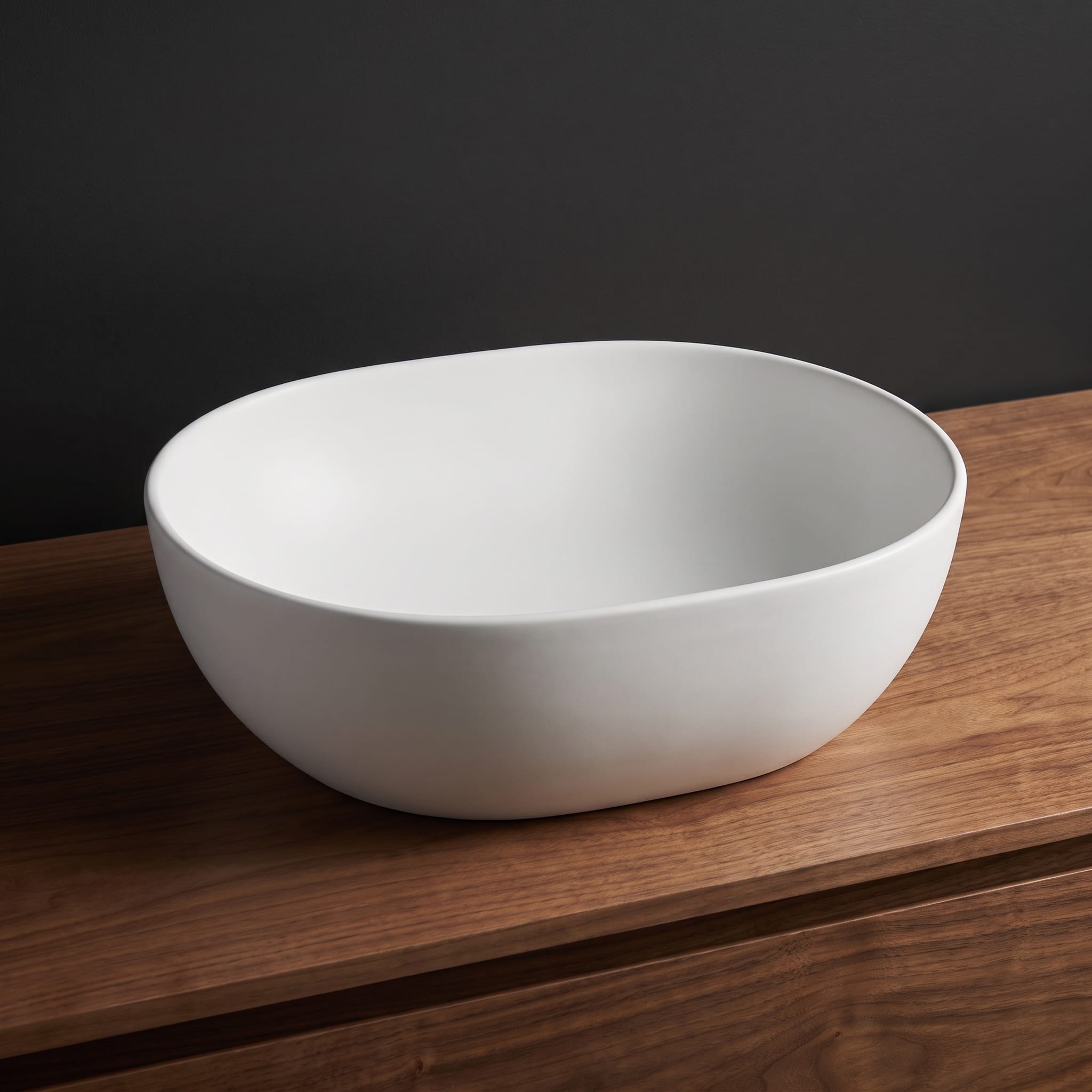
The white oval vessel basin sitting on the walnut vanity is the brightest object in the room — and that’s exactly its job. Against a field of dark tile and warm wood, a pale ceramic form creates a point of contrast that draws the eye without competing with the wall. It functions as visual relief: a deliberate interruption of the dark palette that prevents the room from reading as monotonous.
The shape matters as much as the color. The soft oval profile — no hard edges, no angular rim — introduces a curved form into a room defined by the rigid grid of square tiles. This interplay between the geometric tile grid and the basin’s smooth organic contour adds visual interest that you register even if you don’t consciously analyze it.
One practical note: a vessel basin sits on top of the vanity surface rather than recessing into it. This means the rim of the basin stands well above the countertop. That elevated position has direct implications for faucet height, spout reach, and how water lands in the bowl — all of which need to be coordinated before tile goes on the wall. More on that in the faucet section.
If you’re sourcing a similar basin, the KES Oval Vessel Sink in matte white ceramic has the same compact oval profile — a clean, low-rim form that sits naturally on a floating vanity top.
Warm Brass as a Coordinated System
The mirror frame, wall-mounted faucet, and picture light in this bathroom are all brushed brass, and their warmth is a significant part of why the room feels inviting rather than austere. Brass has warm yellow-gold undertones that naturally harmonize with walnut’s amber grain. Chrome, polished nickel, or matte black hardware would have produced a cooler, more industrial result — not wrong, but not warm.
What makes the brass work here is consistency. The mirror’s thin circular frame, the three-piece faucet’s round escutcheons and lever handles, and the picture light’s horizontal tube all share the same brushed, satin-finish tone. They don’t match in shape — the mirror is round, the faucet is a linear horizontal arrangement, the light is a slim bar — but they match in material warmth. This coordination lets them read as a system rather than a collection of separate fixtures.
A brushed or satin brass finish creates softer, more diffused reflections than a highly polished brass finish, which gives it a quieter visual presence in a room with multiple reflective surfaces. Care requirements vary by manufacturer and coating type — some protected finishes are designed for improved durability against tarnishing, but no brass finish is maintenance-free in a humid space. Follow the specific care instructions for whatever fixtures you choose, and wipe down hardware after heavy steam.
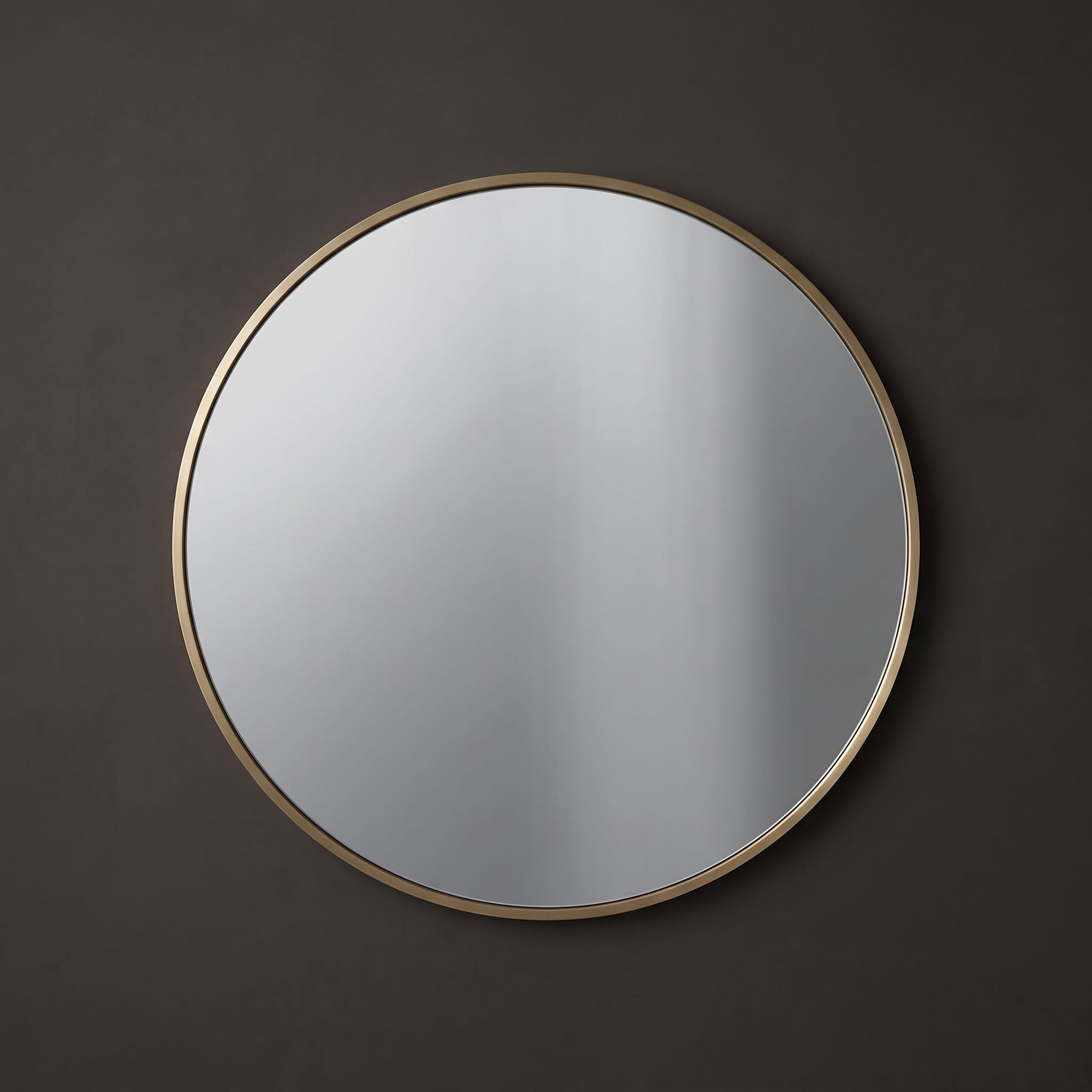
For a similar round mirror, the ANDY STAR 30-inch Gold Mirror offers a thin stainless-steel frame in a warm brushed finish, sized to sit proportionally above a floating vanity.
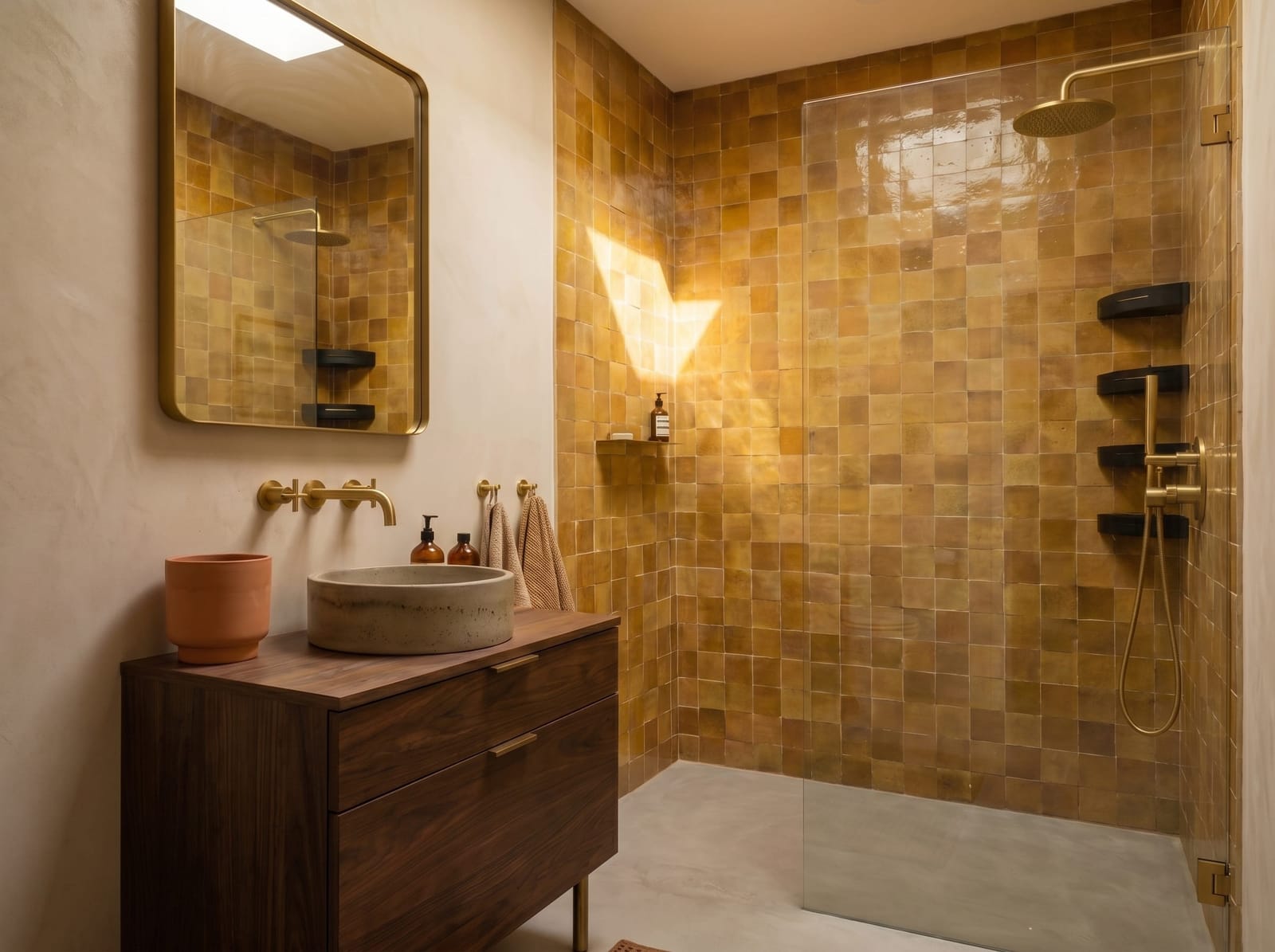
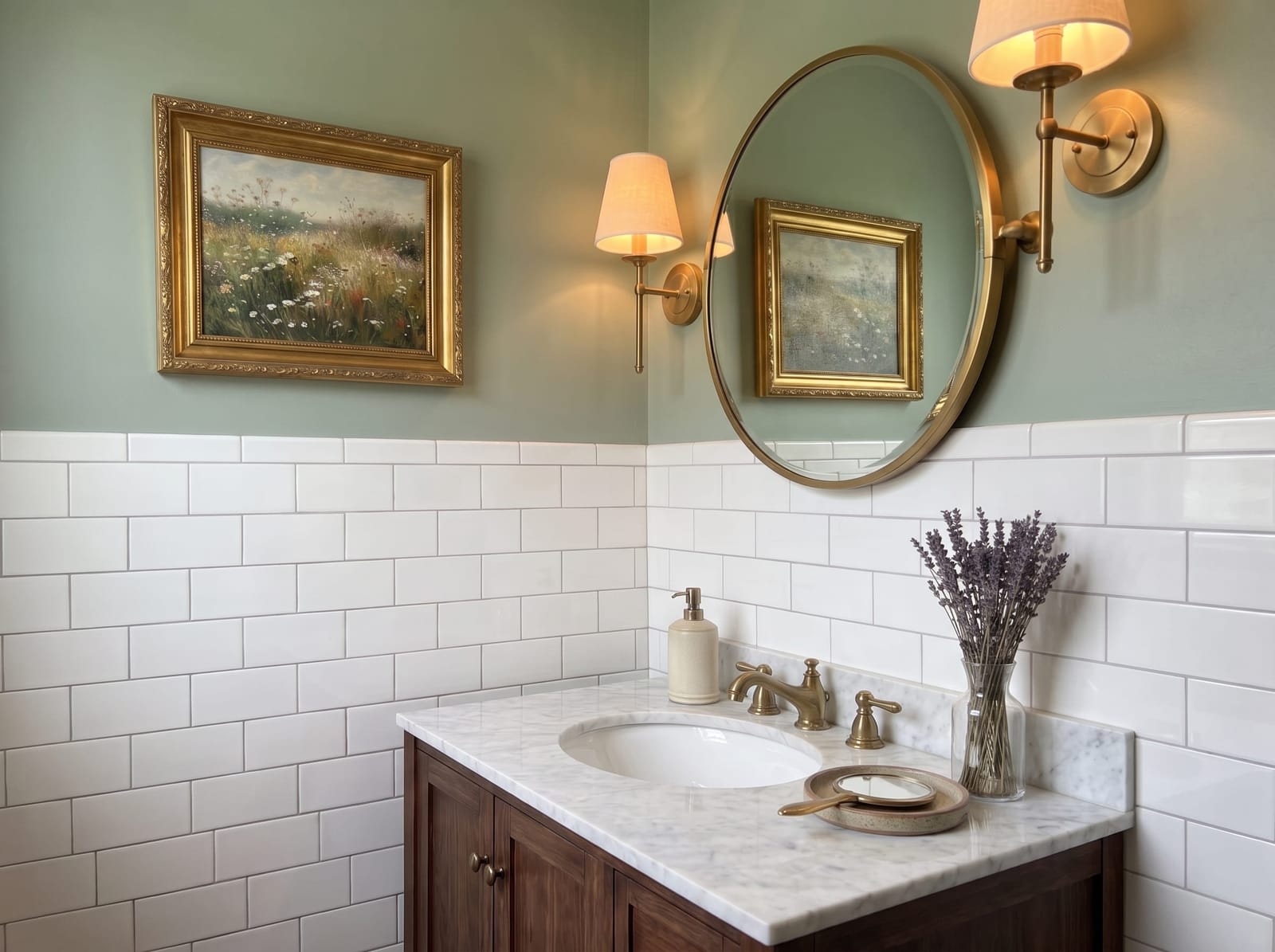
A similar approach to coordinating brass hardware across a tiled bathroom appears in the sage green brass vanity bathroom and golden Zellige walnut vanity lookbooks.
Layer the Light — Don’t Flatten It
Lighting is where most black bathroom designs fall short. Two separate factors are at play: color temperature and light placement. Color temperature — measured in Kelvin — changes the perceived warmth of the palette. A 2700K bulb casts warm amber tones that draw out the golden undertones in walnut and brass, while a 4000K or 5000K bulb shifts the entire palette cooler, making warm materials appear more gray or washed out. Separately, fixture placement, diffusion and source geometry affect shadow quality. A single overhead recessed downlight, regardless of its color temperature, can create unflattering facial shadows and leave the tile wall looking flat because it lights surfaces from only one steep angle.
This room uses a brass picture light mounted above the mirror, angled downward. That placement washes warm directional light across the tile surface behind the mirror, activating the Zellige glaze’s specular highlights, and provides supplementary mirror-zone illumination at the vanity. The result is a concentrated zone of warmth around the mirror and sink, while the rest of the tiled wall recedes into soft shadow. A picture light like this works well as directional accent lighting, but for precise grooming tasks — applying makeup, shaving — even face-level illumination from sconces flanking the mirror is generally preferable, because it reduces the shadows that any single overhead or above-mirror source creates.
Color temperature is a genuine design variable here, not a technical afterthought. A bulb in the 2700K range casts a warm amber glow similar to incandescent light — atmospheric and relaxing, well-suited to a powder room used primarily in the evening. A 3000K bulb shifts slightly cooler toward neutral warm, which provides crisper light without losing warmth entirely. Neither is objectively correct; the choice depends on how the bathroom is used. In a room this dark, the difference between 2700K and 3000K is visible and worth testing before committing.
A high-CRI bulb, often rated 90 or above, can help skin tones and warm finishes appear more natural. Lower-CRI bulbs may render walnut grain and brass surfaces with a slightly gray or washed-out cast — fine in a bright white bathroom, but noticeable in a dark room where warm material colors are doing the heavy lifting.
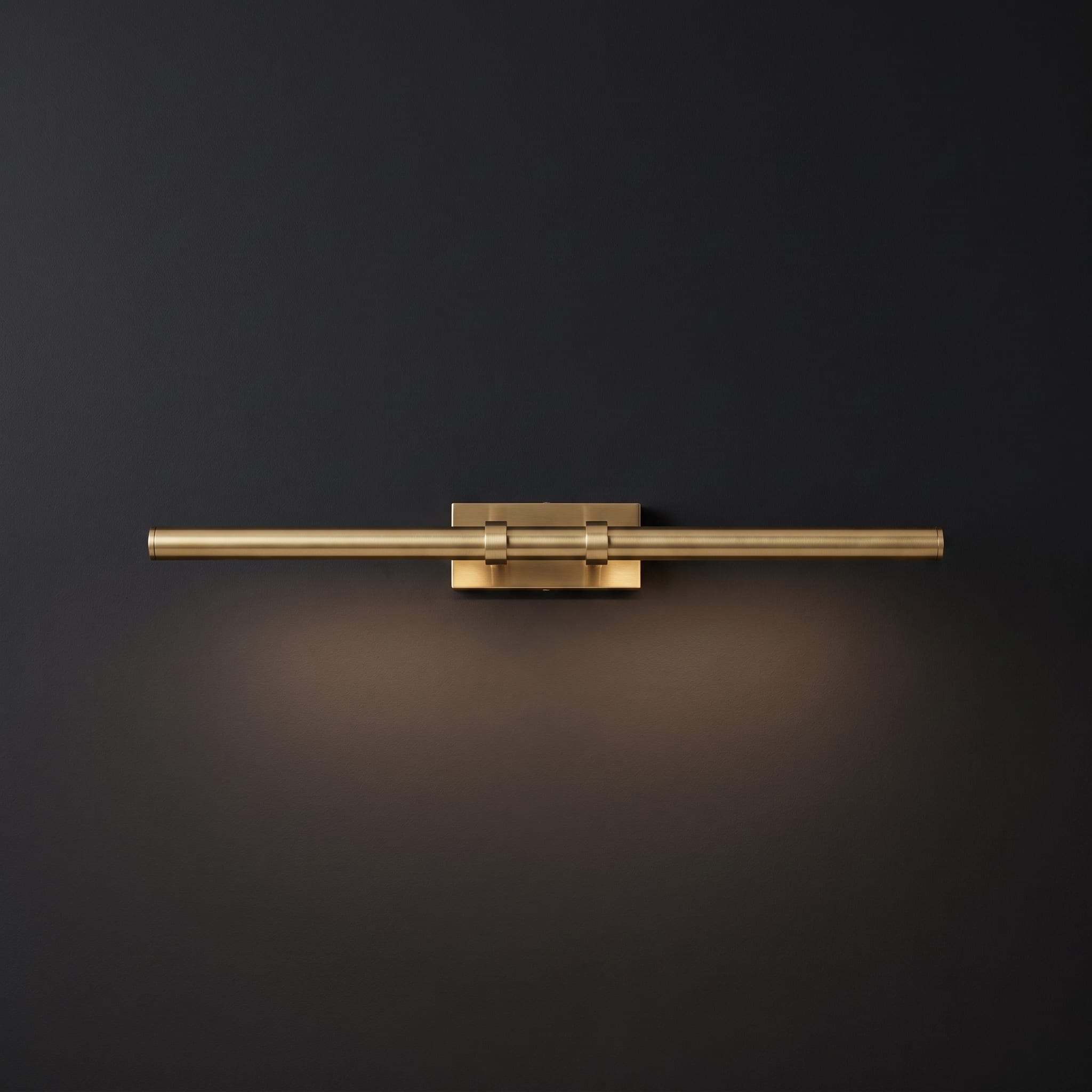
The Knurldon 24-inch Brass Picture Light is a hardwired option that provides this kind of focused downward accent wash. Its slim horizontal tube in brushed brass complements a round mirror without visually competing with it.
Coordinate the Wall-Mounted Faucet and Vessel Sink Before Tiling
A wall-mounted faucet with a vessel sink creates one of the cleanest vanity compositions in a bathroom like this — the faucet emerges directly from the tiled wall, no deck holes interrupt the vanity surface, and the overall arrangement looks intentional and streamlined. But a wall-mounted faucet is not a standard swap-in fixture. The rough-in valve sits inside the wall behind the tile, which means its position is permanent once the tile is installed.
Plan the vessel sink, wall-mounted faucet, and rough-in valve together before tiling. Check the exact basin height, faucet projection, water landing point, and manufacturer installation documents, because correct placement varies by model. A spout that’s positioned too high may splash; too low, and it won’t clear the vessel rim. These are model-specific dimensions, not universal numbers.
The RBROHANT Wall-Mounted Faucet JK0303 is a three-piece widespread design in brushed gold with round escutcheons and lever handles — similar in configuration to the faucet in this scene.
The arched plaster shower vanity article covers a similar wall-mounted faucet and vessel sink arrangement in a different material context.
Choose Grout Color Deliberately
Grout choice is one of the quieter decisions in a black tile bathroom, but it has an outsized visual impact. The two basic approaches — matching and contrasting — produce fundamentally different results.
Bedrosians’ guide to choosing grout color for their Cloé tile line explains the distinction clearly: matching grout (dark gray or near-black) creates a seamless, continuous appearance where the tile grid recedes and the surface reads as a unified dark plane. Contrasting grout (lighter gray or white) highlights the grid geometry, making each individual tile visible as a separate element.
In this bathroom, a mid-dark charcoal grout sits between the two extremes. It’s dark enough to read as cohesive from a few feet away, but just light enough to reveal the tile grid up close. This is an editorial aesthetic preference — it keeps the wall from looking like a solid painted surface while avoiding the visual maintenance challenges that come with high-contrast grout lines on dark tile.
Some homeowners report that stark white grout against dark tile discolors relatively quickly in wet areas, and that jet-black grout can sometimes dry with a faint cloudy efflorescence film. Sealing requirements vary by grout type, so follow the grout manufacturer’s instructions for your specific product.
What Undermines a Black Bathroom
These are the decisions that most often turn a moody black tile bathroom into one that feels cold, harsh, or uncomfortable:
Cool-white lighting without supplementary warm sources. A 4000K or 5000K bulb shifts the perceived palette cooler, making warm wood and brass finishes appear more gray. When that cool color temperature is combined with a single overhead fixture — which tends to create unflattering facial shadows regardless of bulb temperature — the result is a flat, uninviting space. The tile’s glazed surface benefits from warm-toned, angled light that activates its reflective texture.
All-chrome or all-polished-nickel hardware. Cool-toned metals tend to emphasize the cooler undertones of dark tile rather than drawing out warmth. Brushed brass, aged brass, or warm bronze all push the room toward amber.
Mixed metal tones without coordination. A chrome faucet with a brass mirror and a nickel towel bar creates visual static. Keeping hardware in one metal family — or at most two complementary warm tones — keeps the room feeling composed.
Skipping the wood. Black tile and white fixtures alone produce a high-contrast monochrome room. Without a warm mid-tone like walnut, oak, or teak to bridge the gap, the palette can feel stark rather than sophisticated.
Ignoring the floor. A pale neutral floor, like the large-format stone tiles in this bathroom, provides a quiet base that keeps the dark walls from dominating the entire visual field. A dark floor combined with dark walls can make the room feel noticeably more enclosed, especially in compact spaces.
A Final Note on Material Balance
Black tile does not need to be overwhelmed by white to feel livable. It needs carefully chosen counterweights — wood grain, reflective glaze, pale ceramic, warm metal and layered light. These five elements work alongside the dark surface rather than against it, and they do it without diminishing the drama that drew you to black tile in the first place.
The darkness is the point. The warmth is how you live inside it.
Sources & Details
Explore the complete source list for this room, from the anchor pieces to the smaller finishing details.
Source note: Some links in this source list may be affiliate links, which means we may earn a commission at no extra cost to you. As an Amazon Associate I earn from qualifying purchases.
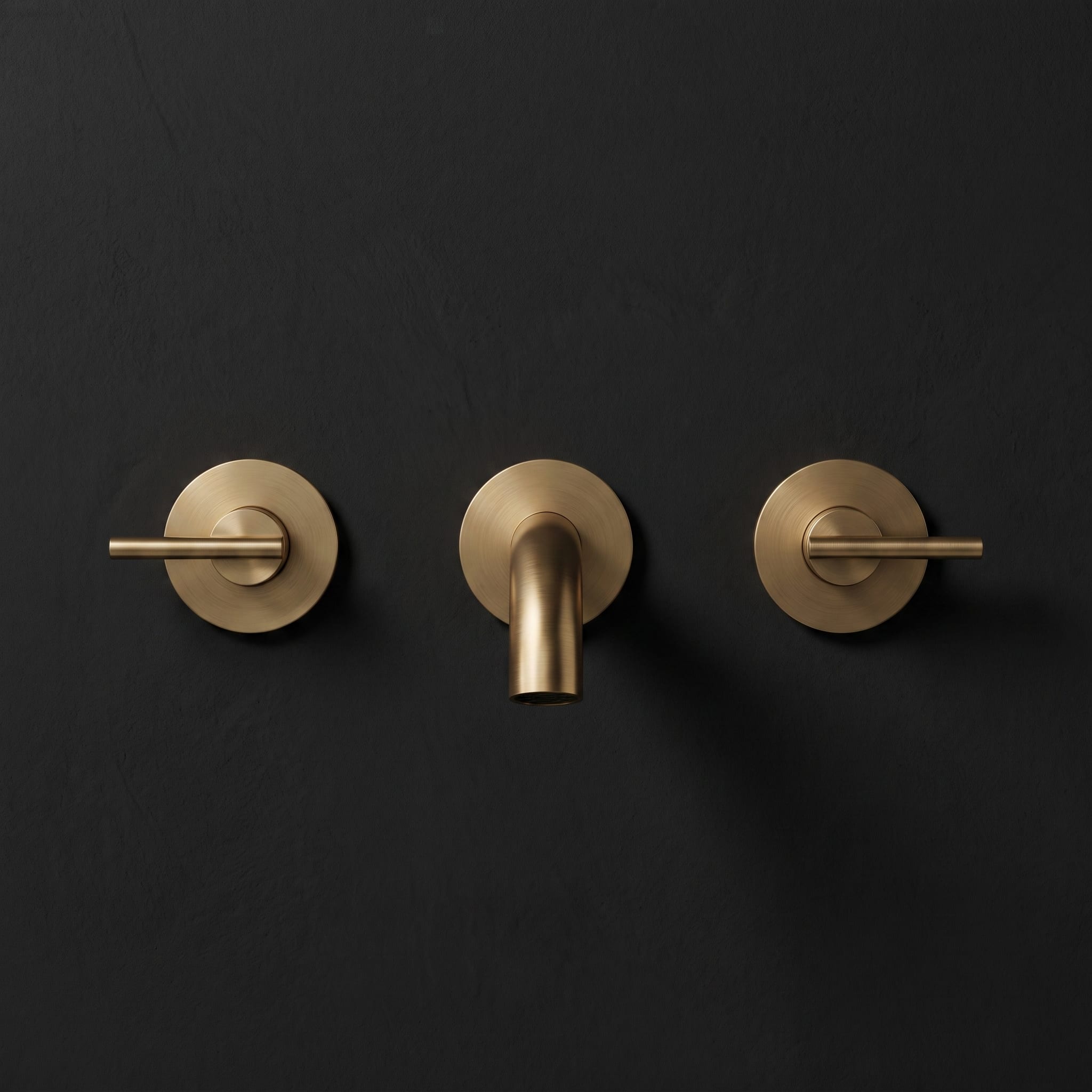
RBROHANT Wall-Mounted Faucet
Solid brass wall-mounted 2-handle bathroom sink faucet with drain assembly in brushed gold.
Three-piece widespread wall-mounted faucet in brushed gold with round escutcheons and lever handles.
Frequently Asked Questions
What colors warm up a black bathroom?
The most effective warm-up colors sit in the amber-to-brown range: walnut, honey oak, warm brass, caramel, and terracotta. These work because they share warm undertones with black surfaces that have been lit with warm-temperature lighting, creating a cohesive palette rather than a jarring contrast. White or off-white as a secondary accent — on a vessel basin, a towel, or a pale stone floor — provides visual relief without cooling the room down. Avoid cool grays, blue-toned whites, or icy metallics as dominant accents, since these push the room toward the sterile, clinical end of the spectrum rather than the atmospheric one.
Does black tile make a small bathroom look smaller?
It can, but it doesn't have to. What makes a small dark bathroom feel claustrophobic is usually a combination of flat matte surfaces, no visual relief, and harsh overhead lighting — not the color alone. Glossy or glazed tile reflects light back into the room, which creates an impression of depth that flat tile doesn't. A floating vanity opens up floor space visually, and a pale floor plane keeps the enclosure from feeling total. Small powder rooms in particular can carry full-wall dark tile well because the reduced square footage concentrates the moody atmosphere rather than spreading it thin.
What grout color works best with black tile?
It depends on the look you want. Matching grout — dark charcoal or near-black — creates a seamless, monolithic surface where the individual tiles recede and the wall reads as a continuous dark plane. Contrasting grout — lighter gray or white — highlights the grid geometry and makes each tile visible as a separate element. A mid-dark charcoal offers a visual middle ground: cohesive from a distance while allowing the tile grid to remain visible up close. Maintenance and sealing requirements depend on the grout product. Bedrosians' guide to grout color for their Cloé line is a helpful reference for understanding these trade-offs.
What lighting color temperature works in a black bathroom?
Both 2700K and 3000K work well, and the right choice depends on how the room is used. A 2700K bulb casts a warm amber glow similar to traditional incandescent light — atmospheric and relaxing, ideal for an evening powder room. A 3000K bulb provides slightly crisper neutral-warm illumination that's better for vanity grooming tasks. In a dark-tiled room, a high-CRI bulb, often rated 90 or above, can help skin tones and warm finishes appear more natural. Higher color temperatures — 4000K and above — shift the perceived palette cooler and can make warm wood and brass finishes appear washed out. Separately, fixture placement matters: a single overhead source tends to create unflattering facial shadows regardless of bulb temperature, so consider supplementary face-level or angled lighting.
Is black tile hard to keep clean?
Dark tile, especially glossy dark tile, tends to show water spots, soap residue, and dust more visibly than light-colored tile. This doesn't mean it's harder to clean — it just means you see the film sooner. A quick squeegee after showering and regular cleaning with a pH-neutral tile cleaner will keep glossy black tile looking sharp. Avoid harsh acidic or abrasive cleaners, which can dull the glaze over time. The maintenance reality is manageable, but worth knowing before you commit: if you dislike wiping down surfaces, a high-gloss dark tile in a wet area will test your patience.
How should a wall-mounted faucet be planned with a vessel sink?
Plan the vessel sink, wall-mounted faucet, and rough-in valve together before tiling. The faucet's rough-in valve sits inside the wall behind the finished tile, which means its height and position are permanent once tile is installed. The critical dimensions — spout height above the vessel rim, spout reach and projection over the basin, and where the water stream lands relative to the drain — vary by faucet model and basin shape. Check the exact manufacturer installation documents for both the faucet and the basin, and work with your installer to mock up the placement before any tile goes on. Getting this wrong is expensive to fix after the fact.
Does walnut work well in a humid bathroom?
Walnut can be suitable in a bathroom when the vanity is specifically made for that environment. Choose a bathroom-rated product, follow its care instructions, wipe up standing water and maintain adequate ventilation. The key consideration is not whether walnut survives moisture in the abstract, but whether the specific vanity product you select is built and finished for bathroom conditions.